Monday, October 31, 2005


Random Thoughts
Parents who permit their preteen daughters to stand on the street corner and play "hooker" for Halloween candy should be flogged again.
Methodist Blogs Weekly Roundup #37
James Gibson attacked dispensationalism.
Andy Bryan wrote about re-establishing civil discussion in the UMC over homosexuality and the contextualization of ideology.
At Bandits No More, Steve Heyduck expressed his disdain for the current Major League Baseball commissioner and Richard Heyduck the Texas referendum on gay marriage.
Ben Witherington reviewed the movie The Legend of Zorro.
Betty Newman wrote about Reformation Day, the simplicity of theology, and generational memories.
Will Willamon blogged about the strange bedfellows of politics and religion (Best of the Methodist blogosphere!)
Brian Russell wrote about what you can learn about people from their prayers.
Chett Pritchett blogged about the theology of plumbing.
Church Medic wrote about the telecommunications marketplace.
At Connexions, Richard Hall blogged about common mistakes in prayer.
Dare We Be Christians wrote about the meaning of blessing.
Dave Camphouse blogged about saints in the UMC.
Derek Tang wrote about the soccer team Manchester United and presented a cavalcade of bite-sized sports commentaries. He also blogged about the proper way to dispose of a worn-out American flag (Best of the Methodist blogosphere!).
Donald Sensing wrote about the Scooter Libby indictment, US prosecutor Patrick Fitzgerald, the new Mercedes-Benz technology that will make cars almost self-driving, why Islamic terrorists attacked journalists in Baghdad, and the Christianity of novelist Anne Rice.
Steve Heyduck remembered Rosa Parks and the meaning of eternal life.
Gavin Richardson celebrated his first blogoversary and pondered whether homosexuals can be legitimate spiritual leaders.
Gerry Charlotte Phelps is advocating a new branch of apologetics that would justify Christian lifestyles. She also gave step-by-step advice on how to start up a charity and how one should be organized. Gerry also wrote about roadblocks to Christian evangelism in Kenya.
Greg Crofford blogged about how African Anglicans are responding to homosexuality.
Greg Hazelrig wrote about how God brings good to all situations and appropriately, uses a Star Trek reference. It is therefore a correct interpretation.
Greg Lee blogged about what he's learned from his recent Charge Conference. As Christians, we often talk about 'God's timing'. Greg offers the contrast of 'Satan's timing'.
Guy Williams pondered about how theologically diverse the UMC should be.
Inside Mike's Head wrote about how hypocrisy affects evangelism.
James Spring advised people to pay their drug dealers on time. He also has a somewhat positive impression of Wal-Mart employment.
Jay Voorhees blogged about the dreams that members of his congregation have for the church.
Jonathon Norman wrote about All Saints' Day and the post-modern understanding of Scripture (Best of the Methodist blogosphere!).
Ken Carter blogged about intercessory prayer.
Maobi compared Ramadan and the Chinese New Year. He also wrote that given the Islamic propensity for violence during this period, Ramadan clearly isn't that holy. He further compared Christian and Muslim approaches to adultery. Maobi then compared terrorist sympathizers with those who disdain rape victims (Best of the Methodist blogosphere!).
Matthew Johnson wrote about Bible software for Macs.
Craig Moore blogged about the logical implications of the divine inspiration of the Scriptures.
Michael Daniel has disdain for professional journalists. To put mildly. He also wrote about Beth Stroud and Rosa Parks.
Mike Lamson wrote about the 'Kingdom of Heaven' thesis of N.T. Wright.
Pjeffy blogged about dealing with politics as a pastor.
Wes Magruder wrote about evangelism in Africa as a mental attack upon African cultures.
Dan Gates wrote about the Beth Stroud decision.
Lorna Koskela linked prayer and mission and wrote about childhood religious education in Finland, the practical matters of evangelism, the devotional guide that RevBlogGalPals are publishing, Christian superficiality, and perspective in church interal conflict.
Stephen Fife wrote about openly identifying as a minister in public.
Movable Theoblogical blogged about labeling people prematurely in theological arguments and different kinds of fundamentalism.
Tim Sisk likes Raynorlanches and using movie clips in sermons. He also likes bossy women who dress in skimpy leather and carry whips, but tries to be discreet about it.
Tony Mitchell wrote about Reformation Sunday.
Jim McKay wrote about the Scooter Libby indictment.
Shane Raynor blogged about Beth Stroud.
Corrections? Additions? Do you know of a blog that should be included in the MBWR? Leave a note in the comments or e-mail locustsandhoney2005 at yahoo dot com!
UPDATE: Be sure to check out John Wilks, who expressed his views about Halloween for Christians.
Beth Stroud Defrocked
Sunday, October 30, 2005
Methobloggers on Communion
Saturday, October 29, 2005
The Conservative Revolt
So what is the real problem? The real problem is that the President has done a piss poor job of demonstrating any form of conservatism. In his first term, we forgave a lot of this because he had a war to fight, trouble in the Senate, and hopes for a second term. But now? There can't be a third term. Iraq is greatly improved, but government spending remains out of control. Furthermore domestic security, one of the things we trusted him to take care of, was proven insufficient by Hurricaine Katrina. His first term staff was an impressive brain trust. With the exception of Cheney and Condi, I wouldn't trust his second term staff to out-think my old high school trivia team.
He also offers Bush some advice:
Most of this is fixable. Get fixing. You base is your problem. Make us happy. Stop pandering to a left that will never even like you and throw us a bone. And not the kind you find in the bottom of a barrel of pork.
Note to the GOP: when you've lost people like Jeff, you are seriously screwed. As I've written before, there really isn't much future for the Right. Whereas Reagan at least gave lipservice to the notion that small, restrained government is better than large, intrusive government, Bush doesn't even pretend to believe in small government.
This would appear to be his mistake, most notably with the Miers nomination. He assumed that the Right had so completely embraced statism that strict constructionists would not be able to mount any resistance -- or would be so afraid of a Democratic victory in any situation that they would be willing to compromise. Conservatives gnashed their teeth and put up with the prescription drug benefit, unwillingess to clamp down on illegal immigration, and massive expansion of the federal budget because they wanted one thing on the domestic front: a conservative Supreme Court. And Bush stabbed them in the back by nominating some unprepared hack who gave every indication that she would high-tail it to the Left once she got a leather chair on the Court.
It's rather reassuring to know that there is a sufficiently powerful anti-statist movement within the conservative movement that can and will fight back against Bush's leftward tilt. Now to finish the present task, Zack Welding has a question for our President:
Second, for Bush, "What did you learn from all this?"
I'd like to hear an answer.
Book Review -- Settling Accounts: Drive to the East by Harry Turtledove
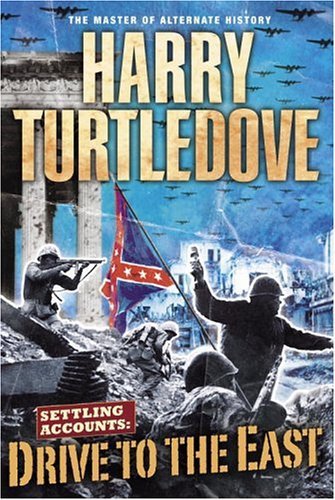 I'm a big fan of the fiction genre known as alternate history. This can be challenging for a fan, because very little quality alternate history is published on a regular basis.
It is not a genre that many people can write well because it requires strong background knowledge of the time period in question. The key to quality alternate history is realism. A lack thereof can be crippling, well-demonstrated in the novel 1901, which focuses on a hypohetical war between the US and Germany during that period of time. History majors like myself raise questions when reading this book such as "Why would Germany want to go to war against the US at the time? How is Germany able to move a massive invasion fleet capable of landing and supporting several hundred thousand troops across the Atlantic without being detected until troops have waded ashore in New York City? Why do these 19th Century people have very 20th Century attitudes about race and gender?" And so on.
Harry Turtledove, a Ph.D-trained historian, does not make these mistakes. His novels are very realistic, including his recent addition Settling Accounts: Drive to the East. This novel is his ninth in a series in which the South wins the Civil War and successfully forms an independent nation. The USA and CSA clash again in the 1880s, the 1910s, and now in the 1940s. The USA is presently allied with Germany and Austria-Hungary (who won WWI) against Japan, France, Britain, and the Confederacy.
After being defeated in the last war (a surprise, after winning the previous two), the Confederacy went through a series of political and economic crises that led to a fascist government vaguely resembling that of Nazi Germany.
The most fascinating parts of this book focus on Jefferson Pinkard, a broken down old Confederate soldier from WWI. Having some experience running a POW camp in the war, Pinkard is placed in charge of a internment camp for rebellious Blacks. Eventually more and more Blacks are sent to this severely overcrowded camp. Totally out of room, Pinkard is desperate and orders some Blacks trucked out into the swamp and shot in order to make room for new arrivals.
But even more Blacks are sent to the camp. And more. And more. Mass executions become increasingly routine. Almost unconsciously, the Confederate hierarchy conceives of a Final Solution to the Black problem. Pinkard is ordered to build more camps, and he does so in West Texas.
The guards can't handle the mass shootings. Depressed, some kill themselves. One does so by running a hose from the exhaust pipe of his truck to the cab. That gives Pinkard an idea of a way of killing Blacks more efficiently: gas. So he builds trucks with sheet metal containers on the back. Blacks are taken from the camp and put into the trucks, informed that they are being moved to another camp. The truck drives out of the camp toward a mass grave. Once out of the camp, the box is sealed airtight and exhaust fed in. The Blacks die and are thrown into the mass grave. Repeat as necessary.
As the war goes increasingly badly for the Confederacy, it blames its woes on the Blacks. Troops empty out ghettos en masse and ship their residents to the camps. But production is too high for Pinkard to keep up. The trucks are inefficient and cannot keep up with, shall we say, 'demand'. So he gets an idea: feed incoming blacks into fake shower and delousing buildings, where they are sealed in and gassed.
And so it goes.
In the beginning, Pinkard is just looking for a job. Step by step, he engages in the worst evils imaginable. He starts out as an ordinary guy, and becomes an extraordinary monster. What's so disturbing about Pinkard and the people who work for the camps is how they seem to be normal people who are gradually willing to do monstrous things. Turtledove is saying "This could be you. You have it within you to be evil incarnate."
Such is the path of sin.
Friday, October 28, 2005
Shane Raynor is Messing With My Family
Methodist Blogger Profile: Ben Thomas


Ben Thomas of Sojourner's Journal
My name is Ben Thomas, I am a pastor in The Wesleyan Church. I pastor Mt. Moriah Wesleyan Church in Candler, North Carolina (just outside of Asheville). I am married to Tiffany and we have a son named Cole who is 10 months old. I grew up in Ohio and Indiana, attended Indiana Wesleyan University and Asbury Theological Seminary.
Why do you blog?
For personal growth, through the writing of my thoughts, and connection to others.
What has been your best blogging experience?
I love to get conversations going. Anytime that happens it is great.
What would be your main advice to a novice blogger?
Keep blogging. I have found out that I go through “dry spells” but the discipline of blogging is spiritually healthy, much like a journal, but different.
If you could read only three blogs a day, what would they be?
Ben Witherington, Alan Creech, Monastic Mumblings.
Who are your spiritual heroes?
Jesus of Nazareth, John Wesley, Henri Nouwen, My Father.
What are you reading at the moment?
“Ancient Future Time” by Robert Webber.
What is your favorite hymn and why?
And Can it Be – Because it rocks; both my heart and my mind.
Can you name a major moral, political, or intellectual issue on which you've ever changed your mind?
Not any specific issue lately, but I can say that I have become more and more aware of the influence of the Republican party in Conservative Evangelicalism.
What philosophical thesis do you think is most important to combat?
The thesis that began in the garden, “We can be like God”, or “We don’t need God”.
If you could affect one major change in the governing of your country, what would it be?
I am unsure. I do know that we need a return to justice and compassion.
If you could affect one major policy change in the Wesleyan Church, what would it be?
I would take many of the Covenant Membership Requirements out.
What would be your most important piece of advice about life?
“For me to live is Christ, and to die is gain” – the Apostle Paul
What, if anything, do you worry about?
My vocational performance.
If you were to relive your life to this point, is there anything that you'd do differently?
I would give more of myself to God daily.
Where would you most like to live (other than where you do now)?
Indianapolis, Indiana
What do you like doing in your spare time?
Spend time with my wife and son, read, sports, video games.
What is your most treasured possession?
I enjoy my personal library very much.
What musical talent would you most like to have?
Anything musical; guitar, piano, drums.
If you could have any three guests, past or present, to dinner, who would they be?
Jesus of Nazareth, John Wesley, St. Patrick.
Observations from the Methodist Blogger Profiles, III
Andy Bryan:
Pharisaic rigidity. Jesus fought against the “my way or the highway” people of his day, and lo and behold, they are still around today.
Michael Daniel:
That man is into doing good only because he is expecting something in return. We view too many actions and question ulterior motives when we refuse to realize that man is quite capable of doing good for the sake of goodness itself
Richard Hall:
Individualism.
Greg Hazelrig:
It would probably be the individualistic view of those who believe it’s all about them and Jesus, while love of neighbor is absent from their thinking. I just love the quote from Jim Wallis’ book God’s Politics that goes “God is personal but never private.” These people are often times the ones that hold to the belief that once they have become Christians they can do pretty much what they want while judging others for their sinfulness. People may not say this, but many live it.
Steve Heyduck:
Following on my previous answer, that we in the US are somehow “beyond” culture and particularity.
Larry Hollon:
The thesis that science and religion are incompatible.
Grandma Jean:
I don’t waste my time on stuff like that.
Whit Johnstone:
Prosperity Theology. It’s the antithesis of the Gospel.
Lorna Koskela:
Erm …can I skip this? Seriously the belief that all truths are equal is anti-scriptural. We should respect people’s right to believe what they choose, but we cannot in all honesty say that their belief is right and when asked we must learn to say that Scripture says and we believe that salvation comes from belief that Jesus is the Christ and died for our sins.
Gregory Lee:
Liberal theology where the deity of Christ is denied.
John the Methodist:
Collectivism – the notion that people only have value as members of groups, rather than as individuals. It is collectivism that has led to the worst evils the world has known: communism, fascism, and the Teletubbies.
Craig Moore:
Call me a ‘modernist,” but I hate to conceive of a world without absolutes and any reliable authoritative truth. I think that people need to have something bigger than themselves to believe in, inspire them and guide them.
Chris Morgan:
The underlying philosophical principle of determinism, a principle seldom clearly expressed but appearing everywhere. Sex-ed classes assume that because teens have sexual urges, they must inevitably act upon them. Criminal defendants claim that their actions are determined by their upbringing. “We can’t help it,” everyone seems to say about something.
I, on the other hand, believe quite strongly in personal responsibility. No one forces a man to have an affair with his secretary. Those who are fired because they do not come to work on time have no one to blame but themselves. I am certain everyone will encounter the unexpected, even the unfair. But we must own our actions and reactions; we are not all innocent victims of circumstance. I believe a great deal of personal growth takes place when we recognize our capacity for choosing wisely and take responsibility for doing so.
Jonathon Norman:
I think in our culture- the idea that “it’s all about me”/ie individualism is a HUGE problem that must be addressed by the church, and responded to. An affect of individualism is that Christians tend to see our relationship with Jesus as personal rather than communal (it’s just me and Jesus). I won’t go into specifics here, but both conservative and liberal Christians suffer theologically from individualist theology. If we take the Trinity seriously then we take serious that God is communal in nature
Gerry Charlotte Phelps:
The conceits that science has proved Christianity false, and that God does not exist; and that modern scholarship has debunked the Bible.
Beth Quick:
I think it is important to combat views like those that hold God directly responsible for things as acts of punishment, such as God punishing America in September 11th because of gays and lesbians in the world, or God punishing Southeast Asia with earthquake and tsunami because of non-Christians. I think those views can be so harmful to people, their faith, and their relationship with God.
Shane Raynor:
Religious and moral relativism. We have high-profile people within our own denomination who teach that there are ways to eternal life apart from Jesus Christ. This is unacceptable.
Gavin Richardson:
“God is Dead” by nietzche. Being in youth ministry I get questions from my youth that they feel that God is dead (they don’t actually know of nietzche) but I feel it’s a feeling more and more people are feeling comfortable to finally say ‘this is my view of God, but I don’t want it to be.’ So I see part of my role as a minister in helping people relate to their God that is alive.
Brett Royal:
I don’t believe that truth is relative. If two people believe differently, and their beliefs are mutually exclusive, at least one of them is wrong. I had a coworker make the following comment to me (almost verbatim): “To me, God doesn’t exist. If you believe in God, that’s ok, because to you he does exist.” I told him that he is missing the point. Either God exists or he doesn’t. If He does exist, my coworker’s disbelief is not going to make God not exist. On the other hand, if God doesn’t exist, all the prayers in the world will not conjure him up. We can’t both be right. We can agree to disagree, but we can’t both be right. To say we are both right is nonsense.
Josh Tinley:
I don’t know if this counts as a philosophical thesis, but I abhor the practice of classifying everything as either liberal or conservative, left or right.
Joel Thomas:
Objectivist-type philosophies such as those of Ayn Rand because they conflict with Christ’s command of “love of neighbor.” Although I disagree with libertarianism, which seems a distant cousin to objectivist philosophy, libertarians can and often do feel there is a moral obligation to help by private means those in need. Objectivist philosophy, however, seems centered around the created, as opposed to the Creator.
Dean Snyder:
If I had to pick one, I guess I’d go with laissez-faire capitalism -- the idea that human welfare is best achieved by a free market left to its own devices; the idea that less government involvement in economic decisions such as pricing, production, labor, and distribution of goods and services improves human welfare in the long run; the idea that weak individuals should be sacrificed for the greater good. In social life, its spiritual equivalent might be called “survival of the fittest.”
Jay Voorhees:
Individualism and consumerism. These are the ethical challenges that put our society most at risk.
Cole Wakefield:
What an interesting question
Dave Warnock:
Christian Faith is a personal thing disconnected from Christ and his Church that should not affect the whole of life or other people.
John Wilks:
In terms of evangelism, relativism has to be the biggest issue. Relativism and monotheism are flatly incompatible. Besides, relativism, when it gets passed academia and into practice, becomes "might makes right" and opens the door for great oppression and injustice.
MBWR # 36 Update
Thursday, October 27, 2005
Patti's Bunny
While the cats are willing to interact with him at one level, he often tries to initiate more intimate contact. The fact that the cats object to this is obvious. Even if this were consensual and private it would bother me, but unfortunately, it is neither. The cats are always angered by these advances and have made it clear that they want him to stop, but the rabbit ignores their wishes.
Pippin has no defined territory in the house. In fact, he considers the whole house his territory, upstairs and down. There is no Pippin-free zone. He is everywhere.
Pippin uses his litter box only when he is downstairs. He is downstairs about half the time. And even if he is downstairs, he frequently surrenders to the urge to pee on the couch. It must give him guilty pleasure, because he continues to even though he knows he shouldn’t.
Pippin has eaten all my houseplants except the lemon tree and the cactuses.
He eats books.
He has started chewing on furniture and is trying to take bites out of the floor.
He can jump and land gracefully, and has an uncanny sense of height and distance. Table tops are not out of his range. He steals apples from the fruit basket and eats the candle sticks.
Oh, he also pees on Joseph’s bed.
I know I could try having him neutered or buy him a cage. Both options are currently out of my price range.
It sounds like Patti fell for the houserabbit myth. There is a popular notion among some rabbit people that one can raise a pet rabbit like one keeps a cat. The rabbit will wander about the house and can be trained to use a litter box. It can be trained not to chew on things by spraying it with a water pistol.
If this were true, it would necessitate that my rabbits are exceptionally stupid for rabbits. I do not think that this is the case. My bunnies will use one corner of their cage as a toilet, but they have never taken to litter training. I tried repeatedly in the past, but they always pushed the box out of the way so that they could get to their toilet spot. When roaming free, they will chew on things, particularly carpet and books (Inlehain seems to be particularly fond of Bibles, which may be interpreted as a hunger for the Word of God, or a disrespect for it). When I spray them with a water pistol in response, their reaction is one of "WTF? I'm wet! How did that happen?" No matter how many gallons of water I have used, they have never been able to answer that question. They have never been trainable, and again, unless they are truly very, very stupid by rabbit standards, I suspect that the notion that rabbits can live as cats is a myth [someone will write in and insist that he/she has a free-roaming rabbit. Nota bene: I don't believe you].
For that matter, rabbits should not be living with cats. Or dogs. Period. At my wife's insistence, we did buy a dog, but we purposefully chose one that was (a) small and (b) not bred to hunt. Even still, Sunny cannot be trusted alone with the rabbits. He wants to play with them, and like any dog, he plays rough. Rabbits are very fragile creatures. A rabbit's body mass is 8% skeleton -- vs. 13% for a cat -- so they have very little bone structure. To make the situation even more perilous, rabbits have spinal columns so fragile that they cannot support their own body weight. This is why a rabbit must be picked up with two hands -- one under the pelvis and one under the rib cage -- or the rabbit's back will break. What would be a minor injury for a dog or cat will kill a rabbit.
Cats and dogs, in the wild, hunt rabbits. Someday, your cats will kill your rabbit. You cannot train them otherwise. It is intrinsic to their nature.
It will happen.
Fortunately, there's a simpler solution. Here's what I do: Hyz and Inlehain live in a 18" by 36" cage. For a combined 15 pounds of rabbit flesh, that can be a bit cramped, but unless you pour out the bucks for luxury rabbit housing, it's not too shabby. I can't find a link for the type of cage that I use, but they're always at Pet Supermarket, and they're $65.
My bunnies do not roam free. Every morning and evening, I lock the dog in the bedroom and let the rabbits out. They romp about for 15-30 minutes each session, and they typically put themselves away back in the cage. This may seem more like incarceration than pet-keeping, but bear in mind that wild rabbits spend about 23 hours out of the day underground. Close quarters are natural for rabbits.
Neutering will improve your life. And Pippin's. Shell out the cash and go for it. This will require an exotic animal vet, since rabbits are hypersensitive to anesthesia and prone to post-surgical infections. Call vets in your area and ask them to whom they refer major rabbit cases. Call about 10 vets and you'll know who are the qualified rabbit vets in town. Neutering a buck rabbit costs about $150.
Once you neuter him, he'll be far less inclined to mark his territory with urination. He'll probably still mount the cats, but this will be an expression of domination and not sex. There will, however, be no ejaculate, which will...uh, make it substantially less unpleasant.
Bring It On
"Perjury"? "Obstruction of justice"? Those are not real crimes! Those are crap crimes, girly crimes, the crimes that got wedgies from real crimes in gym class! Nobody counts those crimes! You get like six free perjurings and three free conspiracies to obstruct justice back where Giblets comes from, and Giblets comes from a town of manly men where the houses are made entirely of raw cow meat! Many of the townsfolk have since died of trichinosis. It is very sad.
Why Haven't We Bombed Iran Yet?
Supreme Court Justice Gonzalez?
Yes, he has more of a track record, having been a justice of the Texas supreme court and having been White House counsel for a longer time than Miers. But the administration surely can't relish facing cronyism charges, conservative disaffection, and requests for privileged documents all over again.
I'm not so certain. If the White House was concerned about cronyism charges, it wouldn't have nominated Miers on the heels of Mike Brown's departure from FEMA. It wouldn't surprise me one bit if the next nominee was Barney.
Given the stunning failure of Bush's staff to sit the President down and explain to him why nominating Miers would be a bad idea, it's very important (but unlikely) that Bush understand why the Right turned against him.
Blame Bush!
Sounds like something that Grace would say.
Wednesday, October 26, 2005
Methodist Blogger Profile: Whit Johnstone

Whit Johnstone, the Methotaku
Hi, I’m the Methotaku, otherwise known as Whit Johnstone. Most of the time, I live in my dorm room in Arlington, TX, but some weekends I drive back to Irving to visit my family. I’m going to get an actual apartment this summer, hopefully. At this point, I have my Mom, my Dad, and my little sister for family. I’ve attached a fairly recent picture, one that shows my new haircut.
Why do you blog?
me an outlet for things I can’t say IRL.
What has been your best blogging experience?
When I blogged about reading Walter Wink’s The Powers That Be and it was really popular and Rev. Mommy commented about using my posts to study.
What would be your main advice to a novice blogger?
Don’t be afraid to blog trivial things.
If you could only read three blogs a day, what would they be?
Untied Methodist, Wesley Blog, and mock_the_stupid. The last is because it’s funny.
Who are your spiritual heroes?
Jesus (obvious reasons), Martin Luther (for working through depression, and for breaking with an established orthodoxy), John Wesley (the founder of my theological worldview and denomination), Ghandi and MLKJr (because of their dedication to Jesus’ teachings of nonviolence).
What are you reading at the moment?
The Culture of Translation in Anglo-Saxon England
What is your favorite hymn and why?
“They Will Know We Are Christians By our Love”, for both the words and the tune.
Can you name a major moral, political, or intellectual issue on which you've ever changed your mind?
Abortion. I used to be for abortion on demand, whenever. Now I am against second and theird trimester abortions except to save the life of the mother. I still think that abortion should be legal for most medical and economic reasons in the first trimester.
What philosophical thesis do you think is most important to combat?
Prosperity Theology. It’s the antithesis of the Gospel.
If you could affect one major change in the governing of your country, what would it be?
Honestly? No more Bush.
If you could affect one major policy change in the United Methodist Church, what would it be?
I would like to see complete reunion between the UMC, the African Methodist Episcopal denominations, and the Episcopal Church. I hope that it will happen in my lifetime, and I have faith that someday all schisms will be mended, and we will all be one Body.
What would be your most important piece of advice about life?
Don’t get discouraged by failure.
What, if anything, do you worry about?
Not graduating from UTA, not being admitted to a good seminary, not being ordained, failing in general. Sometimes I worry that I am too lazy or too impulsive to amount to anything.
If you were to relive your life to this point, is there anything that you'd do differently?
I’d be more active in my church’s youth group in high school.
Where would you most like to live (other than where you do now)?
Anglo-Saxon England, in the late 800s to early 900s.
What do you like to do in your spare time?
I enjoy watching anime and playing videogames. Occasionally I blog or write fanfic. In essence, I’m a total geek. When I do exercise (not often enough), I walk, jog, bike, or play basketball.
What is your most treasured possession?
My laptop, if I have to pick something. But I don’t really care about any of my possessions- I just care about what I do with the possessions. One tool will do as well as another- and there’s nothing sad about replacing a tool when it wears out or if there’s an improved model available.
What talent would you most like to have?
The ability to draw, paint, and write neatly and legibly.
If you could have any three guests, past or present, to dinner, who would they be?
John Wesley, Alfred the Great, and V. Gene Robinson
Tuesday, October 25, 2005
Greek and Hebrew
So What?
Monday, October 24, 2005

Methodist Blogs Weekly Roundup # 36
Steven Manskar wrote that the UMC should provide formal training to its members in prayer.
James Gibson blogged about the hope a Christian can find in the Resurrection.
Andy Bryan gave an update on the 'open pulpit' at his church and wrote about the GBCS's recent call for US withdrawal from Iraq.
At Appian Way, Cliff Guy blogged about church podcasting.
At Bandits No More, Richard Heyduck aborting disabled babies. Steve Heyduck wrote about the feasibility of moral perfection.
Beth Quick returned to her alma mater, Drew Theological Seminary, to attend lectures.
Betty Newman prayed for a young couple.
Brian Russell wrote about the appropriateness of using movie clips as sermon illustrations (Best of the Methodist blogosphere!).
At Connexions, Richard Hall wrote about the primacy of the academic discipline of economics in modern life. Joel Thomas announced a blogging hiatus.
Contending for the Faith has decided to give conservative Christians the benefit of the doubt. Sort of.
Dare We Be Christians pondered isolation as she prepared for the birth of her child.
Donald Sensing wrote about Osama bin Laden as a messianic figure.
Steve Heyduck blogged about taking care of the little things.
Gavin Richardson wrote about his approach to understanding Scripture.
Gerry Charlotte Phelps blogged about managing volunteers, evangelism and breaking out of mental ruts, why you shouldn't give cash to the homeless, criteria for evaluating assistance programs, and how to handle confrontation with assistance clients.
Greg Crofford wrote about the insignificance of politics, the immorality of lotteries, and a modern Christian view of demonic possession.
Greg Hazelrig noted that Jesus pulls us out of our comfort zones and wondered what the impact of Hurricane Wilma will be.
Gregory Lee thinks that churches place too little emphasis on children these days. He also wrote about what it means to be a chosen people, the need to be a bit more explicit in evangelism, and restoration in Christ.
James Spring wrote about the way that homosexuality is debated.
Jay Voorhees blogged about the nature of revival in his church and churches in general.
John Wilks wrote about what is and what is not the responsibility of the clergy.
Jonathon Norman opened up a can of whupass on Starbucks and Rick Warren and wrote about litmus testing in the church.
Jordan Cooper blogged about the lameness of the media.
Just As I Am wrote about letting God overcome your prejudices.
Ken Carter blogged about the necessity of moral boundaries.
Larry Hollon wrote about the UMC focus on homosexuality, adapting the communication mission of the church to changing technology, and increasing computer mobility.
Maobi applied the 'broken window' theory of crime to the streets of Malaysia, the likelihood of a bird flu pandemic, why the concept of royalty is defective, and how bad customer service hurts companies.
Matt Collins wrote about free speech at Auburn University.
Michael Daniel blogged about the alleged desecration of terrorists' bodies by US soldiers in Iraq and Jesus' referrals to the covenant with Israel.
Octomusings wrote about the morality of God in natural disasters.
Phil Smith called for the church to evolve to meet modern culture.
Random Thoughts pondered the task of stewardship under the leadership of Joshua.
Dan Gates wrote about the upcoming Beth Stroud appeal.
Lorna Koskela blogged about church size.
Movable Theological gave his thoughts on the politics of Jim Wallis.
Thoughts From a Clay Pot blogged about the GBCS's call for the US to withdraw from Iraq.
Tim Sisk wrote about whether pastors should wear distinctive clothing, i.e. 'clericals' (Best of the Methodist blogosphere!)
Tony Mitchell wrote about seeker sensitivity and its implications for the Gospel message.
Shane Raynor blogged about urban ministry.
Additions? Corrections? Do you know of a blog that should be added to the MBWR? Leave a note in the comments or e-mail locustsandhoney2005 at yahoo dot com!
UPDATE:
Derek Tang wrote about a recent mission trip to the Gulf coast.
Brent Royal blogged about how the doctrine of Original Sin applies to infants.
True to Form
Given a Republican president with plummeting approval ratings and a Republican congressional leadership that is being investigated, indicted, and in at least one case fingerprinted, Democratic party leaders said today that they are “actively seeking” ways to squander their historic opportunity.
At a press conference in Washington, D.C. today, Democratic National Committee chairman Howard Dean reassured the party faithful that the Democrats would stick to tradition and find some way to blow this golden opportunity.
[snip]
According to those familiar with the strategy session, the Democrats have already settled on a new slogan for the 2006 midterm elections, “Read our lips – tons of new taxes,” and that most of that new tax revenue would be used to promote the legalization of crystal meth.
While it is still early to be planning how to lose the 2008 election, Gov. Dean said that most preliminary discussions have revolved around nominating the Rev. Al Sharpton for President.
“We’re only going for Sharpton because our first choice, Jacques Chirac, was unavailable,” Gov. Dean said.
Sunday, October 23, 2005
Homiletic Ethics
After 20 years? Changing the names of those involved? What ethical standards do you place for yourself in this situation?
Please Excuse Me While I Take a Moment to Defend the Anti-War Movement
Well, it would appear that this Quaker organization is planning a large number of 'events' across the country. Perhaps they're anti-war rallies, protests, or meetups. I can't tell, but there's no evidence that I can find to suggest that they are celebratory parties. To suggest that these anti-war folk are happy about American casualties in Iraq is rather harsh, and cannot be supported from any information on their website.
Apparently, a number of liberal bloggers are calling out Johnson on this accusation. Charles should either state precisely what language used by the Quakers can be seen as celebratory, or retract his mischaracterization of this anti-war organization.
Saturday, October 22, 2005
Prey Alone
Friday, October 21, 2005

Kill the White People!
Now how do I know that the white people know that we are going to come up with a solution to the problem? I know it because they have retina scans, they have what they call racial profiling, DNA banks, and they’re monitoring our people to try to prevent the one person from coming up with the one idea. And the one idea is, how we are going to exterminate white people because that in my estimation is the only conclusion I have come to. We have to exterminate white people off the face of the planet to solve this problem. Now I don’t care whether you clap or not, but I’m saying to you that we need to solve this problem because they are going to kill us. And I will leave on that. So we just have to just set up our own system and stop playing and get very serious and not be diverted from coming up with a solution to the problem and the problem on the planet is white people. [emphasis in original]
Good Job, United Nations!
Methodist Blogger Profile: Josh Tinley
 Josh Tinley of Scrambies
Until recently, I was an HTML purist with limited HTML skills. Creating new material worthy of the effort it took to post something on the website took time, and I only updated the site once every month or two. I finally decided that, if I broke down and got a Blogger account, I could post short writings about anything on my mind and put up links to interesting articles and websites whenever I felt like it. Even better, Blogger would automatically archive everything. Now, I discipline myself to blog daily (allowing for a blogging sabbath on Saturday or Sunday).
2) Blog as frequently as possible.
3) Regularly re-read what you have written and correct any mistakes you notice.
Wonkette (www.wonkette.com): Wonkette has become my favorite political blog. It’s a credible source of news, but it also has a sense of humor. Though by most accounts Wonkette is a “liberal” political blog, its editors are happy to question and criticize their political allies from time to time.
Father Charlie Strobel runs the Campus for Human Development downtown, which provides shelter, counseling, job training, and entertainment for Nashville's homeless population.
Rev. Becca Stevens founded Magdalene House to rehabilitate local prostitutes; her ministry has been very successful.
Rev. Bill Barnes gave his life to the Edgehill community, which suffered severely as a result of urban renewal efforts in the sixties.
Dr. Forrest Harris is a preacher, activist, and president of American Baptist College.
Rev. Ed Sanders ran unsuccessfully for governor a few years ago, but has been undeterred in his efforts to assist people with HIV/AIDS.
Sister Sandra Smithson has devoted her life to education and recently opened a charter elementary school for students from depressed neighborhoods on Nashville’s west side.
All of these prophets consider their work a ministry, a calling, and an important part of their relationship with God. And all of them see Christ in “the least of these” (though they probably wouldn’t use that language).
It’s taken me so long to fill out this interview (and I apologize again), that I’ve read several books since I first began answering your questions. Here are a few I’d recommend:
The Time Traveler’s Wife by Audrey Niffenegger: Maybe the best novel of the twenty-first century so far
http://www.amazon.com/exec/obidos/tg/detail/-/015602943X/qid=1128594177/sr=8-1/ref=pd_bbs_1/103-9902739-0483800?v=glance&s=books&n=507846
The Gospel of Jesus by James Robinson: A “historical Jesus” study published earlier this year that doesn’t fall into the trap of trying to introduce “shocking new revelations”
http://www.cokesbury.com/search.aspx?scope=author&query=James%20Robinson&pid=0060762179
Rabbi Jesus by Bruce Chilton: Probably the most enjoyable book I’ve read on the “historical Jesus”; Chilton beautifully tells the story of Jesus’ life—his book feels more like a novel than a historical reconstruction
http://www.amazon.com/exec/obidos/tg/detail/-/0385497938/qid=1129805149/sr=8-1/ref=pd_bbs_1/103-9371608-6093449?v=glance&s=books&n=507846
Momentum for Life by Michael Slaughter: A good self-assessment book for church leaders; get out your highlighters
All six Harry Potter books by J.K. Rowling: I cannot say enough good things about the Harry Potter series
On the other hand, I have also come to understand the importance of personal responsibility. I don’t think we (the government, the church, whoever) should ever take the attitude, “You’ve made poor decisions; now you’ll have to suffer the consequences.” Everyone makes poor decisions and has to suffer some of the consequences, but grace and mercy are so central to our identity as Christians. We should never give up on anyone. But we can say, “This is how we can help you, but you’ll have to take reponsibility for this, this, and this.” People need to know that their decisions do matter, that their choices do have consequences and that they do have some control over their lives. Such knowledge can be empowering.
http://scrambies.blogspot.com/2005/07/fair-wage-plan.html
I think that clergy, congregations, conferences, boards, and agencies need to communicate better. General boards and agencies too often step on one another’s toes instead of working together as partners. Many congregations have no idea what is going on at the national level or even the conference level. On the other hand, boards and agencies are sometimes out of touch with the local churches. The church has several excellent resources (both those developed on the national level and those developed by individual congregations) that go largely unnoticed.
Nahum: The Angry Prophet
A man who is deeply and truly religious is always a man of wrath. Because he loves God and his fellow men, he hates and despises inhumanity, cruelty and wickedness. Every good man sometimes prophesies like Nahum.
Quoted in Old Testament Survey, Lasor et al., p.322
Thursday, October 20, 2005
Interview: God
FAFBLOG: It's great to have you on the blog today God! We never hang out anymore.
GOD: Well, God's a busy man, Fafnir - what with all the smiting, and the earthquakes, and the smiting, and the pestilence, and the smiting. Oh - and I'm speaking at a charity fundraiser later this afternoon.
FB: Well - see there, that's good! You're helpin out in your community.
GOD: A charity fundraiser for smiting. And of course I have my government work.
Save John Podhoretz!
 Friends, I'm writing today to urge you to support a noble and charitable cause. To the left, you see National Review columnist John Podhoretz.
As this shocking photo reveals, the JPod desperately needs your help -- specifically, a shoulder waxing.
Like all National Review columnists, Podhoretz is poorly paid (except for the Derb, who gets a $100 from Buckley every time he uses the word 'buggery') and cannot afford the basic necessities of living.
Shave John Podhoretz!
National Review, Inc.
215 Lexington Ave.
New York, NY 10016
Give until it hurts.
Tuesday, October 18, 2005
Happy Chocolate Land vs. Reality
On one level, you can’t be in favor of the Iraqi vote and opposed to the war. On another level, you can, but it’s a happy chocolate land where the fountains spout fudge and the bunnies are edible and Saddam relinquishes power, ashamed, because Kofi Annan drafted a stern letter promising Serious Consequences, and some Iraqi Gandhi not only showed he was morally superior to the Tikriti gang, but had a titanium-hulled body that made him impervious to torture shredders. And then the Baathists devolved and the Rotarians took over.
Perhaps in 15 years Iraq would be free under that scenario; who cares? I don’t live there. Of course, perhaps in 15 years it will be Rabid Foamy Mullah Central. We’ll see. I just like the idea of actual voting for actual constitutions in the Land of the Strong Man, and seeing all the fictions of the post WW2 Arab landscape upended and dynamited. But that’s me. What struck me was that these people standing by the shopping mall were protesting the means by which the right to vote had been secured. It seems like protesting Meals-on-Wheels because the truck broke the speed limit and had expired tags.
Then again, the Meals-on-Wheels truck didn’t kill anyone en route, right? One of the signs, of course, said “Who Would Jesus Bomb.” Never heard that before. Hmm. Well. I think the proper question is “On Whom Would Jesus Levy Porous Sanctions Undermined by Corrupt International Officials Who turned Oil-For-Food Into a Massive Payola Operation for the International Nomenklatura,” but that wouldn’t fit on a sign.
The answer would, though. Jesus, you may recall, got the moneylenders out of the temple. How? With sternly worded pamphlets, I think. Also a march, which oddly enough included people who wanted the Jews out of Palestine. Strange bedfellows and all that.
So why do they get to play the Jesus card? Everyone got highly spooked over that bogus and rebogused story about how God came down in a flaming pillar and told Bush to invade Iraq. It makes an annual appearance, because it confirms what so many wish to believe: Bushitler is a freaky nutwad who thinks he gets specific operational instructions from on high everytime his knees hit the carpet. Sometimes the message comes in a dream, sometimes it’s a bird that looks at him with a cocked head, sometimes it’s the change in the color of his urine. You have to be careful to note the augurs.
Hat tip to Inoperable Terran, who is the best anti-idiotarian aggregator in the blogosphere.
Joel Thomas Roundup
UMC For Sale on eBay
REDKEY, Ind. (NLI) - A local church is selling its building on eBay.
The North Meridian United Methodist Church in Redkey, is being sold on the Internet to raise money for the victims of Hurricane Katrina through the United Methodist Committee on Relief.
Bidding began Monday and will run through Oct. 27. Bids start at $1.
When Evangelicals Go Too Far
NEW ORLEANS — Days after Hurricane Katrina hit New Orleans, zealous Christians from several Southern ministries converged on the Big Easy to destroy every sex shop they could find.
"If looters can rob electronics stores, then we can tear down satanic businesses," said Melvin Smith, a minister from Christ Cornerstone Ministries in Tupelo, Miss. His team of 19 Bible institute students methodically gutted a sex shop in the French Quarter, burning the contents in the street. They left a note posted on the wall: "They will call you the City of the Lord - Isaiah 60:14."
Random Thought While Walking the Dog
Except for Jeff, of course.
Monday, October 17, 2005
Methodist Blogs Weekly Roundup # 35
James Gibson wrote about the theological error of dualism.
Andy Bryan blogged about communication for relationships, why he feels like Luke Skywalker, and identity and the limitations of advocacy.
At Bandits No More, Richard Heyduck wrote about moral ownership of the Iraq War.
Beth Quick, who serves on the the General Board of Church and Society, attended the recent fall meeting and wrote about it extensively (Best of the Methodist blogosphere!). She also compared lectionary preaching with topical preaching.
Betty Newman wrote about taking God for granted, how prayer transforms the prayer-er, the power of intercessory prayer, and prayer quantities.
Will Willamon looked at the example of Moses in relationship to clerical burnout.
Brian Russell continued his series about what the theological concept of the image of God entails.
Cole Wakefield wrote about what homosexual kids and teens.
Church Medic blogged about the agnosticism of religious educators, how conservatives and liberals view the Bible, church planting and the pioneer mentality, what it means to be 'born again', comparing the Wesleyan emphasis on love with the Calvinist emphasis on truth, how technology affects the church experience, Brennan Manning's views on types of church members, and evangelical salesmanship.
At Connexions, Richard Hall wrote about the view of global warming as junk science, Reformed views of truth. Joel Thomas was at GodBlogCon and wrote about it.
Dave Warnock wrote about computer projection technology and gave detailed reviews.
David Camphouse blogged about what he's learned from his vacation.
Dean Snyder interviewed Donald Sensing about the war.
Donald Sensing wrote about the impact of the Iraqi vote, the possibility that the Zawahiri letter is a forgery, and what Viktor Frankl might say about the Iraq War.
Eric Coomer reviewed the movie Elizabethtown.
Steve Heyduck urged readers to get past the minor imperfections of life that mar its beauty and about how common vision and committment to it affect the success of ministry.
Gerry Charlotte Phelps strongly recommends the book Pain Free, tough love with the destitute, helping people out of victimhood, the importance of personal independence, and the human need to work.
Gospel According to the Hood wrote about the compartmentalization of faith and why orthodox Christianity defeated Arianism.
Greg Crofford sang the praises of coffee and wrote about why he thinks that the pro-life movement will win the ideological struggle (Best of the Methodist blogosphere!).
Greg Hazelrig wrote about the importance of acting graciously.
Gregory Lee recently re-read the Chronicles of Narnia.
Inside Mike's Head blogged about the UMC mission statement.
Jay Voorhees wrote about legal and illegal music downloads.
Jordan Cooper compared Blogger and Word Press.
Josh Tinley visited a UMC megachurch.
Just As I Am blogged about confronting racism with grace.
Larry Hollon wrote about information control at the NCC, the importance of timeliness in communication, why mainline denominations need to take mass communications seriously, and Christian community matching collective action.
Craig Moore blogged about what makes ministries successful or not.
Michael Daniel wrote about the politics of public education in Arkansas, smoking in public places, the meaning behind the Pledge of Allegiance debate, his thoughts about the Meirs appointment, praying for those that we view to be despicable.
PJeffy wrote about pastoral burnout.
Wes Magruder blogged about what it means to be an alien, in the Biblical sense of the word.
Random Thoughts wrote about casting the first stone at his church.
Dan Gates advocates withholding apportionments and provides instructions on how to do it. One way is to 'tithe' apportionments by only handing over 1/10th of due apportionments -- if I understand Rev. Gates correctly. [ed.--If I'm wrong, don't tell him, because he is one angry dude]
Theresa Coleman's daughter asked her if her stuffed animal will go to Heaven when it dies. She also wrote about UMC caucuses.
Lorna Koskela wrote about the complications of being in the family of God, going ballistic at home, identifying herself in the Chronicles of Narnia, the narrow door of God, her preferences in church design. But most importantly, Lorna has received a vision from the Lord and is struggling to interpret it.
Shawn Richardson reported in from Iraq.
Theoblogical is uneasy about Radical Orthodoxy.
Tim Sisk wrote about defining orthodoxy for debate purposes.
Tony Mitchell interprets the 'Render unto Caesar' passage in a non-traditional way.
Shane Raynor blogged about Sabbath taking, comparing Mormonism and Methodism, and the UMC chaplain of Planned Parenthood.
Additions? Corrections? Do you know of a blog that should be added to the Methodist Blogs Weekly Roundup? Leave a note in the comments or e-mail locustsandhoney2005 at yahoo dot com!
Geekdom
Via Dave Warnock

