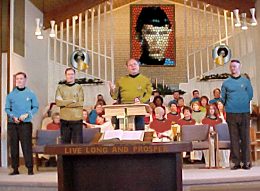
The following is the text of a paper that I wrote for a philosophy of religion class here at Asbury. It was written with a tight deadline and conforming to page and source limits, so it's a bit rough, but mostly represents my views on the subject.
I would like to emphasize that
I do believe in the existence of God, and specifically, the God of the Christian Bible. He is a real, present, and true God as revealed in His infallible Word. It's just that I think that such belief is irrational. "Rational" and "true" are
not synonymous and interchangeable terms. An idea can be irrational
and yet true. Belief in the God of the Christian Bible is irrational, but is nonetheless true.
My understanding of the relationship between reason and faith is that of Soren Kierkegaard -- that one cannot reason a way into belief in God, but must take a leap of faith. Once we have acquired faith, reason is tremendously helpful and should be used. But we will not arrive at belief in God through rational means alone.
We should use our ability to reason, but not exclude non-rational sources of knowledge, such as faith in revelation.
Now before you start reading, please note that
I do believe in the existence of God. I am a Christian theist, not a deist or whatever
Spong is. I'm just completely comfortable being irrational for my Lord and my God. I kneel before the Throne of God, not the Throne of Reason. It is neither feasible nor helpful to take the omnipotent, omniscient, omnipresent God and attempt to shove him into the confines of finite human reasoning.
I believe in God. Catch that? Good. Now start reading.
_____________________________________
It is not rational to believe in the existence of God. I base this assertion on a definition of rationality as a system of thought which regards consistency, logic, testability, and simplicity as core objectives of intellectual exploration. I will test this definition against two definitions of the term “God” in order to provide a wider understanding of theistic irrationality. The first definition of God is that of a supremely powerful and knowledgeable supernatural being possessing personhood. The second definition is this being as specifically identified by Christianity, not other religions, and so is a subset of the first definition.
I will begin with an examination of classical, rational arguments for the existence of God under these definitions and how they fail to be persuasive. The ontological argument, made famous by Anselm, asserts that people can imagine the greatest possible being. Anything which exists is greater than that which does not exist. So the greatest possible being which exists is greater than the greatest possible being which is imaginary. Therefore if one can conceive of said imaginary being, then there must be an existential one which is greater. And so the greatest possible being exists.
This argument is logically incoherent because it assumes that any skeptic of Anselm’s argument has necessarily misunderstood it; that any doubter of the existence of this being is necessarily referring to some other potential being. Despite Anselm’s protests, he cannot simply declare the existence of his being by fiat and insist that critics are attacking a strawman when they doubt the existence of a supreme being on the basis of properties that Anselm himself spells out. Therefore the ontological argument does not provide a rational basis for believing in God using either of my definitions.
Another common argument for the existence of God is a group of perspectives called the cosmological argument. They argue that everything in the universe has a cause. As Aquinas argued:
Everything that is moved is moved by another. That some things are in motion – for example, the sun – is evident from sense. Therefore, it is moved by something else that moves it. This mover is itself either moved or not moved. If it is not, we have reached our conclusion – namely, that we must posit some unmoved mover. This we call God.[1]
The cosmological argument is persuasive in proving that there was a First Causer or First Mover. But it does not provide evidence that this First Causer/Mover is supremely powerful, knowledgeable, or possessing personhood. And since it does not establish these qualities in the first definition, it therefore does not establish these qualities in the second definition. Belief in the existence of God is then unsupported by the cosmological argument.
The teleological argument, resurgent with the Intelligent Design movement, asserts that the universe is sufficiently complex that the likelihood that it could be formed by natural, impersonal forces (such as natural selection) is profoundly unlikely if not impossible. The physics of the universe and the subtle structures of living cells, for example, are too delicate and intricate to be explained scientifically. This argument is flawed in that it assumes that that which science cannot explain in detail now, it will never be able to explain. A basic grounding in scientific history dashes this view. The tides of Earth’s oceans, the cause of the bubonic plague, and the source of Earth’s seasons were all, once, ascribed to divine actions, as they defied human explanation. As Arthur C. Clarke said in this Third Law of Prediction “Any sufficiently advanced technology is indistinguishable from magic.”[2] When Native Americans first encountered European sailing vessels and firearms, they attributed to them magical powers. But a failure to understand a phenomenon is not proof of supernatural causes behind that phenomenon. At best, the teleological argument is evidence for a supremely powerful being, but neither omniscient or personal, let alone the Christian God. And with every passing year and further advances in human scientific understanding, the evidence which forms the basis for the teleological argument rolls back further.
Another argument for the existence of God is known as the moral argument. As espoused by C.S. Lewis, it argues that a sense of moral direction exists within every person, as an objective moral law. What is the source of this law?
It cannot be grounded on the factual reality observed by science, for the laws of nature tell us only what things actually do, while moral law deals with what ought to occur…The moral law must be grounded in mind, for only mind can give instructions regarding doing the right. This mind cannot be a human mind, for the moral law continues to hold despite the births and deaths of individual human persons. Hence, there must be a power or mind behind the universe, “urging me to do the right and making me feel responsible and uncomfortable when I do wrong….”[3]
Like all of these arguments in favor of the existence of God, the moral argument points to some logical consistency in the universe and labels it as “God”. But God is not evidenced here. At best, the moral argument suggests that there is an intrinsic sense of moral reasoning in humanity, but nothing more. It is not necessarily an external mind, but may be biological caused, or any of a number of potential sources for the existence of the concept of morality, but Lewis’ argument that it must be a mind because it survives human birth and death presupposes – without evidence – that moral reasoning is an external factor placed upon humanity, and not intrinsic.
Even if we were to concede that it was a mind behind this sense of morality in humanity, although this would attribute personhood to that mind, it does not establish omnipotence or omniscience – especially since what constitutes right and wrong is widely disputed. If this mind contained all three traits of Godhood in my initial definition, then even if such a being granted moral free will to humans, then humans would still possess an undisputed sense of right and wrong, even if these guidelines were disobeyed.
Thus the moral argument fails to provide evidence for the existence of God provided in my first definition. Although it is, then, unnecessary for me to prove its failure to meet the second definition, I would like to point out how the moral argument is particularly preposterous with it.
If (1) humans have a moral sense given to them by the Christian God who is (2) the morally perfect being and (3) the Bible is an accurate representation of the Christian God, then it would be mentally impossible for humans to doubt the morality of the Christian God.
Yet given the reams of paper devoted to morality of the actions of the Christian God, this conclusion is not supported experientially. The Christian God’s order of genocide against the people of Canaan during the Israelite settlement has disturbed Christians for generations. If the three suppositions listed above are true – all of which are suppositions of the moral argument – then it would not be possible to doubt the morality of God’s order to commit genocide.
However, many theistic believers have argued that evidence is not even necessary or desirable; that in an evidentially neutral universe (no proof of God’s existence, no proof of his non-existence), one should believe in God:
Why should the belief that God exists not be part of the foundation? Why should this not be one of our properly basic beliefs? The theist, after all, certainly thinks that this belief is one that she is rationally justified in holding. And if she finds (as Plantinga thinks most believers in God will find) that it is not a belief that she holds because it is justified inferentially from other beliefs, then the procedure just described will lead her to consider it a basic and indeed, a properly basic, belief. And why not? What is wrong with this possibility? Is there any reason why “God exists” cannot be a properly basic belief? And if it is properly basic, then there is no need for the theist to produce proofs or arguments for God’s existence in order to be justified in believing in God.[4]
To be logically consistent, such believers must also believe in other unproven beings, such as elves, fairies, leprechauns, and imaginary friends. To follow this argument, one’s belief should not stop with God (let alone the Christian God), but extend to every flight of fancy or speculation that the human mind can imagine. A universe which allows for the rational acceptance of an unproven God must necessarily allow for the rational acceptance for every other unproven being unless it can provide a reason for speculation on the reality of non-evidentiary beings to end with the supposition of the existence of God. Soon, one’s cosmology is filled with countless non-evidentiary beings and one is logically obligated under this system to accept the reality of every potential being. If the definition of rationality is a system of thought which regards consistency, logic, testability, and simplicity as core objectives of intellectual exploration, then this universe is no longer compatible with rationality. The burden of proof is on the theist, not the non-theist.
Proof, for the theist, is based on revelation: evidence provided directly by the divine being in the form of holy documents or mystical experiences. The latter may be persuasive in individual cases, but mystical experiences are always confined to individuals or groups and are not universal occurrences. One can accept reports of mystical experiences of others as proof, but this depends upon those reports being accurate. As few people have had such experiences, and many are self-serving or contradict other mystical experiences, belief based upon them is only as rational as the source of that information is reliable.
Likewise, holy documents are only rational as sources for belief if they are reliable. In a world filled with many such documents, most of them contradicting each other in fundamental ways, acceptance of the beliefs contained within them is, at best, a crap shoot. Successful choosing is based more on luck than reason.
Thus, having failed to provide rational proof of an omnipotent, omniscient, and personal God – or the Christian God, specifically – there is no rational basis for believing in God.
[1] Thomas Aquinas, “The Classic Cosmological Argument.”
Philosophy of Religion, Michael Peterson, et al., eds. (New York: Oxford, 2001) 185.
[2] “Brilliant Careers: Arthur C. Clark”
Salon (http://archive.salon.com/people/bc/2000/03/07/clarke/index.html accessed 13 October 2006).
[3] C.S. Lewis, as quoted in Michael Peterson et al.,
Reason and Religious Belief: An Introduction to the Philosophy of Religion (New York: Oxford, 1998) 107.
[4] Peterson, 152.
UPDATE: Serious formatting error fixed.
 Weekend Fisher:
 Previous contest winner
 Ireland has repealed a law forbidding coffee merchants from mixing sheep manure into coffee grounds.
 Jonathan Adler:
 A short list of ill-conceived ideas. My favorite --
 Bishop Woodie H. White at Candler says:
 Fernando Botero (1932- ) is a Colombian painter and sculptor. As a boy, he studied to be a matador, but later studied the fine arts in Medellin. Botero was most heavily influenced by Rivera, Siqueiros, and Orozco. Later, in Madrid and Paris, he was shaped by Picasso, Gauguin, and Goya. His work can be broadly classed as Neo-Figurative, which is the application of the Expressionist Revival to figure studies. Botero is noted for painting his subjects as obese, a trend that he attributes toward the individual artist's intuitive search for a central form. He recently made headlines for an exhibit critical of Abu Ghraib.
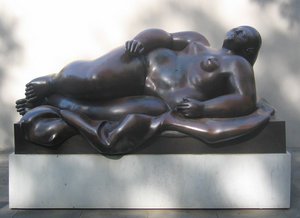 The first Botero that I ever saw was this one: Reclining Figure at the Birmingham Museum of Art. It is the crowning piece of a marvelous sculpture garden on the roof of the first floor.
 The General and His Family.
 Drinking Man.
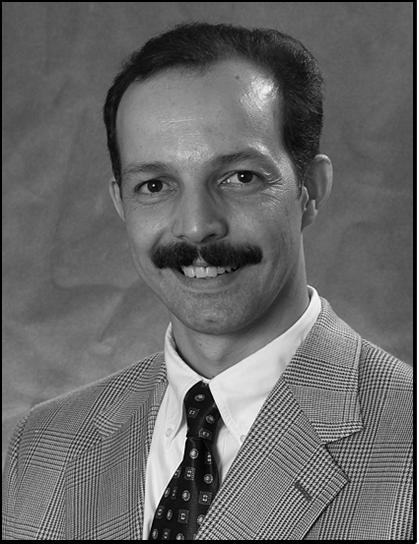 One of the top professors here at Asbury/Orlando is Dr. Hugo Magallanes -- one of those rare teachers who takes positive delight in people disagreeing with him. I used to think that he was a liberal, but now I suspect that he'll just take the opposite position of whatever you take in order to force you to defend your perspective. Anyway, I have Christian Ethics with him this semester and today we talked about homosexuality and church membership. In the UMC, this is hot issue, and the Methoblogosphere was hoppin' with it back when the Judicial Council handed down the Ed Johnson case decision.
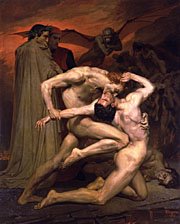 Jack Handey of Deep Thoughts fame reports in after his first day in Hell:
 Previous contest winner
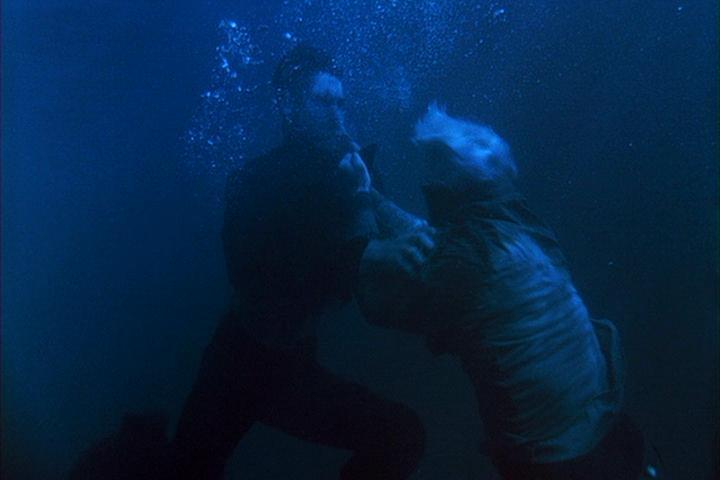 Zombies can't swim, but they also don't need to breathe air. You, however, do. So bodies of water may not be as effective barriers as you might hope. Plan accordingly.
 I ran across an interesting passage in Thomas Oden's systematic theology:
 7 from the complete list:
 It's easiest to fight zombies during the winter because they don't produce internal heat. When the temperature drops below 32 F, they freeze solid and are harmless. You can pick-axe their braincasings at your leisure.
 Rather clever.
 There's a dreaded issue that we don't like to talk about in churches.
 Picture via Ironic Catholic
 Previous contest winners
 Subscribe in a reader