Tuesday, February 28, 2006

Where Are the Men?

Mark Winter and John Battern (in Theresa Coleman's comments) have written about the declining presence of men in the Church.

I haven't picked up on this trend. But I have noticed that the children at my two most recent churches are overwhelmingly female (about 5 to 1).

A few years ago, John Eldredge wrote a book called Wild at Heart, which asserted that modern Christianity emasculates men.

Why do you think men are leaving the church?

Is Post-Modernism a Myth?

In a fascinating piece, Joe Carter says yes. I'll give my own analysis later in the day. Gotta Greek quiz right now.

Monday, February 27, 2006

There's a fine line...

...between love and felonious stalking.

That would make a great country music ballad. I'm thinking of Randy Travis as the singer.

Art Blogging: Léon Bazile Perrault

Leon Bazile Perrault (1832-1908) was a French Academic painter from Poitiers. Perrault studied first under Francois-Eduoard Picot and later William Adolphe Bouguereau. The latter's influence is seen strongly in his style and content.

Perrault rose to high fame after the 70s, when the French people craved beauty and delicacy to replace their humiliations from revolutions and lost wars. In Perrault's idyll of languishing Greek women and children at play, there are no German armies slapping France into submission.


The Bird Charmer (1873) now in a private collection.


A Good Story, also in a private collection. Compare. What can I say? I'm a Bouguereau fanboy. Art snobs may dismiss us as simple-minded, but history is on our side.


When I first saw this picture, I immediately thought of this one by Perrault's master. Notice the foot and reflection. Nature's Mirror, in a private collection.

Question of the Day

Should the United Methodist Church develop an independent nuclear weapons program?

Sunday, February 26, 2006

Art Blogging: Ludwig Knaus

Ludwig Knaus (1829-1910) was a German genre painter. He studied in Dusseldorf and Paris and later became a professor at the Berlin Academy. Knaus' themes focused on the idealization of country life, as later typified by Norman Rockwell. Like many artists of the Dusseldorf School, his technique was Neoclassical, but his subject matter was not. I appreciate Knaus' tendency to find beauty in everyday life.

This painting is called A Portrait of a Tyrolean Girl (1874), now hanging in a private collection. It's simple, ordinary, and beautiful.

MBWR Delayed

The Methodist Blogs Weekly Roundup will be delayed until early Wednesday morning due to time constraints.

This post will be kept at the top. Scroll down for updates. I'll write short posts, but the MBWR requires a 6-8 block of uninterrupted time to compose.

UPDATE: This post has been moved down.

Saturday, February 25, 2006

New Members at the Church

If it were up to you, what would new member classes at your church teach?

Weekend Rabbit Videoblogging

Congratulations

To Whit Johnstone on getting admitted into seminary.

Larry, Beth, and I went to college in the same small town where MTSO is located. You'll enjoy it.

Confessing Other People's Sins

Andy Bryan wrote about the recent decision of the World Council of Churches to publicly ask God's forgiveness for America being such an awful country, what with the war and the environment and such. Andy asks readers if it is acceptable to confess someone else's sins.

Here's my take: the confession of sin is a sacred act. It is an act of communion with God, who is holy, for the sake of our redemption. In contrast, political speeches (Left or Right) are not holy. They may be necessary or appropriate in certain settings, but they are not a sacred act established by God. This speech was not an authentic confession addressed to God. It was a political speech intended to attack the US government for perceived wrongs. It was just plain rude to God for them to talk past him to their real audience. God deserves better than to serve as a prop (again, Left or Right) in a staged event.

I don't think that the US has anything major to confess, but if you, as an American, do feel that way, here's what you do:

"When you pray, you are not to be like the hypocrites; for they love to stand and pray in the synagogues and on the street corners so that they may be seen by men Truly I say to you, they have their reward in full. But you, when you pray, go into your inner room, close your door and pray to your Father who is in secret, and your Father who sees what is done in secret will reward you."

Let the WCC close its doors, turn off the cameras, kneel before God, and apologize for America. It would be, IMHO, morally misguided, but at least it would be an authentic confession directly addressing God.

Friday, February 24, 2006

The Wesleyan Quadrilateral

1/2 oz. gin
1/2 oz. peach schnapps
1/2 oz. bronte
2 oz. milk

Shake and serve chilled.

Art Blogging: Edmund Blair Leighton

Edmund Blair Leighton (1853-1922) was a British Pre-Raphaelite painter. You may have heard of the term 'Pre-Raphaelite' before. Let me explain what it means.

The Pre-Raphaelites were a number of mostly British artists who emerged in the second half of the 19th Century with distinctive beliefs about aesthetics and style. Like the later Impressionists, they rejected the formal standards of Academic painting. In their view, the Academic emphasis on photographic realism and Greco-Roman subject matter had stifled imaginative art. This realism was typified by the precise anatomical depictions of Italian Renaissance artist Raphael. Rejecting this school of thought, the rebel artists called themselves the 'Pre-Raphaelites'. Famous members of this movement included Edward Burne-Jones, John Everett Millais, and Dante Gabriel Rossetti. The Pre-Raphaelites are massively popular in our time and can be found in countless prints and posters.

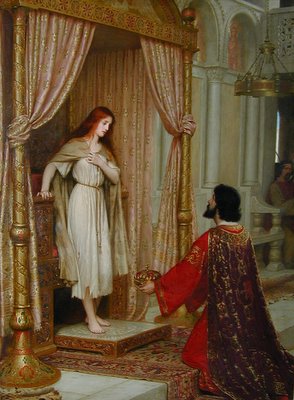
Edmund Blair Leighton (as distinguished from Lord Frederick Leighton, an Academic painter from the same era) was fond of Medieval genre scenes, such as The Accolade. Idealizations of the Medieval era were common among the Pre-Raphaelites and heavily influenced J.R.R. Tolkein.


Leighton was part of a revival of interest in Arthurian and Teutonic folklore. This painting is a depiction of the romantic couple Tristan and Isolde, which has taken the form a 12th Century poem, a Wagnerian opera, and an upcoming movie.


The King and the Beggar Maid is a reference to a Medieval legend about a king named Cophetua who had no interest in women until he fell in love with a penniless beggar.

Thursday, February 23, 2006

Methodist Blogger Profile: Mark Winter

Mark Winter of Mark's Remarks


Howdy! I live in Ft Worth, Texas with my wife of 25 years, Laura. Laura is from Southern California and I’m from Oklahoma, a mixed marriage if there ever was one. We have three children. My two sons are basketball fanatics. Paul, 20, attends the University of Texas at Arlington and wants to go into sports management. Sam, 15, plays basketball and when he isn’t, he’s thinking of basketball. Abby, 11, loves to sing, shop, draw and talk a lot on her cellphone. We also have two goofy rat terriers, Checkers & Sampson.

I am a fulltime General Evangelist of the United Methodist Church. Most UMs cock their heads funny when I tell them I’m a Methodist evangelist. We are ordained elders who operate our own ministries. My One Man Show is a drama ministry. In the Old Testament, God used a jackass to speak through, so I figured he could use a ham. I portray over 30 characters, including Lazarus, Simeon and a Methodist circuit rider. UM evangelists travel to any church that will host us. Besides my blogsite, I have two other websites: www.onemanshow.org and www.francisasbury.com

Why do you blog?
When I first heard about blogging, I thought it would be a great promotional tool for my ministry. Now I see it as a playground for all my hyperactive thoughts.

What has been your best blogging experience?
When my sister told me I was a good writer. She made me feel that my journalism degree wasn’t in vain.

What would be your main advice to a novice blogger?
Ask yourself, “If I were a complete stranger who happened across my blog, would I want to read what I just wrote?”

If you only had time to read three blogs a day, what would they be?
I pretty much hang around the Methodist blogosphere. I also like World Mag Blog because of the fast-paced news items and the gloves-off comments that people leave.

Who are your spiritual heroes?
Francis Asbury—for his unwavering self-sacrifice to ‘reform the nation and spread scriptural holiness across these lands.’
C.S. Lewis—for drawing me and countless others to Christ through his imaginative and honest writings
Mother Teresa—for her deep love of Jesus and commitment to the poor

What are you reading at the moment?
I’m picking my way through An Introduction to the Devout Life by St. Francis de Sales. I’m also going through a one-year Bible reading plan and reading the daily devotional from My Utmost for His Highest by Oswald Chambers. On top of that, I’m reading a children’s book about a talking hamster—uh, my daughter’s making me do it.

What is your favorite hymn and why?
I love the classic, awe-inspiring hymns like Holy, Holy, Holy, A Mighty Fortress, Immortal Invisible, God Only Wise. Plus Christmas hymns, because they make me feel all warm and tingly inside.

Can you name a major moral, political, or intellectual issue on which you've ever changed your mind?
I used to be a libertarian. Now I think it’s naïve to believe we can have such limited government when it’s grown so big and complex.

What philosophical thesis do you think is most important to combat?
Hedonism because it focuses squarely on sensual, selfish pleasure and getting rid of pain—one of the biggest idols & illusions in our nation.

If you could effect one major change in the governing of your country, what would it be?
I have to take out a bank loan to fill up my gas tank, so channeling more resources into finding cheap, renewable forms of energy would be helpful.

If you could effect one major policy change in the United Methodist Church, what would it be?
Financially support our fulltime evangelists (not that I have an ax to grind).

What would be your most important piece of advice about life?
Cultivate friendships.

What, if anything, do you worry about?
Wow, this could turn into a counseling session. I’m a melancholy personality, so I tend to worry a lot, though I know it’s not good for me. Mainly I worry about the salvation and safety of my children, but I am learning to pray it over to God. Other than that…no, you don’t have the time.

If you were to relive your life to this point, is there anything that you'd do differently?
would’ve drank less beer in college and actually studied.

Where would you most like to live (other than where you do now?)
Hmmmm…..I go to Mexico on mission trips and would like to live down there for a while so I could become fluent in Spanish. Plus they have killer tacos. If I could take away all but one week of winter, I’d like to live in Vermont. Such beautiful scenery.

What do you like doing in your spare time?
I like to write, listen to music, read and watch movies. A while back, I enjoyed gardening, but my hectic travel schedule turned my garden into a hell of weeds. Maybe when I retire…

What is your most treasured possession?
My baseball card collection. I have vintage cards from my childhood and have actually put them in my will for my boys.

What talent would you most like to have?
Either play the piano so beautifully that it would move women to tears—or dunk a basketball like Shaq and move men to tears.

If you could have any three guests, past or present, to dinner, who would they be?
Frank Sinatra (to provide dinner music)…Mickey Mantle (my all-time baseball hero)…my father, whom I reconciled with on October 7, 1994 and then lost him to a sudden heart attack three hours later….

Bush Inks Irish Firm to Guard National Whiskey Reserve

Washington DC - The Bush Administration today angrily defended its controversial approval of the Irish company Donnybrook Lads Ltd. to oversee security at the National Strategic Whiskey Reserve in Lynchburg, TN, vowing to veto a new House bill that would force the two-man firm to undergo federal breathalizer testing.

"During the rigorous 7 minute review process, both Seamus and Kevin gave us an express oral promise that they never touch the stuff," said White House Spokesman Scott McClelland. "Well, maybe just a wee nip at wakes, and on All Saints Day."

"Congressional postering on this issue plays into the worst anti-Irish stereotypes," added McClelland, who said that the security contract included a failsafe Designated Driver clause to keep the Irish firm away from sensitive whiskey truck keys.

"We can reassure the American people that all Strategic Whiskey Reserve transportation and driving duties will be handled by highly-skilled elderly Koreans," said McClelland.

Read the rest.

Hat tip.

Photoshopped Romance Novel Covers

Wednesday, February 22, 2006

You Decide

If you got into a barfight with a pack of ravenous Swedenborgians, which of the following people would you prefer as a fighting companion?
John Calvin
Martin Luther
John Wesley
Ignatius of Loyola
Jacobus Arminius
Ulrich Zwingli
Free polls from Pollhost.com

ESV vs. TNIV vs. Kingon Standard Version

Ben Witherington has problems with the translation of gender in the ESV. It has caused quite a stir.

I do not speak Greek and Hebrew and inspite of this limitation, have no opinion on the subject.

Are You Questioning My Patriotism?

Greg Hazelrig has a low view of mine.

Art Blogging: Frederic Remington

Frederic Remington (1861-1901) was was a popular American painter, sculptor, and illustrator of the American West. He was raised in New York State, educated at Yale, but dropped out when his father died. Remington developed a fascination with the West and earned a good living as an illustrator of popular magazines and newspapers. His images of the West portrayed it as a world of masculine courage and struggle. It can be argued that the modern image of the Old West in film and fiction derives directly from Remington. Over his prolific lifetime (shortened by a botched appendectomy), Remington produced 3,000 illustrations, dozens of sculptures, and many written compositions. There is a museum in his native New York devoted to his work.

Apache Fire Signal (1908) in the Thyssen-Bornemisza Museum.


The Trooper (1891).


Arresting the Deserter (1885).


The Cheyenne (1992). I've seen a number of Remington statues. They have remarkable fluidity.

The Historicity of Jonah

For class, Brian had us read The Book of Jonah and do preliminary analysis and study.

I am not proud of it, but I have doubts about the historicity of The Book of Jonah. There is still a little atheist inside of me which raises two points:
  1. No work outside of Jonah records the conversion of the Assyrians, which would have been a momentous event in their social history.
  2. Plenty, however, do record further generations of ruthless and savage Assyrian conquest and destruction.

The little atheist suggests the application of Occam's Razor to the story: perhaps a prophet feels called to prophesy destruction upon Nineveh, which then does not take place. This prophet is angry at God for making him look like a fool in public, but eventually creates the story that Nineveh did actually repent just enough to merit God's mercy. History outside of the prophet's account does not record this revolution.

I know that these are not Christian thoughts and I hope that I don't offend anyone. But I have these niggling doubts about The Book of Jonah. The historical record flatly contradicts its central event.

UPDATE: Jeff the Baptist shares his thoughts on what we can learn from Jonah.

Tuesday, February 21, 2006

Giving in United Methodist Church Hits Record Highs

United Methodists are giving more generously than ever before, according to new figures reported to Monday by the denomination’s General Council on Finance and Administration.

"We celebrate the overwhelming generosity of the people of The United Methodist Church," said Sandra K. Lackore, general secretary and treasurer of the Council.

Statistics from 2005 showed that United Methodists gave $85 million more than 2004, which translates to a 53.6 percent increase in offering over the last year.

Story link.

Reflections on the Monastic Heritage

As there is a harsh and evil zeal which separateth from God and leadeth to hell, so there is a virtuous zeal which separateth from vice and leadeth to God and life everlasting.

Let the monks, therefore, practice this zeal with most ardent love; namely, that in honor they forerun one another (cf Rom 12:10). Let them bear their infirmities, whether of body or mind, with the utmost patience; let them vie with one another in obedience. Let no one follow what he thinketh useful to himself, but rather to another. Let them practice fraternal charity with a chaste love.
-- Rule of St. Benedict

Can modern-day Protestants learn anything useful from the monastic tradition?

Art Blogging: George Dunlop Leslie

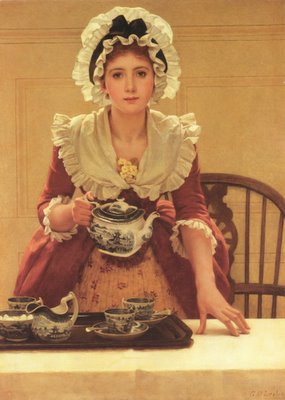
George Dunlop Leslie (1835-1921) was a British Neoclassicist and then pre-Raphaelite. He was born in London, the son of famous artist C.R. Leslie. Leslie was educated at Cary's Academy and then the Royal Academy, exhibiting work at the RA continuously after 1857. He later moved to Wallingford-on-Thames and became a devoted gardener.

Leslie was noted for his depictions of idealized Victorian domesticity, such as this serving maid in Tea (1894), now in a private collection.

An Epiphany

My brain is turning mushy as I try to force NT Greek inside of it. In the midst of the haze, I had a sudden revelation. The KJV-onlyists are right! God blessed that translation, making it perfect. We have no need to pour over Greek and Hebrew texts when we have God's Word available in (slightly arcane) English!

Hallelujah!

Monday, February 20, 2006

Methodist Blogs Weekly Roundup # 53

Here's the week in review in the Methodist blogosphere:

At Bandits No More, Steve Heyduck wrote about the importance of sports.

Betty Newman wrote about what it should be mean to be a Christian and standing up for our faith.

Brian Russell blogged about the experience of Eden, taking risks for Christ, and naive preconceptions about God.

Bruce Alderman wrote about the distorted images of God that people have and the Biblical call for social justice.

Church Medic blogged about evangelism technology.

Dave Warnock wrote about the towing capabilities of the Citroen C8.

Derek Tang blogged about what ordinary people can do to alleviate poverty.

Donald Sensing wrote about the radicalism of European Muslims, the death of the US Navy Tomcat, the and Islamic future of Europe.

Eric Coomer reviewed the movie The Second Chance.

Steve Heyduck wrote about the opportunities of darkness.

Gavin Richardson blogged about the simplicity of worship.

Gerry Charlotte Phelps wrote about the press' response to Cheney's shooting accident.

Greg Crofford blogged about the utility of Christian diversity.

Greg Hazelrig wrote about what God can do with you when you give yourself completely to him.

Greg Lee preached about revival.

Jay Voorhees blogged about Augustinian sexuality.

John Battern wrote about a Wiccan/Methodist worship service and reviewed the movie Gory Road.

John Wilks is cringing in terror before Bill Gates.

Josh Tinley wrote about the Indiana University basketball program.

Larry Hollon is optimistic about UMC giving. He also wrote about the insularity of the American mind, moving from information to understanding, the methamphetamine epidemic, and the impact of devastation on civilizations.

Lawson Stone wrote about visiting the Masada.

Methodist Corner blogged about the importance of doctrinal debate.

Michael Daniel wrote about the megachurch urge, his desire to write professionally,

Olive Morgan blogged about finding time to volunteer at church.

Rick Mang wrote about the evangelistic ministry of Mark Winter.

Peter Raser preached on discipling our lives as runners so.

Pjeffy blogged about remodeling his church.

Dan Gates wrote that SPR committees can help turn the UMC around and the UMC's decision not to hold the General Conference in Richmond.

Rev. Mark blogged about communion.

Theresa Coleman wrote about sentiments toward female clergy.

Lorna Koskela blogged about what it means to Finns to be Christian, beginning Lent and right and wrong prayers.

Sky Lowe-McCracken wrote about the UMC moving its General Conference away from Richmond.

Tony Mitchell blogged about different types of evangelical revivals.

Chris Roberts wrote a letter to Brian McLaren and wrote about the Wesleyan Quadrilateral.

Mitchell Lewis blogged about Jean-Jacques Rousseau's call for a civil religion and how Jesus helps us navigate the world.

Andy Bryan wrote about how he learned the art and science of pastoral care.

Andy Stoddard said that inward repentance must be matched with outward action.

In an epic-length piece, Richard Hall created a systematic theology, explained Grand Unified Field Theory, deciphered the Q Gospel, and listed a dandy recipe for strawberry tarts.

Chris Morgan wrote that the solutions to our problems are often obvious.

Nominees for Best of the Methodist Blogosphere?

Additions? Corrections? Do you know of a blog that should be included in the MBWR? Leave a note in the comments or e-mail locustsandhoney2005 at yahoo dot com!

UPDATE: Chris Morgan, Richard Hall, Andy Bryan, and Andy Stoddard added.

Seminarians and Pastors, Rejoice!

Salvation has arrived!

Sunday, February 19, 2006

Healthy Pastors

I'm in reasonably good health and exercise fairly often. But because I'm facing a medical exam for Certification as a Candidate for the Ordained Ministry, I've given up foods that would boost my normally high cholesterol. My pastor has warned me that he knows of people who have been rejected from Candidacy because of poor health. I'm taking no chances.

Is it fair to restrict from the ordained ministry those who are in poor health? If yes, what basic standards should be required?

Resident Aliens Reconsidered

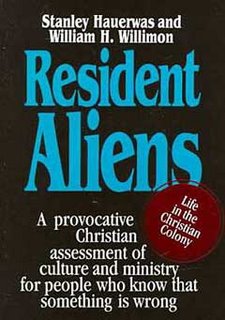
I read Resident Aliens last semester was not initially impressed. But over time, I find myself increasingly drawn to some of its themes.

The title comes from the Anabaptist notion that the Christian community is supposed to live by radically different values than those of the 'world'. That as Christians, we should not be co-opted by the powers that be.

This is the Constantinian Thesis: that the vibrant community of martyring Christians started to die once the Emperor Constantine institutionalized our faith. The purpose of the Church switched to supporting the status quo power structures, rather than supporting only the values of Christ.

I have many disagreements with Hauerwas and Willimon regarding their ideas in this book, but let's not focus on them, rather on the Constantinian Thesis. The authors think that the church in America, until roughly the 1960s, espoused the notion that one was Christian by being born in America and attending church regularly, instead of being Christian by living a Christ-like life. The forces of government (e.g. prayer in schools) and social pressure (e.g. church attendance for sake of social status) supported the Church. But now, since those governmental and social pressures are gone, the Church is left flailing and uncertain about what it means to be a Christian. For generations, the Church preached a watered-down Gospel that was not life- or society-transforming.
I've thought this for a while, but Willimon and Hauerwas put my vague notions into concrete terms. There is no longer a Constantine to back up the Church, and I thank God for it. The Constantian Church preached a Gospel of salvation-by-wearing-a-nice-suit-on-Sundays. Millions of people were inoculated from Christianity as a result and condemned to Hell. Now that the curse of Constantinianism is gone, we can preach an authentic, radical Gospel. The one that Jesus preached.

Art Blogging: Guillaume Seignac

When I first saw a picture of this painting, I thought "Wow! A Bouguereau that I've never seen before!" Every now and then, lost works of the Greatest Artist in the History of the UniverseTM do turn up, but it is not common.

To my greater surprise, this canvas is not the work of Bouguereau, but a devoted student and then imitator of the great master named Guillaume Seignac (1870-1924). Seignac, a Parisian, exhibited frequently at the Salon in the 1890s and early years of the 20th Century. The content, flesh tones, draping, anatomy, and brushwork all proclaim Bouguereau. Seignac even signs his name in the same font as the master. The only difference that I can see is that the woman depicted gazes at the viewer, which would be very unusual for Bouguereau. Perhaps Seignac lacks total originality, but he could not have chosen a better artist to imitate, nor done it so very well.

Saturday, February 18, 2006

Weekend Rabbit Videoblogging

Debt Management Advice

From Saturday Night Live.

Random Thought While Walking the Dog

I'm glad that humans don't mark territorial boundaries like dogs do. Except for Brian, of course.

Art Blogging: Charles Chaplin

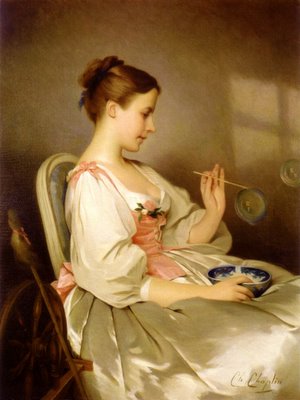
Charles Chaplin (1825-1891) was a French Academic painter, born of an English father and French mother. He studied at the Ecole des Beaux-Arts and, after a few years of painting rustic scenes and the peasantry, became a successful portraitist. Chaplin's body of work consisted almost entirely of pretty aristocratic women. While contemporaries looked to new styles in the future, Chaplin's subject matter reflected the Rococo delight in being rich and idle. Compare. His style was highly realistic, as well-displayed in this work The Soap Bubbles, which hangs in a private collection.

Chaplin was also a noted art instructor. He opened a school which accepted only female students. Few art schools were open to women at the time, so many flocked to Chaplin. Among them was the famous American Impressionist Mary Cassat.

Pass the Mic

I've been tagged by Jim McKay with the latest meme going around. The rules: List seven songs you are into right now. No matter what the genre, whether they have words, or even if they're any good, but they must be songs you're really enjoying now. Post these instructions in your blog along with your seven songs. Then tag seven other people to see what they're listening to.

Well, I really don't listen to music. Some guy sliced my car antenna off a few years ago, so I have limited options in the car. I haven't purchased a CD in years. And I don't download music off the Internet. But let's see what I can do with this.

1. Ace of Spades HQ directed me to this song a few weeks ago, which has turned out to be shockingly addictive. It's the Beatles' Lucy in the Sky With Diamonds sung by William Shatner. I can't stop myself from hitting the play button, over and over again.

2. This one is easier to resist: Leonard Nimoy singing The Ballad of Bilbo Baggins. Nimoy sang more albums that you might think.

3. I can't resist the majesty of the Lord when I sing the old hymn Victory in Jesus.

4. It's been several years since I've been even slightly 'in' to music. But back in the day, Foolish Games by Jewel could stop my in my tracks.

5. Man, the Lilith Fair era was great! I loved those bands. Meredith Brooks may have been a one-hit wonder, but her one hit was really good: Bitch. This isn't a complete video, but the best that I could find.
6. During the Lilith Fair period, I was also exposed to the work of Dave Matthews, such as the lovely song Crash Into Me.

7. My wife introduced me to the beauty of country music. I'm especially fond of Alan Jackson's work, such as the haunting romance Remember When.

Tag: William Shatner, Wil Wheaton, George Takei, Nichelle Nichols, Michael Daniel, Greg Hazelrig, and Jeff the Baptist.

Friday, February 17, 2006

Ragging on the Air Force

Joe Carter, ex-Marine, is doing just that. Hilarious.

Hat tip.

UPDATE: Pieter Friedrich (USAF) has a response.

Life Abroad

If you could live in a foreign country for a year -- and money and language were not issues -- where would you go?

Wiccan Methodists

Ahem. First Commandment, anyone? Sheesh.

Hat tip.

Art Blogging: Herbert James Draper

Herbert James Draper (1863-1920) was a British Neoclassical painter. Born in London, he was initially educated at St. John's Wood Art School (the cradle of the pre-Raphaelite movement) and then at the Royal Academy. Draper traveled in France and Italy before returning to London to earn a successful living as a portraitist for the upper classes. He was most productive in the 1890s and highly sought-after while living but, contrary to proverbial wisdom, his reputation collapsed after his death.


Lament for Icarus, housed in a private collection, is perhaps his most famous work. It won the Gold Metal in 1900 at the Exposition Universelle. Like most of his non-portraiture, it has a mythological theme, featuring the dying, foolhardy young Icarus. What I like about this painting is its dark, passionate coloration found among the pre-Raphaelites, but without that movement's characteristic flatness. It would seem that Draper was a bridge between dying Neoclassicism and emerging pre-Raphaelitism.


The modern revival of Neoclassicism is in large part due, I suspect, to the demands of popular taste. These seem to have swung away from Abstraction (no offense intended toward its defenders) and toward more realistic yet fanciful works found among the Neoclassicists and pre-Raphaelites. Waterbaby (right) is characteristic of this trend. I've often found it in bins of prints at Hobby Lobby, Michael's, and similar stores where the middle classes seek out prints to hang on their walls.

I'm going to mix metaphors here, but this painting reminds me of The Andy Griffith Show. That program is my father's favorite because after long days of working and facing stress, he doesn't want entertainment that is profound or has some deep message. He just wants to relax and be entertained. Waterbaby is like that: pretty, playful, and essentially meaningless. Good art doesn't necessarily have to do anything more than be pretty. That's why Neoclassicism is experiencing revival. It may be a movement with moments of profundity, but its core value is beauty, which is what the common man values in art.

UMC General Conference Rejects Richmond

Because of the name of the city's baseball team:

RICHMOND, Va. Upon further review, the United Methodist General Conference is NOT coming to Richmond in 2012 because of the nickname of the city's baseball team.The conference originally picked Richmond over Atlanta because its policy prevents it from going to cities with sports teams named for American Indians.

The conference apparently wasn't aware that the Atlanta Braves' top farm team is the Richmond Braves.

Richmond officials say the ten-day conference would have been one of the largest ever in the city, bringing of thousands of visitors and nights booked in hotel rooms.

The conference says it will meet now in Tampa, home of baseball's Devil Rays.

Thursday, February 16, 2006

Art Blogging: Albert Bierstadt

Albert Bierstadt (1830-1902) was an extraordinary landscapist. Born in Germany, educated in Dusseldorf, he immigrated to the United States and became that nation's greatest painter of Western landscapes.

This painting is in the permanent collection of the Birmingham Museum of Art. Whenever I go home, I drive downtown if for no other reason than to see this painting: Yosemite Valley, Yellowstone Park (1868). It is an astounding work, filling a wall and virtually dominating the entire museum with its majestic splendor. I'd write more, but there really aren't words to describe it. Bierstadt's work is simply breathtaking. Oh, the wonders of God's creation!

Wednesday, February 15, 2006

Does Size Matter?

Ed enthusiastically proclaims, "Yes!" I proclaim "Too much information, Ed!"

Down in the 'Hood


Wazzzzzup in de hiz-ooouse, homeys!!!!


Whadup dogg.


Yo beeatch, you bin ganking some booty-cheddar theology at we!


Liz up, wanksta, da steez of traditional Methodism is ballin and foshizzle and you jabroni emergent is smack!!!!


Faggle don’t baller-block my whodi or I cap yo ass!


Ay yo trip no banging in the barrio.


Boning out, no diggity!


Peace-N, I got a tray-eight, charvala.


Book now, Wesley, or I 187 yo crackas. I strappin.


Jack all yo, c/s or yo think yo big tymers!!!! Aint nothing but chubble jobbers!!!!

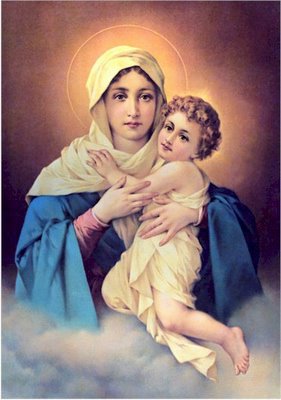
The Virgin Mary

Some Protestants think that the Reformation went too far and that there should be a role for the Virgin Mary in Christian devotion. What do you think of this trend?

Tuesday, February 14, 2006

The Appointment System

We've talked about the UMC appointment system before, which has many critics. One common view is that switching pastors every few years is detrimental to church growth.

Still, the numbers don't look good: we're in numerical decline across the country.

Perhaps we've been going about this the wrong way. Let's think outside the box. Making appointments last 10 years instead of 5 hasn't been helping, so let's go in the other direction. I propose that we move pastors every four hours. That way, pastors can gain valuable experience in many different churches, learning about the work of the ordained ministry in different contexts.

What do you think?

Keyboard Design

For Canadians.

Monday, February 13, 2006

Transformers Are Real!

Finally!

Hat tip.

Methodist Blogs Weekly Roundup # 52 (1 Year!)

Here's the week in review in the Methodist blogosphere:

Steven Manskar wrote about what a congregation designed on Wesleyan principles would look like.

Andy Bryan fisked an IRD press release and wrote about translating Wesleyan thought into modern practice.

At Bandits No More, Richard Heyduck wrote about racial reconciliation in Texas.

Ben Witherington reviewed the film Goodnight and Good Luck and wrote about a Christian view of gambling.

Beth Quick reflected on her ordination interviews.

Brian Russell wrote about the processes of Biblical interpretation and Biblical teaching.

Dave Warnock blogged about creative prayer in his circuit.

Dennis Peay gave birth to a baby. Or his wife did. One of the two.

Donald Sensing wrote about the courage now required of artists and how women live under sharia law.

Steve Heyduck reflected on Christian values, pop culture, and the Superbowl halftime show.

Gavin Richardson wrote about his retreat in an abbey (this one, by the way).

Gerry Charlotte Phelps dusted off her Ph.D in economics and explained the federal income tax. She also wrote about the huge changes that Europe must make in order to survive.

Greg Crofford compared Christian and Islamic fundamentalism.

Greg Hazelrig pondered Methodism and homosexuality.

Greg Lee preached on busyness.

Mike Holly thinks that Christianity can best be seen as an identity crisis. He also said that the if the church is authentic to the gospel, it will be seen by the world as foolish.

Jay Voorhees attended a conference on the emerging church and diversity.

John Battern wrote about a documentary on the Resurrection, a recent conference presided by his bishop, and responding to Theresa Coleman's 16 questions.

John Wilks wrote about the sacred spaces in our lives, being spiritually fed at church, and loving society's rejects.

Jonathon Norman argued that Christians need to live lives of theology, the theology of atonement of yours truly, the theology of atonement of St. Anselm.

Jordan Cooper wrote about the nature of innovation and the emerging church and narrative in church community.

Just As I Am taught on righteous living.

Ken Carter reflected on what Sunday means for pastors and meeting Bishop Willimon.

Larry Hollon reminded communicators to focus on their audiences, not themselves. He also wrote about how age effects technology usage, the age of micromedia, evangelical responses to global warming, and life in Haiti.

Mark Winter wrote about the economics of Valentine's Day and a lost valley found in Indonesia.

Michael Daniel wrote about humility in the 2 Kings 5 story of Naaman and the Muslim understanding of visually portraying Mohammed.

Mike Lamson looked at the theology of justification and reconciliation and whether prophets divide people or bring them together.

Jeff Lutz wrote about how evangelicals are responding to global warming.

Olive Morgan blogged about Islamophobia (or the lack thereof) in the UK.

Rick Mang visited a courthouse and wrote that our lives are the sum of our decisions.

Padre Complex wrote about people taking advantage of the financial gifts of churches.

Peter Raser blogged about the Superbowl as a religious event.

Pjeffy wrote about finding Christ in the Olympics and what the Church can learn from Starbucks.

Dan Gates blogged about Methodism in a post-Christian America and asked whether the UMC can be fixed.

Theresa Coleman demonstrated the dangers of Instant Messaging while intoxicated. She also reflected on the life cycle of the church and advocated cutting out the deadwood.

Lorna Koskela wrote about how the Holy Spirit directs our reading of Scripture today, what to learn from being broken by God, reading the Apocrypha, and reviewed a book about divine healing from pain.

Sky Lowe-McCracken blogged about the cup of blessing that Jesus offers to us.

Brett Royal wrote about whether God extends Salvation to honest spiritual searchers who do not arrive at the Gospel and whether the Christian faith changes over time.

TNRambler is now his church's webmaster and requested advice for church web design.

Tony Mitchell preached on the power of ignorance.

Shane Raynor wrote about conversion experiences.

Bad Methodist pondered what really is blasphemy.

Andy Stoddard lectionary blogged for Feb. 7th.

Chris Roberts blogged about sanctification.

Mitch Lewis blogged about the King of Jordan speaking at the National Prayer Breakfast.

That's one year of MBWRs. It has been wonderful to watch the Methoblogosphere expand as we share community with each other, Left, Right, and Center.

Additions? Corrections? Do you know of a blog that should be included in the MBWR? Leave a note in the comments or e-mail locustsandhoney2005 at yahoo dot com!

Church Mission Statements

Prooftexting is dangerous. If you take your church's motto directly out of Scripture, make sure that you're not quoting Satan.

Hat tip.

Sunday, February 12, 2006

Reflections on My Critique of Asbury

See update at the bottom of this post.

There were many responses to my critique of Asbury. One Asbury student linked to my post in Table Talk, the in-house discussion board at the seminary. An avalanche of furious replies came in my comments section here, Table Talk, and my e-mail in-box. I was simply astonished at the intensity of the venom spewed at me, mostly consisting of personal insults. I deeply regret that although I tried to keep the discussion appropriate, I sometimes jumped into the mire of bitter sarcasm in response. I should have kept to the higher standard of Christ and turned the other cheek.

The general consensus seemed to be that it was inappropriate of me to air my thoughts on the subject on the Internet, where non-Asburians could see them. Above all else, Asbury's reputation must be protected from any negative opinion. After all, prospective students might read my post and learn of these problems.

Although I understand this view, I find it hard to buy into the "cover up" mentality. I'm not even sure how to argue against the presupposition that all problems should be hidden. So in the discussion, I was and am rather dumbfounded by this point of view.

UPDATE: A polite Asburian has e-mailed me and I feel greatly humbled by his persuasive words. I really should have dealt with this situation privately first before broadcasting my criticism all over the Internet. My criticism is valid, but my manner of expressing it was not. I apologize to the Asbury faculty for my immature and unChristian conduct.

FINAL UPDATE: Wow! Nothing clears one's head like staying up all night to study Greek. I can't believe that I let a bunch of whiny brats in Wilmore scream at me and degrade me for the past couple of days. And I just took it because I figured that as a Christian I had to be a doormat for their abusive behavior. What the hell was I thinking?

Well, that's over now. No more dramatics. No more trying to make peace where there is no reciprocation. We now resume normal programming. I have a humor piece in the oven; it should be ready on Wednesday morning. I think that you'll like it. Until then, my time belongs to the Greek language and my wife. Blessings on you all!

Saturday, February 11, 2006

Caption Contest


WINNERS (sorry, but I figure this is a tie):

Richard Hall: A whole new meaning to 'bunny hops'

John Wilks: Fluffy knew he'd get kicked out of Asbury for doing it, but the temptation of cold, crisp, wonderful beer was too strong.

The Pop Christian Marketplace

South Park lampoons Christian rock music. It's about 20 minutes long, so set aside the necessary time.

Art Blogging: Sophie Gengembre Anderson

Well, that's enough scrappin', don't you think? Pretty pictures, that's what we need. Entre Sophie Gengembre Anderson (1823-1903). She's normally classed as a pre-Raphaelite, a breed of painters I normally don't get excited over. She was British by birth, but lived a long time in both the US and France.

Yep. Every now and then, I show non-French artists. Try not to faint in surprise. There aren't many of note, but on rare occasions, the fates permit a great artist to be born outside of France. That artist, once an adult, usually then corrects the error.

Where was I? Oh yeah, Anderson. Well, she was most famous for her ability to depict draping and light in oil. Look at this here painting, why it practically glows before your eyes. It's called Take the Fair Face of Woman and it hangs in a private collection.

Anderson painted a lot of idealized domestic scenes. Sort of like if Victorian England had a Norman Rockwell. Here's a good example: Christmas Time -- "Here's the Gobbler!", from a private collection. Ah, the paradise of Christmas, with family, rest, and most importantly, more food that you can eat! Compare. Notice the level of detail on the greenery in the bottom-right corner. Isn't that amazing?


Portrait of a Young Girl, also in a private collection. Remember what I said about her handling of light? Good example. Also: perfect facial anatomy. That's hard (I've tried). Lots of artists can realistically show skin tone, but few, like Anderson, can show the bone structure beneath the skin that accurately.

I confess

that I did not turn the other cheek today. I did not blog as Christ would.

Art Blogging: Charles François Jalabert

Charles Francois Jalabert (1819-1901) was a French Academic Classicist. He studied at the Ecole des Dessin of Nimes and then at the Ecole des Beaux Arts in Paris under Paul Delaroche. He won second place in the Prix de Rome in 1841, but never achieved the fame and recognition of the first-tier artists of his generation.

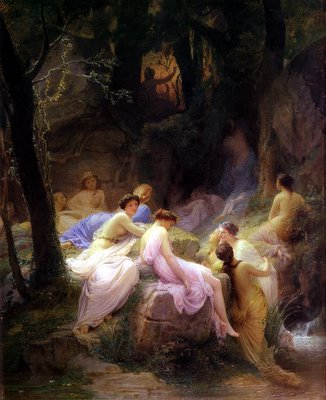
This picture is Nymphs Listening to the Song of Orpheus (1853), which is in a private collection. In Greek mythology, Orpheus was said to be the greatest musician and poet. I like this painting because of its smooth, hazy, dreamy atmosphere, similar to the works of Boucher.

UPDATE: Bad link fixed.

Closing Dying Churches

Rev. Ed has a thoughtful post about the dynamics of small churches. Like the UMC, his denomination has an episcopal structure, so his examples are largely applicable to the experiences of many readers of Locusts & Honey:

When I first arrived here over eight years ago, much of the focus of the church was on survival. A few disputes had caused some to leave and my predecessor had just left -- another in a long line of pastors. Money was tight, attendance was down and concern drifted away from worshiping God and doing any real ministry. It wasn't easy to change the mindset around the church, but God used people and circumstances to do the improbable.

With this experience in mind, I want every local church to have the opportunity to remember the reason services are held. But at the same time if no one is willing to change out of survivalist mode, there is no reason for the church doors to remain open. The focus of the church is never to be the church itself, but upon Jesus Christ. But if we become so wed to the idea that the survival of one local church is of paramount importance to the Church Universal, we're really not worshiping God anyway.

Friday, February 10, 2006

Weekend Dog Blogging

My dog and I wrestled for control of a prize rope toy.

Airport Screening

From the San Francisco Gate:

Airport baggage screeners found a human head with teeth, hair and skin in the luggage of a woman who said she intended to ward off evil spirits with it, authorities said Friday.

Myrlene Severe, 30, a Haitian-born permanent U.S. resident, was charged Friday with smuggling a human head into the U.S. without proper documentation.

Hat tip to Stephen Green, who adds:

What's wrong with this story is, it seems to imply that there's such a thing as proper documentation for this kind of thing.

Star Wars Valentines

This Tuesday, let the Force be in your love life.

Hat tip: Ace

Please Excuse This Seminarian's Rant

I hope that you don't mind, but I need to vent a little.

I had two seminary choices: Asbury and Garrett-Evangelical. Garrett offered me a 75% scholarship, but it was far away, making job-switching for my wife tricky and completing the candidacy process very challenging. And its theology was scarily unitarian/pantheist/New Age. Asbury was a lot more expensive, but close by and conveniently located in the very state where I am seeking ordination. Its theology is solidly orthodox.

But (there's always a "but") Asbury is badly run. The left hand doesn't know what the left hand is doing, let alone the right hand. In my first week, all of the room assignments for classes were wrong. Each and every one. They could have put up a sign with the correct room assignments, but I guess that would involve doing work or something. The computers wouldn't let me log in. Professors assigned items that dozens of students were locked out of. Books were unavailable.

There's no accountability for professors. Papers are returned when and if they want to. They stroll in late for class and spend 45 minutes trying to get their computers to work. The amount of downtime (time that I paid for) spent on professors' computers is enormous. And let's not even get started on the Distance Learning Technology!

One thing that I have at Asbury that I don't know that I would have at Garrett is that I'm certain that my professors are actual Christians. That's nice, and so far, appears to be the only advantage to my attendance here.

I haven't studied at any other seminary, but I did go to college and grad school, and neither institution suffered such repeated failures.

I will, of course, finish my M.Div here. My geographic situation is locked in. Still, if Garrett-Evangelical was across the street from Asbury, I'd go there.

In spite of Asbury's conservative theology, I can't recommend it to any United Methodist student outside of Florida.

Thank you for letting me vent. Rant concluded.

UPDATE: Since not all of this debate is available to the general Methoblogging public, I would like to note something in the interest of full disclosure. There is widespread disagreement with my assessment of Asbury. So if you're a candidate for ministry and you're considering Asbury, bear in mind that my views are not met with universal agreement.

ANOTHER UPDATE: Further thoughts here.

Happy Blogiversary to Me

This blog is one year old today.

I had been thinking about starting a blog for a while, but I figured that I didn't have the time and that it was too late to get into the market.

Then, at about 11 PM one night, as my wife and I lay in bed, I said, "I'm going to start a blog." So I got up, turned on the computer, and pulled up Blogger.

It took about a dozen tries before I could get a name that wasn't taken yet. I wanted a name with a Biblical reference. My first choice would have been "Jumping Jehoshaphat," but it was already taken. My sleepy wife called out "How about Locusts and Honey?"

That worked. So here we are.

Methodist Blogger Profile: Betty Newman


Betty Newman of Prayerlogue

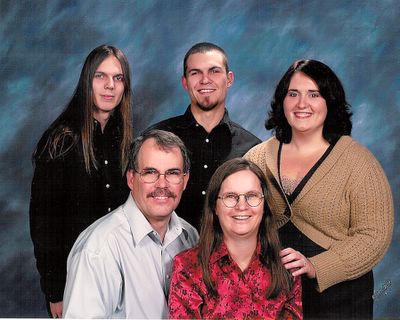
Since my “work picture” is on my blog and is included when I make a comment most of the time, I’ve chosen to include our family picture that was recently made for our Church directory. As you can see, we “clean up” pretty well!

I’ve been a member of the UMC for about 42 years (since before it was “United”) - joining when I was 10 years old (you can do the math!) I’ve been married to Joe for nearly 31 years now. We’re pretty simple folks. We’ve known each other all our lives, even belonging to churches on the same Circuit as we were growing up. We’ve both been lay speakers since the late 70’s, and have held nearly every office in our local church (still belonging to one of the churches on that same rural Circuit.)

We live on a pretty secluded farm with horses and assorted wildlife. Joe is a systems analyst (who would rather be on a tractor) and I own an antiques restoration and custom picture framing business located on our farm.

We have 2 sons and a daughter (by law). Our older son, Joe, Jr. married Suzanne last summer. He is a welder by profession (and a cowboy at heart) and she is a teacher. Our younger son John is a musician (can you tell?) He is a student at the University of Tennessee with a Jazz and studio music major (check out his web site at www.aeolianjazz.com) He is also in, and writes music for, a Christian Rock Band.

Why do you blog?
Actually I have 2 blogs. The original “Prayerlogue” (http://www.prayerlogue.blogspot.com/) began as a way to have a “searchable” form of my weekly e-mail devotional. The weekly mailing began nearly a year ago by e-mailing a group of mostly teachers and women friends with prayers and devotionals that I had written. It grew in popularity until I had a pretty big mailing list and thought that maybe others would enjoy reading them as well.
The second - “Between a (Theological) Rock and a Hard Place” (http://www.methodistmusings.blogspot.com/) came about because of some of the struggles and thoughts I have about theology - and - I didn’t want to “muddy up” Prayerlogue with sometimes controversial and personal thoughts.

What has been your best blogging experience?
As many others have stated, getting feed back, both as comments and as private e-mails, that something you’ve said has touched another’s life. That is so awesome and humbling as well.

What would be your main advice to a novice blogger?
I guess first of all I’d ask “why do you want to do it?” Examine your reasons “why” and that will give you your “motivation to”. Also, as for practical advice - don’t make them too long. Most folks don’t have a lot of time to read a long treatise. If your piece is long - break it up and give your readers a reason to come back!

If you only had time to read three blogs a day, what would they be?
I am not much of a technical person, so when I found “hotkeys” I was ecstatic! I have 10 blogs saved on “hotkeys” that I try to check every day or so, but the ones I always check are Wesleyblog, Rekindling Methodism (http://rekindlingmethodism.blogspot.com/) and of course Locusts and Honey! Sometimes I check this one several times a day (John just gets on a roll sometimes, ya know!)

Who are your spiritual heroes?
I group my heroes in categories. Biblical heroes include Jeremiah - I both admire him and fear a call like his. John, the apostle for the change in his life - how one could change from a “son of thunder” to one with such love is amazing to me. And I am just learning more about Paul - the man.
Church heroes - John Wesley of course, but Martin Luther amazes me, and I love the writing of AW Tozer. More contemporary - I love to listen to the teaching of R.C. Sproul, and then more personal - my Mother. And the older I get, the more of a hero she becomes to me.

What are you reading at the moment?
I read a lot (you should see the stack beside my bed!) - so, “Blue Like Jazz”, EM Bounds’ “The Possibilities of Prayer”, Barclay’s “The Acts of the Apostles”, as well as trade magazines “The Crafts Report”, “Picture Framing Magazine”, “Décor”, “INC”, “Entrepreneur” and “Fast Company.” (On-going: my SS lessons, “My Utmost for His Highest”, “The Practice of the Presence of God”, “The Pursuit of God”, and of course the Word of God!)

What is your favorite hymn and why?
Oh man, there are so many! Foremost - “How Firm a Foundation” I love the words,
“What more can He say, than to you He has said.
To you, who for refuge to Jesus has fled.
‘Fear not, I am with you. Oh, be not dismayed,
for I will be with you and will still give you aid.
I’ll strengthen and help you and cause you to stand,
upheld by My righteous, Omnipotent hand!’ ”
Wow! What power. I keep a copy of this in my pocketbook at all times. It has strengthened me more than once in difficult times!

Can you name a major moral, political, or intellectual issue on which you've ever changed your mind?
I am a child of the 60’s - ‘nuff said! (I’m an old hippie Republican and a liberal conservative Christian!)

What philosophical thesis do you think is most important to combat?
Man, I have a hard enough time just combating my own daily struggles, but if I had to name one it would be that “man is basically good.” No, he is not!

If you could effect one major change in the governing of your country, what would it be?
Every single thing I can think of - the welfare system, social security, restrictions on small business, the balance between meeting needs and protecting the environment, etc - all comes back to individual responsibility. We are a country that was created for “self”-government. But there can’t be “self-government” until there is “self-control” and there can’t be self control until there is “God-control” in the self’s life.

If you could effect one major policy change in the United Methodist Church, what would it be?
When Joe and I became certified Lay Speakers, we began to immerse ourselves in the Church - District and Conference-wise. We immediately discovered (at least here) the “Good Ole Boy Club” (which included both men and women, by the way.) If you were “new” or “young” it was difficult to break into it. (We’re not much on politics.) So we just sorta kept to ourselves. If I could change one thing, it would be the way “politics” runs our church just like it runs business, the marketplace, and the world. Who you know seems to be more important that what you can do.

What would be your most important piece of advice about life?
Learn to communicate. More problems arise from misunderstanding than any other reason. Great communication is the key to a great marriage, by the way!

What, if anything, do you worry about?
I worry about becoming a “Scribe.” (I learned about this from Tozer.) There is nothing I love more than Bible Study and I have a fear of knowing all “about” the Word of God, and not “knowing” the God of the Word!

If you were to relive your life to this point, is there anything that you'd do differently?
I didn’t go to college - perhaps I’d do that. I didn’t know that there was such a thing as “art school” perhaps I’d have gone there. But if I had, I wouldn’t have worked where I did, nor lived here. And would I have married Joe? I like to live by “But who knows but that you have come [to the kingdom] for such a time as this…”

Where would you most like to live (other than where you do now)?
We live on a 65 acre farm that has been in my husband’s family for over 200 years - the only place I’d like to live differently is on another piece of the original farm (a piece which we no longer own) that is right on the French Broad River.

What do you like doing in your spare time?
Hmmm, what’s that? I am so blessed! I live where I love. I own a business that I love, and work everyday doing what I love. I am surrounded by books and resources that support the study that I love, and I have a husband that I love to spend time with, and allows me to be “me!” We work all the time, but once in a while, we sneak off to ride our horses. So, I guess that is “spare” time.

What is your most treasured possession?
Since I consider my wedding band a part of my soul, my treasured “earthly possession” is my laptop. Where I used to have “40 jillion” books and commentaries spread out on my bed while studying, I now have my laptop (and e-sword!) and only a couple dozen books… Plus, my writing has skyrocketed since Joe got it for me.

What talent would you most like to have?
I know everyone says this, but I’d really like to be able to sing and make music. I truly cannot. I am tone deaf (just ask my husband who has a wonderful tenor voice and our younger son who writes music!)

If you could have any three guests, past or present, to dinner, who would they be?
Well, first of all, someone else would have to do the cooking. I’m more like Mary than Martha! But for guests - my Mother, Gran (my aunt) and Mamaw. Man, how I miss these women in my life…