Kurt Boemler is tired of infighting among Methobloggers:
When I joined the Methodist Blog Roll I was thrilled to see that someone was doing something to extend the connection through and into cyberspace. As I read through the articles I was surprised and a bit assured to find that not all who claimed United Methodism were on the same page socially, politically, or theologically. However, as I dug deeper into prevailing themes and especially the comment threads, I became increasingly distressed. I saw the same scenarios I had lived out in my encounters with several subscribers of ideologies different than my own. Methodists were fighting among themselves. I sound naïve as I write this, but I didn’t think that would happen. That’s something that Methodists tried not to do with anyone. Our willingness to come into communion with others, leaving our petty differences behind to sit as brothers and sisters around Christ’s table is what I love most about being United Methodist. I get the distinct impression that there are some members of the Wesley Blog community who would not only detest the idea of sharing in Christ’s body and blood with me, but may actually denounce the legitimacy of my relationship with Christ as my savior based on my voting record, opinions on the death penalty and abortion, or even on my understanding of the Sacraments.
Friday, March 31, 2006


Caption Contest

WINNER: Jeff the Baptist: Springfield Elementary debuts new traffic signs designed to increase their standardized test scores.
Thursday, March 30, 2006
Wednesday, March 29, 2006
Immigration and Christian Response
Andy Bryan has written two posts (hat tip) about how American Christians in general and Methodists (in reflection of our Social Principles) in particular should respond to illegal immigration and calls for reform.
As he says, the Bible seems fairly clear that the policy guidelines outlines by God for the Israelite state included generosity toward immigrants, especially since such foreigners could not own land and as a consequence, would likely be impoverished.
I am unsure if these features of Mosaic Law were intended only for the Israelites at the time or can and should be followed by all citizens of all future states that ascribe to worship Yahweh. One must be careful applying laws for the Israelites to modern times, lest you find yourself stoning homosexuals to death on an otherwise pleasant afternoon.
The New Testament has nothing specific to say about immigration policy, or political policies at all, since the Gospel is clearly presented as a transnational message.
That said, I think that a Christian response to immigration policy is part of the larger issue of the relationship between and within the individual Christian and the role of the state. For example, can a Christian use violence in the defense of his state against invasion? Can he kill for his country and remain a faithful Christian. I have no resolution to this issue, but my default position (until such time as I can find a solution) is 'yes'.
In the same respect, can a nation defend itself from an immigration invasion? Can Christians advocate laws to provide for the integrity of its borders? Again, there is muddling on this issue, so until resolution, I say 'yes'.
So I don't know about how to apply Christian ethics to national immigration policy, but on the political level, I think that the problem is pretty clear: we are facing the dissolution of the United States culturally and politically.
I really enjoy being in the dominant, majority culture. While my ancestors may have worn kilts and lederhosen and spoken Gaelic and German, upon arrival they soon dropped these identities and joined the dominant national culture of the United States, which is English-speaking and Protestant (literally or effectively) along with various other attributes that make American culture American. The experience of my ancestors is a common one, as immigrants rapidly assimilated into the dominant culture, whose descendants today have no real ties to their ancient homelands.
That dominant culture is being washed away in favor of a different one from Latin America. The new wave of immigrants have little to no desire to assimilate to the dominant culture. In fact, they are becoming the dominant culture. That bothers me because I like my culture and I don't want to see it go away. Many Americans agreed in the past, which is why immigration policies a century ago advocated assimilation, and largely succeeded. We made a deal with immigrants: you can come to our country, but you have to join our culture. As an independent polity, I think that we have inherent property rights to our own territory and can therefore require such bargains. No one has a right to come to our country anymore than anyone has a right to walk into your house and start living there.
But beyond our lovely culture being absorbed into a different one, we Americans also face a real political danger from massive immigration from Latin America. Healthy states are ones that are largely uniform. Although multiethnic societies can thrive, multicultural societies fail, almost without exception, such as the Soviet Union and Yugoslavia (which don't exist anymore. Guess why). Multiple divergent cultures within one polity ultimately lead to Balkinization, a process exacerbated if those divergent cultures actually have different languages. If people can't even talk to each other easily, they have trouble forming a cohesive society.
In America, this problem is seen in a large Mexican population which identifies with Mexico, has no plans to join the dominant culture, has less motivation to learn English, and sees the land that it populates as stolen from their homeland. In spite of efforts by critics to tie these fears into historical nativism, Americans have real reasons to worry, as Jonah Goldberg writes:
Obviously, there's some truth to this. Many of the complaints do sound similar. But that doesn't mean the arguments have the same weight. The arguments against interracial marriage sound very similar to the arguments against gay marriage, but that doesn't mean a black woman marrying a white man is the same thing as a man marrying another man.
Similarly, people may have complained about the ability of legal immigrants from Italy to assimilate, or fretted that these Italian immigrants were taking jobs from Americans, but that doesn't mean illegal Mexican immigrants in the early 21st century are indistinguishable from legal Italian ones a century ago. The fact is that America has never shared an enormous border with Italy. Large chunks of U.S. soil never belonged to Italy or Ireland. You can be as romantic as you like about the glory and honor of America's noble tradition of accepting the "wretched refuse" of the world: It won't change this very basic fact.
 We are looking toward a future in which the majority of the American Southwest speaks only Spanish, has no ties to the traditional culture of the United States, and no plans to acquire them. They will not identify with the United States, and while for economic reasons they are unlikely to secede and join Mexico, the fact that they would have the capacity to do so should worry us. Last weekend, 500,000 illegal immigrants demonstrated in Los Angeles, along with other large rallies across the country. Many waved Mexican flags and said that they considered the land on which they were standing to be stolen from their homeland. That's called a 'clue': they don't consider themselves to be a part of America.
So culturally and politically, let's do the smart thing: drive the illegal aliens out, keep them out, and wait a couple generations for the Mexican population here legally to be absorbed into our culture before resuming large-scale immigration from Mexico.
UPDATE: Joe Cathey has a few practical suggestions for reforming our immigration policy. Richard Heyduck thinks that we should take a more organic view of immigration.
As he says, the Bible seems fairly clear that the policy guidelines outlines by God for the Israelite state included generosity toward immigrants, especially since such foreigners could not own land and as a consequence, would likely be impoverished.
I am unsure if these features of Mosaic Law were intended only for the Israelites at the time or can and should be followed by all citizens of all future states that ascribe to worship Yahweh. One must be careful applying laws for the Israelites to modern times, lest you find yourself stoning homosexuals to death on an otherwise pleasant afternoon.
The New Testament has nothing specific to say about immigration policy, or political policies at all, since the Gospel is clearly presented as a transnational message.
That said, I think that a Christian response to immigration policy is part of the larger issue of the relationship between and within the individual Christian and the role of the state. For example, can a Christian use violence in the defense of his state against invasion? Can he kill for his country and remain a faithful Christian. I have no resolution to this issue, but my default position (until such time as I can find a solution) is 'yes'.
In the same respect, can a nation defend itself from an immigration invasion? Can Christians advocate laws to provide for the integrity of its borders? Again, there is muddling on this issue, so until resolution, I say 'yes'.
So I don't know about how to apply Christian ethics to national immigration policy, but on the political level, I think that the problem is pretty clear: we are facing the dissolution of the United States culturally and politically.
I really enjoy being in the dominant, majority culture. While my ancestors may have worn kilts and lederhosen and spoken Gaelic and German, upon arrival they soon dropped these identities and joined the dominant national culture of the United States, which is English-speaking and Protestant (literally or effectively) along with various other attributes that make American culture American. The experience of my ancestors is a common one, as immigrants rapidly assimilated into the dominant culture, whose descendants today have no real ties to their ancient homelands.
That dominant culture is being washed away in favor of a different one from Latin America. The new wave of immigrants have little to no desire to assimilate to the dominant culture. In fact, they are becoming the dominant culture. That bothers me because I like my culture and I don't want to see it go away. Many Americans agreed in the past, which is why immigration policies a century ago advocated assimilation, and largely succeeded. We made a deal with immigrants: you can come to our country, but you have to join our culture. As an independent polity, I think that we have inherent property rights to our own territory and can therefore require such bargains. No one has a right to come to our country anymore than anyone has a right to walk into your house and start living there.
But beyond our lovely culture being absorbed into a different one, we Americans also face a real political danger from massive immigration from Latin America. Healthy states are ones that are largely uniform. Although multiethnic societies can thrive, multicultural societies fail, almost without exception, such as the Soviet Union and Yugoslavia (which don't exist anymore. Guess why). Multiple divergent cultures within one polity ultimately lead to Balkinization, a process exacerbated if those divergent cultures actually have different languages. If people can't even talk to each other easily, they have trouble forming a cohesive society.
In America, this problem is seen in a large Mexican population which identifies with Mexico, has no plans to join the dominant culture, has less motivation to learn English, and sees the land that it populates as stolen from their homeland. In spite of efforts by critics to tie these fears into historical nativism, Americans have real reasons to worry, as Jonah Goldberg writes:
Obviously, there's some truth to this. Many of the complaints do sound similar. But that doesn't mean the arguments have the same weight. The arguments against interracial marriage sound very similar to the arguments against gay marriage, but that doesn't mean a black woman marrying a white man is the same thing as a man marrying another man.
Similarly, people may have complained about the ability of legal immigrants from Italy to assimilate, or fretted that these Italian immigrants were taking jobs from Americans, but that doesn't mean illegal Mexican immigrants in the early 21st century are indistinguishable from legal Italian ones a century ago. The fact is that America has never shared an enormous border with Italy. Large chunks of U.S. soil never belonged to Italy or Ireland. You can be as romantic as you like about the glory and honor of America's noble tradition of accepting the "wretched refuse" of the world: It won't change this very basic fact.
 We are looking toward a future in which the majority of the American Southwest speaks only Spanish, has no ties to the traditional culture of the United States, and no plans to acquire them. They will not identify with the United States, and while for economic reasons they are unlikely to secede and join Mexico, the fact that they would have the capacity to do so should worry us. Last weekend, 500,000 illegal immigrants demonstrated in Los Angeles, along with other large rallies across the country. Many waved Mexican flags and said that they considered the land on which they were standing to be stolen from their homeland. That's called a 'clue': they don't consider themselves to be a part of America.
So culturally and politically, let's do the smart thing: drive the illegal aliens out, keep them out, and wait a couple generations for the Mexican population here legally to be absorbed into our culture before resuming large-scale immigration from Mexico.
UPDATE: Joe Cathey has a few practical suggestions for reforming our immigration policy. Richard Heyduck thinks that we should take a more organic view of immigration.
Tuesday, March 28, 2006
The Passíusálmar on Peace and Vengeance
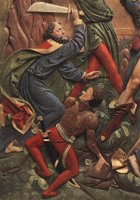 In his seventh song in the Passíusálmar, Hallgrímur Pétursson wrote about the arrest of Christ in the Garden of Gethsemane. Peter, completely misunderstanding the mission of Jesus, drew his sword and struck off the ear of the servant Malchus. Jesus rebuked him, healed Malchus, and humbly took up his cross, saying "Put the sword into the sheath; the cup which the Father has given Me, shall I not drink it?"
In the example of Jesus, we see how we are to live as Christians in the midst of our foes, drinking our apportioned cup. Let us pray this hymn:
And take it well to heart;
Do not resist aggression,
Do not defend thy part.
Agents of higher powers
Bear not the sword in vain,
But vengeance is not ours,
Thus did the Lord ordain.
[….]
When thine own cause defending,
The sword thou shalt not draw,
Alone on Him depending –
This is the Master’s law.
Suffer, like Him, in meekness,
Commit thy cause to God,
And in Thy presence kneeling:
Oh, Master, touch my ear!
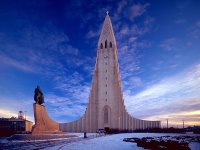 Lord, forgive me for my wrath. Create in me a clean and peaceful spirit so that we may be instruments of healing, not hacking. Remind me to love my enemy and bless those who curse me, for they are your beloved children. As you healed the ear of Malchus, Master, heal our savage hearts. Amen.
Art Blogging: Eugenio Zampighi
 Eugenio Zampighi (1859-1944) was an Italian Realist painter noted for his romantic portrayals of Italian peasant life. Think of him as the Norman Rockwell of 19th Century Italy.
Zampighi was born in Modena, where he showed a prodigious talent for the fine arts. He went to a local art school at the age of 13 and then studied at Rome. After completing his education, he settled in Florence and prospered through private commissions.
This painting is called A Captive Audience. Like many other Zampighi canvases, it shows grandparents and young children at play. It demonstrates a unique quality of this artist. Most genre painters show the beauty of peasant life by exaggerating its aesthetics unrealistically. For example, Bouguereau's peasant girls, though shoeless, had clean feet and though poor, were well-fed. Other genre painters likewise imported lovely, healthy studio models into rural backdrops and costumes. Why? Well, impoverished peasants without access to good food, health care, and shelter tend to not look very pretty.
But Zampighi did not shy away from the effects of age and poverty. In fact, most of his subjects are elderly. Yet we all remember our grandmothers as beautiful, and these wrinkled old crones can not help but charm us. Norman Rockwell, in a similar fashion, took ordinary people and made them beautiful works of art. Zampighi takes a step further and celebrates the beauty of outright ugly people.
How does he accomplish this feat? Look at the faces in his paintings. The people portrayed are filled with devoted love to each other, in contrast to ennui of other peasant genre scenes. These are the expressions of love that many of us remember from our own grandparents.
 The Center of Attention.
 The Hunter's Tale.
Monday, March 27, 2006
Cracker Jack, RIP
Let us keep Rev. Ed and his family in our prayers as they mourn the passing of old friend.
Methodist Blogs Weekly Roundup # 58
Here's the week in review in the Methodist blogosphere:
Andy Bryan wrote about how Christians should respond to immigration reform in America and how church should be about being, rather than doing.
Andy Stoddard lectionary blogged for March 20 & 22.
At Appian Way, Brian Slezak wrote about the future of the church in a postmodern world.
Bad Methodist wrote about how children are effected by gay adoption.
At Bandits No More, Richard Heyduck wrote about ideology as mental illness and freedom of/from religion in the Abdul Rahman case.
Betty Newman wrote about her intention to begin 40 days of prayer after Lent, the difficulty of ending prayer, the reality of prayer, and the restless evil of the tongue.
Brian Russell blogged about his core values and how the miracle stories of the Gospel of Matthew instruct us to break down social barriers.
At Connexions, Richard Hall blogged about the response of the CPT hostages to their rescue.
ConXian wrote about Methodism and the Borg mentality.
CABRN blogged about genome decay and its relationship to creationism.
Dave Warnock wondered if he is violated Methodist discipline by reading non-Methodist blogs. He also wrote that churches should abandon MS Windows and suggested ideal urban bikes.
Dave Camphouse wrote about his mission trip to Louisiana.
Michael Daniel is considering running for the state legislature. He also wrote about tying standardized testing scores to teacher bonuses, selling out your dreams for cash, and whether Christians have a moral obligation to turn in illegal immigrants.
Daniel Hixon blogged about the Abdul Rahman case.
Growing Up responded to Hotel Rwanda and that one of the purposes of Christian community is to find the good in each other.
Guy Williams wrote about the increasing number of people entering seminary that do not plan to be pastors.
Chris Roberts blogged about how churches can be hospitable to homosexuals, how Conferences deal with a deficit of appointments, and UMC churches that are not part of the appointment system.
Olive Morgan wrote about overweight pastors and the role of food in church community. She also wrote about the spiritual impact of aging.
Mike Holly blogged about the increasing average age of Elders and why the Board of Ordained Ministry asks candidates to tell their calling story so many times.
Jason Woolever wrote about how he'll let God decide where he should be appointed and the spiritual discipline of waiting.
Jay Voorhees blogged about having open conversations about homosexuality in the church and the Episcopalian election of a bishop for Tennessee.
Jeremy Putnam wrote about the nature of prayer.
John Wilks blogged about marriage in Black America, the life of sacrifice that Jesus calls believers to, and how we are like Herod.
Jonathon Norman wrote about ordained ministry in the UMC.
Josh Tinley wrote about the SBC and glossolalia, how the increasing age of elders effects youth and young adult ministry, and the US Senate race in Tennessee.
Just As I Am blogged about lessons from the Screwtape Letters.
Mark Winter wrote that our churches are not growing because we do not repent of our sins (or preach for repentance) and the spark in prayer that initiates revival.
Steven Webster blogged about the dangers of Biblical literalism.
After many years of preaching, John Battern is thinking about changing his style.
Theresa Coleman wrote about the intentionality of authentic prayer.
Sandpiper blogged about the problems with Promise Keepers and different worship styles.
Kurt Boemler wrote about the fighting in the Methoblogosphere.
Peter Raser blogged about the voluntary nature of love.
Thoughts From a Clay Pot wondered if voters should have to pass a basic civics test.
Tony Mitchell preached on 'sound-bite' Christianity.
Nigel Coke-Woods wrote about how the media is handing the CPT rescue story.
Henry Neufield blogged about testing the spirits of revivalism, confronting apparently condoned immorality in the Bible through logic, introductions to tradition criticism, source criticism, redaction criticism of Scripture, how the Bible addresses slavery, the dynamics of Scriptural inspiration, and the Abdul Rahman case.
TN Rambler wrote about recovery efforts on the Gulf Coast.
Turbulent Cleric blogged about the moral implications of the Abdul Rahman case.
Jim McKay wrote about confusing communion choreography and WVU basketball.
Willie Deuel asked readers how they publicly express their Christian faith.
Gerry Charlotte Phelps wrote about carp fishing and the native birds of downtown Austin.
Greg Hazelrig wrote about modern-day idolatry.
Greg Crofford blogged about getting fat, how actors can hurt their reputation by performing in controversial films, the dangers of gender selection technology, and the future of Islam in the light of the Abdul Rahman case.
Additions? Corrections? Do you know of a blog that should be included in the MBWR? Would you like to receive the MBWR via e-mail? Leave a note in the comments or e-mail locustsandhoney2005 at yahoo dot com!
UPDATE: Gerry Phelps and Greg Hazelrig added.
UPDATE: Greg Crofford added.
Andy Bryan wrote about how Christians should respond to immigration reform in America and how church should be about being, rather than doing.
Andy Stoddard lectionary blogged for March 20 & 22.
At Appian Way, Brian Slezak wrote about the future of the church in a postmodern world.
Bad Methodist wrote about how children are effected by gay adoption.
At Bandits No More, Richard Heyduck wrote about ideology as mental illness and freedom of/from religion in the Abdul Rahman case.
Betty Newman wrote about her intention to begin 40 days of prayer after Lent, the difficulty of ending prayer, the reality of prayer, and the restless evil of the tongue.
Brian Russell blogged about his core values and how the miracle stories of the Gospel of Matthew instruct us to break down social barriers.
At Connexions, Richard Hall blogged about the response of the CPT hostages to their rescue.
ConXian wrote about Methodism and the Borg mentality.
CABRN blogged about genome decay and its relationship to creationism.
Dave Warnock wondered if he is violated Methodist discipline by reading non-Methodist blogs. He also wrote that churches should abandon MS Windows and suggested ideal urban bikes.
Dave Camphouse wrote about his mission trip to Louisiana.
Michael Daniel is considering running for the state legislature. He also wrote about tying standardized testing scores to teacher bonuses, selling out your dreams for cash, and whether Christians have a moral obligation to turn in illegal immigrants.
Daniel Hixon blogged about the Abdul Rahman case.
Growing Up responded to Hotel Rwanda and that one of the purposes of Christian community is to find the good in each other.
Guy Williams wrote about the increasing number of people entering seminary that do not plan to be pastors.
Chris Roberts blogged about how churches can be hospitable to homosexuals, how Conferences deal with a deficit of appointments, and UMC churches that are not part of the appointment system.
Olive Morgan wrote about overweight pastors and the role of food in church community. She also wrote about the spiritual impact of aging.
Mike Holly blogged about the increasing average age of Elders and why the Board of Ordained Ministry asks candidates to tell their calling story so many times.
Jason Woolever wrote about how he'll let God decide where he should be appointed and the spiritual discipline of waiting.
Jay Voorhees blogged about having open conversations about homosexuality in the church and the Episcopalian election of a bishop for Tennessee.
Jeremy Putnam wrote about the nature of prayer.
John Wilks blogged about marriage in Black America, the life of sacrifice that Jesus calls believers to, and how we are like Herod.
Jonathon Norman wrote about ordained ministry in the UMC.
Josh Tinley wrote about the SBC and glossolalia, how the increasing age of elders effects youth and young adult ministry, and the US Senate race in Tennessee.
Just As I Am blogged about lessons from the Screwtape Letters.
Mark Winter wrote that our churches are not growing because we do not repent of our sins (or preach for repentance) and the spark in prayer that initiates revival.
Steven Webster blogged about the dangers of Biblical literalism.
After many years of preaching, John Battern is thinking about changing his style.
Theresa Coleman wrote about the intentionality of authentic prayer.
Sandpiper blogged about the problems with Promise Keepers and different worship styles.
Kurt Boemler wrote about the fighting in the Methoblogosphere.
Peter Raser blogged about the voluntary nature of love.
Thoughts From a Clay Pot wondered if voters should have to pass a basic civics test.
Tony Mitchell preached on 'sound-bite' Christianity.
Nigel Coke-Woods wrote about how the media is handing the CPT rescue story.
Henry Neufield blogged about testing the spirits of revivalism, confronting apparently condoned immorality in the Bible through logic, introductions to tradition criticism, source criticism, redaction criticism of Scripture, how the Bible addresses slavery, the dynamics of Scriptural inspiration, and the Abdul Rahman case.
TN Rambler wrote about recovery efforts on the Gulf Coast.
Turbulent Cleric blogged about the moral implications of the Abdul Rahman case.
Jim McKay wrote about confusing communion choreography and WVU basketball.
Willie Deuel asked readers how they publicly express their Christian faith.
Gerry Charlotte Phelps wrote about carp fishing and the native birds of downtown Austin.
Greg Hazelrig wrote about modern-day idolatry.
Greg Crofford blogged about getting fat, how actors can hurt their reputation by performing in controversial films, the dangers of gender selection technology, and the future of Islam in the light of the Abdul Rahman case.
Additions? Corrections? Do you know of a blog that should be included in the MBWR? Would you like to receive the MBWR via e-mail? Leave a note in the comments or e-mail locustsandhoney2005 at yahoo dot com!
UPDATE: Gerry Phelps and Greg Hazelrig added.
UPDATE: Greg Crofford added.
"Marriage is for White People"
Via Ian comes an article about a horrific emerging trend. I make no assertions about its validity. If the allegations are true, God help us all from the social consequences.
Sunday, March 26, 2006

The Importance of Zombies
Ace of Spades writes about the increasing importance of zombies in American life and culture. That's good, because people are more and more likely to see the advantages of zombieality. While there are still paranoid fears about the undead among us, or spurious accusations of political misconduct, most Undead-Americans simply wish to live and feed in peace among us -- and even join our churches!
Some people will never abandon their violent prejudices, but we don't have to be held behind by their bigotry. Like the Smurfs, we can live in peace with our zombie brethren.
UPDATE: Mike Hensley tells it like it is.
Some people will never abandon their violent prejudices, but we don't have to be held behind by their bigotry. Like the Smurfs, we can live in peace with our zombie brethren.
UPDATE: Mike Hensley tells it like it is.
Question of the Day
What are you lookin' at? You trying to start something? 'Cause your keyboard is writing checks your body can't cash.
Friday, March 24, 2006
Praying Through the Passíusálmar
 My Lenten devotional this year is the Passíusálmar, an Icelandic Lutheran collection of hymns by Hallgrímur Pétursson (1614-1674). They are considered to be among the finest works of Lutheran hymnody, as well as the pinnacle of 17th Century Icelandic literature. Today they are central to Icelandic Lenten worship.
I am not an expert on devotional worship, but have applied what I have learned of lectio divina to the quiet, meditational reading of these hymns. Here is a selection from the introductory hymn “Christ goes to the Garden [of Gethsemane]”. Petursson writes:
Since Jesus gave His latest breath
To save me from eternal death,
Should not the powers He thus renewed
Show forth to Him my gratitude?
At last repentance rends my heart,
How poorly have I played my part!
What Jesus suffered in my place
I oft forget, -- to my disgrace!
What a vivid expression of the depravity of humanity before the sacrifice of Christ! In the context of Jesus' mournful prayer, Petursson puts into our lips the guilt that we all share as sinners:
My conscience smites me with the thought
That hereby was my freedom bought.
‘Twas sin of mine that tortured Thee,
All that Thy suffering was for me!
Oh, how I grieve that deeds of mine
Should fill with gall that cup of Thine!
The purpose of such careful devotional prayer is to remind ourselves of essential Christian truths. Among them is that each of us is responsible for the nails in Christ’s hands.
My hope is that through this devotional practice, I shall more fully be convicted and sanctified in the sacred time of Lent.
Man Just Using Virgin Mary to Get to Jesus
 TUPELO, MS—The Blessed Mother Mary said Monday that devout Catholic Anthony Montero is simply praying to her as a way to get to her Son, Jesus Christ. "People exploit me for my connections, worshipping me as a way to get closer to Jesus," said the Holy Virgin, bathed in a golden light and attended by seraphim. "How would Anthony feel if I called upon him in the guise of friendship, but simply wanted his cousin to do some plumbing work for me? It's just rude." Our Lady added that, if Montero wants to reach Jesus so badly, maybe he should "grow a pair and pray to Him directly."
Story Link

Thursday, March 23, 2006
Interfaith Hospitality Network
Interfaith Hospitality Network (also known as Family Promise) is an organization created in the 80s in response to the prevalence of homeless families. In most homeless shelters, families are divided along gender lines. For example, if a single mother has a 14-year old son, the mother will go to the women's shelter and the boy will go to the men's shelter.
As an alternative, IHN houses homeless families in churches for a week at a time. Here's how it works: IHN provides a trailer full of folding twin-size beds to a church, which sets them up in classrooms for individual families. The church provides dinner, activities in the evening, an overnight supervisor, and breakfast in the morning. An IHN van picks up the families in the morning and takes the kids to school or day care, and the parents to a 'Day Center', where social workers assist them in finding employment and housing. In the evening, the van takes the families back to the church. Each church does these tasks for one week at a time in rotation. Here at the Orlando branch, we are currently in a 2-month rotation cycle.
Our church is too small to find enough volunteers for this effort, but we have united with an adjoining Episcopalian church and a nearby Church of God (Anderson) congregation to pull together the necessary resources. I am the primary coordinator for this effort, which has been a great chance for me to grow and develop both spiritually and practically.
Back when I was at Ortega UMC, we contemplated participating in IHN. There was never enough support because the task of providing for these families in the system appeared too vast and complicated.
But what I've learned is that operating an IHN-participating congregation is very simple. You provide dinner in your fellowship hall kitchen and have someone there in the evenings to supervise (something akin to substitute teaching) and someone to sleep overnight. That's it.
IHN seems scarily complex for congregations to take on, but it isn't at all. So if your church is thinking about joining IHN, do it! IHN isn't nearly as difficult as it looks.
Just do it!
As an alternative, IHN houses homeless families in churches for a week at a time. Here's how it works: IHN provides a trailer full of folding twin-size beds to a church, which sets them up in classrooms for individual families. The church provides dinner, activities in the evening, an overnight supervisor, and breakfast in the morning. An IHN van picks up the families in the morning and takes the kids to school or day care, and the parents to a 'Day Center', where social workers assist them in finding employment and housing. In the evening, the van takes the families back to the church. Each church does these tasks for one week at a time in rotation. Here at the Orlando branch, we are currently in a 2-month rotation cycle.
Our church is too small to find enough volunteers for this effort, but we have united with an adjoining Episcopalian church and a nearby Church of God (Anderson) congregation to pull together the necessary resources. I am the primary coordinator for this effort, which has been a great chance for me to grow and develop both spiritually and practically.
Back when I was at Ortega UMC, we contemplated participating in IHN. There was never enough support because the task of providing for these families in the system appeared too vast and complicated.
But what I've learned is that operating an IHN-participating congregation is very simple. You provide dinner in your fellowship hall kitchen and have someone there in the evenings to supervise (something akin to substitute teaching) and someone to sleep overnight. That's it.
IHN seems scarily complex for congregations to take on, but it isn't at all. So if your church is thinking about joining IHN, do it! IHN isn't nearly as difficult as it looks.
Just do it!
Wednesday, March 22, 2006
Art Blogging: James Jacques Joseph Tissot
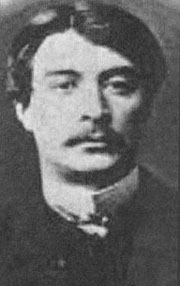 James Jacques Joseph Tissot (1836-1902) was a French Neoclassical painter. A native of Nantes, he studied at the Ecole des Beaux Arts and lived in Paris until the disastrous Franco-Prussian War and bloody Paris Commune. In 1871, he fled to London in response.
Although Tissot was initially an Impressionist, he learned that he could make more money by creating Academic-style paintings of fashionable Victorian society. His decision created a permanent rift between himself and his Impressionist colleagues.
Tissot later married a disgraced adulterous divorcee, causing him to withdraw from London's social scene. When his wife died in 1882, he moved back to Paris and devoted the rest of his life to painting religious scenes.
 Tissot's dominant motif was the cultured bourgeoise of London. A Bunch of Lilacs (1875) is representative. One of the qualities that I enjoy about Tissot is his remarkable capacity to vividly express emotion on canvas, as demonstrated in this work's palpable joy.
 The Ball on Shipboard (1874). Tissot was a master of detail. If you look carefully, you will see that each person in this scene has an agenda, from the bored woman at the left, the old man at the center calculating his chances with her, the gossips to his right, or the fatigued beauty ascending the stairs.
 Many Tissot paintings were subtle satires of high society, such as A Woman of Ambition (1883). This woman has attached herself to an elderly gentleman and purchased the frilliest dress she could find in the hope of rising in Britian's class structure. Those around her are more amused than impressed.
Tuesday, March 21, 2006
MBWR Seriously Messed Up
It looks like I lost a lot of listings in the recent MBWR, roughly in the middle of the Methoblogroll. I'll try to fix it within the next couple of days. Thanks for New Reality for calling this to my attention.
Monday, March 20, 2006
Methodist Blogs Weekly Roundup # 57
Here's the week in review in the Methodist blogosphere:
2Theo2 wrote about the attitudes that different generations have toward communion.
Andy Bryan blogged about sex education in public schools and how we can apply the 'cleansing of the Temple' by Jesus to today's life.
Andy Stoddard lectionary blogged for March 13, 14, 16, 17, and wrote about Benedictine principles for healtcare.
At Appian Way, Clif Guy asked why MySpace is so successful and Brian Slezak wrote about the communication gap between moderns and post-moderns.
Chris Morgan wrote about the day when the Air Force nuked South Carolina and the heroes of pharmaceutical research.
At Bandits No More, Richard Heyduck wrote about an Afghan man on trial for converting to Christianity, his proposal for a seminary curriculum, breaking the 200-attenders barrier in church growth, and what UMC universities should foster in students. Steve Heyduck wrote about the success of American sports abroad.
Betty Newman wrote about antique Christians.
Beth Quick blogged about prefering certain Scriptures over others and a remarkable story of a man ordained as an Episcopal priest while in prison.
Brian Russell preached on the radicalism of Jesus' teachings and wrote about the usefulness of blogging to pastors.
Bruce Alderman wrote that we need diversity in the Church to accomodate different images of God.
At Connexions, Joel Thomas wrote about how the UMC should revise its pastoral evaluation process (Best of the Methodist Blogosphere!). Richard Hall wrote about the political/operatic activities of the British National Party.
CBRN wrote that what evolutionists call dinosaurs were actually dragons and genetic statis in species.
Steve Heyduck wrote about people who live in their rear-view mirror.
Gavin Richardson blogged about a Methoblogger meetup in Nashville, explaining what it means to be Methodist, and liveblogging an Episcopalian election.
Gerry Charlotte Phelps wrote about praying for a less debauched America and how political attacks on Bush undermine American foreign policy.
Greg Hazelrig blogged about striving on to perfection.
Greg Lee wrote about putting your trust in God instead of yourself.
Growing Up blogged about what it means to be obedient.
Henry Neufield wrote an introduction to textual criticism, teaching intelligent design in public schools, the Christian doctrine of creation, redaction criticism of the Parable of the Sower, men's abortion rights, how politicians can capture the political center, an introduction to form criticism, reflecting on the good old days of church, Sino-Russian relations, and how textual criticism has influenced modern translations.
Jay Voorhees wrote that Christians need to own up to their bloody history.
John Battern wrote about the formulation of salaries in his Conference.
John Wilks blogged about the consequences of John 3:16, the accomplishments of St. Patrick, that we have no secrets from God, and how the modern UMC fails to promote holiness.
Jonathon Norman wrote about the life of St. Euphrasia, a Methoblogger meetup in Nashville, and whether or not the Church expresses to youth how important they are.
Just as I Am taught about being known completely by God.
Ken Carter wrote about giving up college basketball for Lent.
Larry Hollon blogged about why civilizations collapse, the trend of seminary growth, and the respect that journalism gets from the public.
Matt Kelley wrote about whether America's youngest generation can truly understand the horrors of war seen through their television screen.
Keith McIlwain wrote about The Onion article about missionaries and new inductees into the Rock and Roll Hall of Fame.
Michael Daniel wrote about church mission statements derived from the Bible, South Dakota's abortion bill, and compliments from children.
Michelle Hargrave wrote about the grand cycle of youth ministry.
Mike Lamson reviewed Brian McLaren's new book.
Nate Loucks advised ministers not to accept appointments in their hometowns.
Neil Bishop wrote about how the mindset of business has invaded the modern Church.
At New Reality Blog, Jared proposed that the roles of elder and deacon be redefined in keeping with the needs of modern itinerancy and Ric wrote about the dynamics of change in older churches.
Olive Morgan wrote about what the Methodist Church (UK) is doing to make their churches more accessible for the disabled.
Padre Complex blogged about the role of District Superintendent in pastoral evaluations.
Jeffrey Croft wrote about trying to make peace between urban kids and police.
Jason Woolever blogged about the doctrine of the unforgivable sin and what incoming pastors in the UMC can expect from a lifetime in ministry.
Theresa Coleman wrote about murdered anti-war activist Tom Fox and cats, mooses, and Love Shack.
Sandpiper wrote about men-only Christian groups, such as Promise Keepers and God's approach to discipline.
Patti Wagner wrote about detoxing her body and mind during Lent (Best of the Methodist blogosphere!).
Lorna Koskela blogged about the state of women in Finland and the church, reviewed the book Dirty Dancing at the Prom, and intimidating prayer lives.
Kyrie Eleison admits that he's really into voyeurism (file under 'TMI'). He also says that we're all a bunch of whiners.
Steven Webster wrote about how the UMC Social Principles are promoting LGBT rights abroad.
Kurt Boemler blogged about his past experience with alcohol.
Brett Royal wrote that without the grace of God, we can do no good thing for ourselves or others.
Dale Lature pondered when the use of force by Christians is justifiable.
TNRambler test-drove the Volvo 570 SE.
Tony Mitchell preached on what the 10 Commandments meant for Israel and for believers today.
Turbulent Cleric wrote about why certain sermons are remembered for generations (such as Wesley's).
Scott McKay reviewed the book Irresistible Revolution.
Greg Crofford wrote about how the church has responded to technology over time.
Additions? Corrections? Do you know of a blog that should be included in the MBWR? Would like to receive the MBWR via e-mail? Leave a comment or e-mail locustsandhoney2005 at yahoo dot com!
UPDATE: Greg Crofford added.
UPDATE: Oops!
UPDATE: Fixed now.
2Theo2 wrote about the attitudes that different generations have toward communion.
Andy Bryan blogged about sex education in public schools and how we can apply the 'cleansing of the Temple' by Jesus to today's life.
Andy Stoddard lectionary blogged for March 13, 14, 16, 17, and wrote about Benedictine principles for healtcare.
At Appian Way, Clif Guy asked why MySpace is so successful and Brian Slezak wrote about the communication gap between moderns and post-moderns.
Chris Morgan wrote about the day when the Air Force nuked South Carolina and the heroes of pharmaceutical research.
At Bandits No More, Richard Heyduck wrote about an Afghan man on trial for converting to Christianity, his proposal for a seminary curriculum, breaking the 200-attenders barrier in church growth, and what UMC universities should foster in students. Steve Heyduck wrote about the success of American sports abroad.
Betty Newman wrote about antique Christians.
Beth Quick blogged about prefering certain Scriptures over others and a remarkable story of a man ordained as an Episcopal priest while in prison.
Brian Russell preached on the radicalism of Jesus' teachings and wrote about the usefulness of blogging to pastors.
Bruce Alderman wrote that we need diversity in the Church to accomodate different images of God.
At Connexions, Joel Thomas wrote about how the UMC should revise its pastoral evaluation process (Best of the Methodist Blogosphere!). Richard Hall wrote about the political/operatic activities of the British National Party.
CBRN wrote that what evolutionists call dinosaurs were actually dragons and genetic statis in species.
Steve Heyduck wrote about people who live in their rear-view mirror.
Gavin Richardson blogged about a Methoblogger meetup in Nashville, explaining what it means to be Methodist, and liveblogging an Episcopalian election.
Gerry Charlotte Phelps wrote about praying for a less debauched America and how political attacks on Bush undermine American foreign policy.
Greg Hazelrig blogged about striving on to perfection.
Greg Lee wrote about putting your trust in God instead of yourself.
Growing Up blogged about what it means to be obedient.
Henry Neufield wrote an introduction to textual criticism, teaching intelligent design in public schools, the Christian doctrine of creation, redaction criticism of the Parable of the Sower, men's abortion rights, how politicians can capture the political center, an introduction to form criticism, reflecting on the good old days of church, Sino-Russian relations, and how textual criticism has influenced modern translations.
Jay Voorhees wrote that Christians need to own up to their bloody history.
John Battern wrote about the formulation of salaries in his Conference.
John Wilks blogged about the consequences of John 3:16, the accomplishments of St. Patrick, that we have no secrets from God, and how the modern UMC fails to promote holiness.
Jonathon Norman wrote about the life of St. Euphrasia, a Methoblogger meetup in Nashville, and whether or not the Church expresses to youth how important they are.
Just as I Am taught about being known completely by God.
Ken Carter wrote about giving up college basketball for Lent.
Larry Hollon blogged about why civilizations collapse, the trend of seminary growth, and the respect that journalism gets from the public.
Matt Kelley wrote about whether America's youngest generation can truly understand the horrors of war seen through their television screen.
Keith McIlwain wrote about The Onion article about missionaries and new inductees into the Rock and Roll Hall of Fame.
Michael Daniel wrote about church mission statements derived from the Bible, South Dakota's abortion bill, and compliments from children.
Michelle Hargrave wrote about the grand cycle of youth ministry.
Mike Lamson reviewed Brian McLaren's new book.
Nate Loucks advised ministers not to accept appointments in their hometowns.
Neil Bishop wrote about how the mindset of business has invaded the modern Church.
At New Reality Blog, Jared proposed that the roles of elder and deacon be redefined in keeping with the needs of modern itinerancy and Ric wrote about the dynamics of change in older churches.
Olive Morgan wrote about what the Methodist Church (UK) is doing to make their churches more accessible for the disabled.
Padre Complex blogged about the role of District Superintendent in pastoral evaluations.
Jeffrey Croft wrote about trying to make peace between urban kids and police.
Jason Woolever blogged about the doctrine of the unforgivable sin and what incoming pastors in the UMC can expect from a lifetime in ministry.
Theresa Coleman wrote about murdered anti-war activist Tom Fox and cats, mooses, and Love Shack.
Sandpiper wrote about men-only Christian groups, such as Promise Keepers and God's approach to discipline.
Patti Wagner wrote about detoxing her body and mind during Lent (Best of the Methodist blogosphere!).
Lorna Koskela blogged about the state of women in Finland and the church, reviewed the book Dirty Dancing at the Prom, and intimidating prayer lives.
Kyrie Eleison admits that he's really into voyeurism (file under 'TMI'). He also says that we're all a bunch of whiners.
Steven Webster wrote about how the UMC Social Principles are promoting LGBT rights abroad.
Kurt Boemler blogged about his past experience with alcohol.
Brett Royal wrote that without the grace of God, we can do no good thing for ourselves or others.
Dale Lature pondered when the use of force by Christians is justifiable.
TNRambler test-drove the Volvo 570 SE.
Tony Mitchell preached on what the 10 Commandments meant for Israel and for believers today.
Turbulent Cleric wrote about why certain sermons are remembered for generations (such as Wesley's).
Scott McKay reviewed the book Irresistible Revolution.
Greg Crofford wrote about how the church has responded to technology over time.
Additions? Corrections? Do you know of a blog that should be included in the MBWR? Would like to receive the MBWR via e-mail? Leave a comment or e-mail locustsandhoney2005 at yahoo dot com!
UPDATE: Greg Crofford added.
UPDATE: Oops!
UPDATE: Fixed now.
Sunday, March 19, 2006
Robot Caregivers
The Japanese are building robots to care for the elderly. We technophoic Americans, however, take a different approach.
Saturday, March 18, 2006
The Role of Pastors' Wives
My small church's pastor is a bachelor. The other seminarian is a single woman in her 40s. I, however, am married. My wife is active in the church, but never in a leadership role.
Sometimes, these string of facts come into play when church members have expectations for the traditional role of the pastor's wife. I'm sure that they will be even stronger when I am actually under appointment.
What do you think is the proper role of the pastor's wife?*
*Or husband, for that matter. Yes, I recognize that 'pastor's wife' is not gender-sensitive language. But the concept of 'pastor's husband' is not one backed up by centuries of tradition. That, of course, may actually make it more difficult.
Sometimes, these string of facts come into play when church members have expectations for the traditional role of the pastor's wife. I'm sure that they will be even stronger when I am actually under appointment.
What do you think is the proper role of the pastor's wife?*
*Or husband, for that matter. Yes, I recognize that 'pastor's wife' is not gender-sensitive language. But the concept of 'pastor's husband' is not one backed up by centuries of tradition. That, of course, may actually make it more difficult.
Friday, March 17, 2006
Coffee and Lent
 Mark Winter talks about the blasphemous, evil practice of giving up coffee for Lent. You might as well give up the Eucharist while you're at it. Sheesh.

Thursday, March 16, 2006
The UMC Social Creed
 The Social Creed of the United Methodist Church has many antecedents from the denominations that form it. Most were formulated around the beginning of the 20th Century. In its current form, the Social Creed reads:
We believe in God, Creator of the world; and in Jesus Christ, the Redeemer of creation. We believe in the Holy Spirit, through whom we acknowledge God’s gifts, and we repent of our sin in misusing these gifts to idolatrous ends.
We affirm the natural world as God’s handiwork and dedicate ourselves to its preservation, enhancement, and faithful use by humankind.
We joyfully receive for ourselves and others the blessings of community, sexuality, marriage, and the family.
We commit ourselves to the rights of men, women, children, youth, young adults, the aging, and people with disabilities; to improvement of the quality of life; and to the rights and dignity of racial, ethnic, and religious minorities.
We believe in the right and duty of persons to work for the glory of God and the good of themselves and others and in the protection of their welfare in so doing; in the rights to property as a trust from God, collective bargaining, and responsible consumption; and in the elimination of economic and social distress.
We dedicate ourselves to peace throughout the world, to the rule of justice and law among nations, and to individual freedom for all people of the world.
We believe in the present and final triumph of God’s Word in human affairs and gladly accept our commission to manifest the life of the gospel in the world. Amen.
If you could change anything about the UMC Social Creed, what would it be?
Calvinist Common Grace vs. Wesleyan Prevenient Grace
This is how it has been explained to me:
Calvin said that the elect are born with common grace, which gives them the ability to live righteously. It is intrinsic to human nature, not imputed by God.
Wesley disagreed and said that all people are imputed with prevenient grace by God, but are otherwise graceless. This prevenient grace gives the person the capacity to say 'yes' to God's calling. Accusations of being Pelagian are false. In fact, it was Calvin who did not support Total Depravity, as he said that the elect have common grace as a natural feature of the human soul. Wesley said that we are totally depraved, lacking any grace of own own but that which God grants us.
---------
I am a bit skeptical of this explanation. This is why:
It would seem that Calvin's common grace directly contradicts his doctrine of Total Depravity.
Also, I have noticed that in Internet debates between Calvinists and Arminians, Calvinsts are fond of erecting Pelagian strawmen of Wesleyan/Arminian theology, and then demolishing them. They attack a misrepresentation of Wesleyan/Arminian soteriology.
Given this debating tendency and the profound contradiction between common grace and the rest of Calvinist theology, I wonder if the explanation given to me is an accurate representation of the Calvinist understanding of common grace.
Could anyone illuminate me?
Calvin said that the elect are born with common grace, which gives them the ability to live righteously. It is intrinsic to human nature, not imputed by God.
Wesley disagreed and said that all people are imputed with prevenient grace by God, but are otherwise graceless. This prevenient grace gives the person the capacity to say 'yes' to God's calling. Accusations of being Pelagian are false. In fact, it was Calvin who did not support Total Depravity, as he said that the elect have common grace as a natural feature of the human soul. Wesley said that we are totally depraved, lacking any grace of own own but that which God grants us.
---------
I am a bit skeptical of this explanation. This is why:
It would seem that Calvin's common grace directly contradicts his doctrine of Total Depravity.
Also, I have noticed that in Internet debates between Calvinists and Arminians, Calvinsts are fond of erecting Pelagian strawmen of Wesleyan/Arminian theology, and then demolishing them. They attack a misrepresentation of Wesleyan/Arminian soteriology.
Given this debating tendency and the profound contradiction between common grace and the rest of Calvinist theology, I wonder if the explanation given to me is an accurate representation of the Calvinist understanding of common grace.
Could anyone illuminate me?
Art Blogging: Frederick Leighton
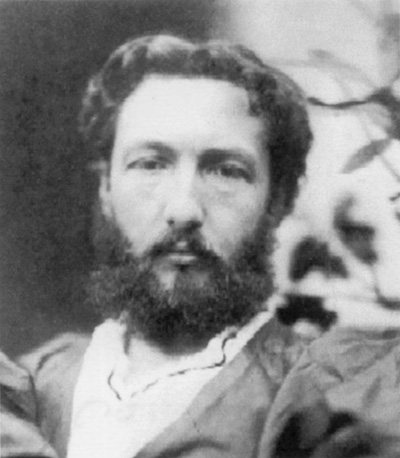 Lord Frederick Leighton (1830-1896) was an acclaimed British Academic painter of the Victorian era and the first artist of that country to be raised to the nobility. Note that he is not the Pre-Raphaelite artist of the same name and time period.
Leighton was born in Scarborough but raised in various cities throughout Continental Europe. While still abroad, he exhibited at the Royal Academy in 1855 and groomed a reputation for excellence before his arrival in London in 1860. He was an ardent proponent of Neoclassicism but maintained friendly relations with the Pre-Raphaelite movement. Such was his public appeal and persona that he was elected President of the RA, serving for twelve years. Leighton gradually moved up the ranks of peerage and was elevated to Baron a day before his death.
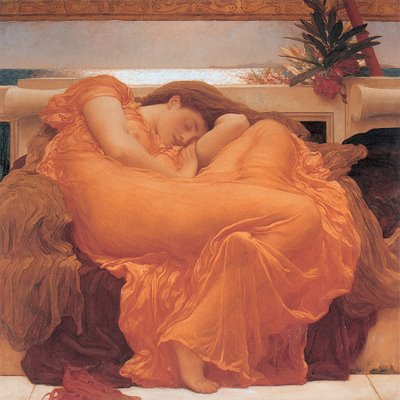 Flaming June (1895) in the Museo de Arte, Puerto Rico. This is perhaps Leighton's most popular painting today. You can't go into a Hobby Lobby without tripping over piles of Flaming June prints.
The draping and foreshortening are simply exquisite.
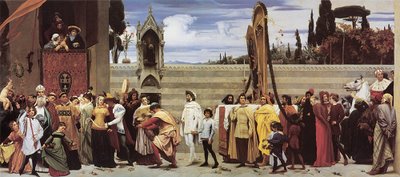 The picture looks really small here. That's because in real life, it's more than 17 feet long. This is Cimabue's Celebrated Madonna (1855), Leighton's first submission to the Royal Academy. It was Leighton's breakthrough work that made him famous.
 Mother and Child (1865) at the Blackburn Museum. I see Pre-Raphaelite figure drawing technique in much of Leighton's work, such as this woman's face.
Poverty-Stricken Africans Receive Desperately Needed Bibles
 MARADI, NIGER—More than 60,000 urgently needed Bibles arrived to allay suffering throughout the famine-stricken nation of Niger Friday, in one of the largest humanitarian-relief operations ever attempted by a Christian ministry.
"Come rejoice, and feast upon the word of Our Lord, Jesus Christ," said Christina Clarkson, executive director of the Living Light Ministries of Lubbock, TX. "Those who were hungry, hunger no more, for the Word brings life."
An exuberant Clarkson said the Bible drop was the culmination of one of the largest and most aggressive grassroots fundraising drives ever undertaken by the organization, which was able to fund the mission largely through local charitable events, such as bake-offs, barbecues, and pie-eating contests.
"We absolutely would not be here today if it were not for the amazing generosity of the people back home," Clarkson said. "People everywhere opened up their hearts and checkbooks to us and said, 'Dig in.'"
Niger, ranked as the second-poorest nation on Earth, is experiencing its worst famine in more than 20 years, as a brutal drought last year was followed by a plague of crop-destroying locusts. An estimated 3.5 million of Niger's 12 million people are currently at risk of starvation.
"That's why it was so important for this mission to happen right now," said Clarkson. "So many people here are suffering. Disease, starvation, and lack of shelter are day-to-day realities in Niger. But once they hear the Good News of Jesus Christ and accept Him as their Lord and Savior—once they really take Him into their hearts—then they will see what poor comforts are the things of this world."
Story Link
Wednesday, March 15, 2006
The Reformation Polka

Martin Luther sings to the tune of Supercalifragilistic-expialidocious (from Mary Poppins).
While a seminarian I studied canon law;
While Erfurt was a challenge, it was just to please my Pa.
Then came the storm, the lightning struck, I called upon Saint Anne, I shaved my head, I took my vows, an Augustinian!
Oh,
Chorus
Papal bulls, indulgences, and transubstantiation -
Speak your mind against them and face excommunication! Nail your theses to the door, let's start a Reformation! Papal bulls, indulgences, and transubstantiation!
When Tetzel came near Wittenberg, St. Peter's profits soared, I wrote a little notice for the All Saints' Bull'tin board: "You cannot purchase merits, for we're justified by grace! Here's 95 more reasons, Brother Tetzel, in your face!" Oh‑
Chorus
They loved my tracts, adored my wit, all were exempleror; The Pope, however, hauled me up before the Emperor.
"Are these your books? Do you recant?" King Charles did demand, "I will not change my Diet, Sir, God help me here I stand!" Oh‑
Chorus
Duke Frederick took the Wise approach, responding to my words, By knighting "George" as hostage in the Kingdom of the Birds. Use Brother Martin's model if the languages you seek, Stay locked inside a castle with your Hebrew and your Greek! Oh‑
Chorus
Let's raise our steins and Concord Books while gathered in this place, And spread the word that 'catholic' is spelled with lower case; The Word remains unfettered when the Spirit gets his chance, So come on, Katy, drop your lute, and join us in our dance! Oh
Chorus
Hat tip: my church history professor, Dr. Bob Tuttle

The Wedding at Cana
Read by Rev. Rowan Atkinson.
Another example of the shabby translation work of the TNIV.
Another example of the shabby translation work of the TNIV.
Tuesday, March 14, 2006
Methodist Blogger Profile: Mitchell Lewis

I'm an ordained Elder in the North Georgia conference of the United Methodist Church. I've been under appointment in the conference since 1981. For the last 15+ years, I've been an Army chaplain on active duty. I'm currently stationed at Fort Leavenworth, Kansas, just outside of Kansas City. As a United Methodist chaplain in a military setting, I am endorsed by the United Methodist Endorsing Agency (a component of the General Board of Higher Education and Ministry) and appointed yearly by my bishop, just like every other clergy member of the conference.
My journey with the Army has taken me to Missouri, Korea, New Jersey, Germany, South Carolina, Georgia, Kuwait, Iraq and Kansas. Before joining the Army, I served United Methodist churches in Bogart, Winder, Stone Mountain and Griffin, Georgia. In college and seminary, I worked part-time in youth ministry and campus ministry. I'm in my 25th year of marriage, and I have two children - a daughter at Georgia Tech, and a son who will start at the University of Georgia in the fall.. I’m a 1977 graduate of Wake Forest University.
I post my general thoughts at Mitchell Lewis, and weekly reflections on the lectionary at Lection Reflections. My posts, of course, express only my own views and do not necessarily represent the views of either the United Methodist Church or my employer. You can contact me at the.ole55 at gmail dot com.
Why do you blog?
I write my personal blog about issues that concern me: my faith, my church, the military and political community, and various religion in the world issues. I also want to make the existence of military Methodists more apparent to the rest of the church. When church leaders talk about military issues, I want them to realize that they are talking about their own church members and not some strange animal from another planet. We are proud not only of our service to the nation, but to the cause of peace and justice as well. We see ourselves as faithful disciples of Jesus Christ whose vocation lies - at least temporarily - in the profession of arms.
I write Lection Reflections as a personal discipline.
What has been your best blogging experience?
I find the StatCounter logs very interesting, especially when they show a visit based on a search.
What would be your main advice to a novice blogger?
I am certainly not qualified to advise others.
If you only had time to read three blogs a day, what would they be?
Mudville Gazette (to keep up with what's happening in the world of Soldiers), Instapundit (to keep up with what's happening in the world of politics) and - now - Wesley Daily (to keep up with what's happening in the UMC).
Who are your spiritual heroes?
Let's reach in the grab bag: Martin Luther, Dietrich Bonhoeffer, George Fox (the Methodist chaplain), Martin Luther King, Jr., Barbara Brokoff (the United Methodist evangelist), N.T. Wright
What are you reading at the moment?
Once again, pulling from the grab bag of books on my desk: The Bible; Moral Man and Immoral Society (Niebuhr); On War (Clausewitz); Dietrich Bonhoeffer's Meditations on Psalms (Robertson); While God is Marching On: The Religious World of Civil War Soldiers (Woodworth).
What is your favorite hymn and why?
A Mighty Fortress is Our God is my favorite because of its theology, although I love all singable hymns that glorify God and reflect his majesty.
Can you name a major moral, political, or intellectual issue on which you've changed your mind?
Suffice it to say, most of the people with whom I went to college and seminary would be shocked that I'm in the Army.
What philosophical thesis do you think is most important to combat?
The philosophy behind Al Qaeda and its fellow travelers is worth combating - in the most literal sense of that word.
If you could effect one major change to the governing of your country, what would it be?
I think a lot about our society and, of course, I have all the answers. As a public servant, however, I'll express my political opinion at the ballot box and to my representatives. Members of the armed forces have a wide variety of opinions about political issues. Neither my vocation as a Soldier nor as a member of clergy calls me to become the leading voice of political opinions or movements.
If you could effect one major policy change in the United Methodist Church, what would it be?
Again, I think I'll express my opinion on church politics to the members of my annual conference as we prepare for the next General Conference.
What would be your most important piece of advice about life?
Be a faithful disciple of Jesus Christ and continue to grow in the knowledge and love of God. Enjoy what life has to offer, take your responsibilities seriously and depend wholly on the grace of God.
What, if anything, do you worry about?
When I am deployed or on temporary duty, I worry about my family's well being.
If you were to relive your life to this point, is there anything that you'd do differently?
Standard military smart aleck response: "I could tell you, but I'd have to kill you."
Where would you most like to live (other than where you do now)?
Athens, Georgia. Go Dawgs.
What do you like doing in your spare time?
Enjoying my home and family, taking infrequent trips with a camera to interesting places, eating good meals, learning new things and playing iTunes DJ.
What is your most treasured possession?
I'm not sure I have one, although a good coffee maker and a pound of Sumatra are pretty darn important.
What talent would you most like to have?
I'd wish I could play the piano. It's solely a wish; I'm not willing to actually study or practice.
If you could have any three guests, past or present, to dinner, who would they be?
Let's make it a theme party: Abraham Lincoln, Robert E. Lee, and Frederick Douglas. We'll certainly have something to talk about.
The State of the American Church
Rev. Ed surveyed his readers and then began a series of thoughtful posts about the major challenges of the Church in America. Here are his first two:
What's Wrong With Church? -- an Introduction
What's Wrong With Church? -- Doctrine
So keep an eye out on Ed's blog for the next few days.
UPDATE: Related.
The Doctrine of the Virgin Birth
 One of the most widely disputed tenets of Christian doctrine is the virgin birth -- or more precisely, the virginal conception of Jesus Christ. I'm utterly flabbergasted as to why. There are many fuzzy and grey areas in the Bible. But the Gospels make it very clear that this was the nature of Christ's conception:
The angel said to her, "Do not be afraid, Mary; for you have found favor with God. And behold, you will conceive in your womb and bear a son, and you shall name Him Jesus. He will be great and will be called the Son of the Most High; and the Lord God will give Him the throne of His father David; and He will reign over the house of Jacob forever, and His kingdom will have no end." Mary said to the angel, "How can this be, since I am a virgin?" The angel answered and said to her, "The Holy Spirit will come upon you, and the power of the Most High will overshadow you; and for that reason the holy Child shall be called the Son of God. Luke 1:30-35
And more briefly:
Now the birth of Jesus Christ was as follows: when His mother Mary had been betrothed to Joseph, before they came together she was found to be with child by the Holy Spirit. Matthew 1:18
Now a while back, Kim of Connexions explained why this doctrine should be re-evaluated. These doubts would be appropriate in an analysis that regarded the gospels are merely ancient texts with no inherent veracity. For example, the absence of this doctrine from the two other gospels might suggest that Luke and Matthew added this narrative element in order to increase credibility for their thriving religion business.
But as Christians, we accept the supernatural as real. God and those whom he fills with his Spirit work miracles routinely. The virginal conception of Christ within Mary is just one more in a long history of God doing pretty amazing stuff, like splitting the Red Sea and feeding the 5,000 and creating Star Trek. So my response to Kim was simplistic, but I think correct.
Yet many Christians deny the virgin birth. That makes me wonder if this doctrine is one of opinion or core belief. I'm not really sure. It could raise all sorts of problems with the Incarnation. What do you think?
Is belief in the virgin birth critical to Christian doctrine?
Monday, March 13, 2006
Baptists vs. Methodists
You may have heard that several churches were recently burned in Alabama, most of the Baptist. The current suspects are students at a Methodist university, Birmingham Southern. Both of Alabama's bishops are putting distance between the UMC and these students. It's appropriate, as UMC colleges tend to Methodist in name only. Anyway, I have reason to avoid scrapping with Baptists.
Methodist Blogs Weekly Roundup # 56
Here's the week in review in the Methodist blogosphere:
Steven Manskar wrote about what it means to "take up your cross."
Andy Bryan blogged about the Missouri legislature's efforts to assert a Christian history to America and the culture of entitlement and UMC connectionalism.
Andy Stoddard lectionary blogged for March 6, 7, 8, 9, and 10.
At Bandits No More, Richard Heyduck wrote about the murder of a previous church member. Steve Heyduck wrote about re-reading Barth on community and his concerns about the way his Conference manages its budget.
Beth Quick wrote about the presence of women in the blogosphere, and the Methoblogosphere in particular.
Betty Newman used a washbasin as a model of our relationship with God.
Bruce Alderman wrote about Constantinian Christianity in America.
At Connexions, Joel Thomas the UMC understanding of the Apocrypha, whether criminal law should reflect the doctrine of Total Depravity (Best of the Methodist blogosphere!), and the burden or lack thereof of Wesleyan perfection. Richard Hall wrote basic guidelines to interpreting the Bible.
Dave Warnock wrote about switching to the Ruby on Rails web platorm.
Steve Heyduck reviewed the movie Crash.
Gavin Richardson wrote that bloggers should write with prophetic voices.
Gerry Charlotte Phelps advised Christians to learn another language for the sake of evangelism.
Grandma Jean is making prayer shawls.
Growing Up wrote about the spiritually cleansing power of rain.
Henry Neufield blogged about how science reporting in the media is too brief to be accurate, Brian McLaren's views on kingdom language, a vote on the sales tax in his county in Florida, issues in determining date and authorship of the Bible, rising American distrust of Islam, false representations of the other side in creation/evolution debates, how to be a grace-filled church, congregational size as a measurement of orthodoxy, the Bush Administration's failure to expect criticism, and dating the Book of Daniel.
Jay Voorhees wrote that even great Christian leaders, such as Bernard Law, can fall into sin. He also blogged about a Christianity that lays on the other side of patriarchy.
John Battern blogged about Christians staying in touch with the secular world, whether or not the UMC has high expectations of members, and the vain search for personal validation.
John Wilks wrote that taking up the name 'Christian' requires a transformation toward holiness.
Jonathon Norman wrote his understanding of what it means to be ordained.
Josh Tinley blogged about the turmoil of airline travel and how personality cults in baseball have created the steriod problem
Chris Kindle artblogged from the Carnegie Museum of Art.
Larry Hollon wrote about the decline of the newspaper business, the ongoing reconstruction of New Orleans, communication in an era of individualism, and organization in era of mass communications.
Mitchell Lewis blogged about having enough faith to pursue God's mission.
Mark Winter wrote about what the spirituality of children implies for the church and comparing worship service styles and baseball.
Craig Moore asked readers to define the evangelistic mission of the church.
Michael Daniel wrote about the prophecy of Fred Phelps and what parents expect from churches for their kids.
Mike Lamson differentiated between ministry to, for, and as postmoderns.
Jeff Lutz wrote about his work on the board of Walk to Emmaus.
Louie Gannon blogged about how Christians should understand fear.
New Reality Blog wrote about why the younger generation is abandoning church.
Olive Morgan blogged about sex trafficking in Europe, raising children without corporal punishment.
Peter Raser wrote about the Tom Fox, the member of the Christian Peacemaker Teams who was murdered in Iraq.
Jason Woolever wrote about what the Bible and Lincoln have to say about schism in the UMC and the hierarchical nature of UMC leadership.
Theresa Coleman heard the legendary Fred Craddock preach and recounts tales of good ideas gone bad.
Sandpiper reviewed the book Extraordinary Faith and wrote about trusting in God when things don't go your way and the purpose of funerals.
Lorna Koskela reviewed the book So Much More and wrote about authentic confession, the asceticism of Jesus, walking through Lent, and our devotional body language.
Stephen Fife saw human virtues and foibles in Peter.
Kurt Boemler wrote about his experiences getting drunk.
Brett Royal explained how a loving God can condemn people to Hell.
Thoughts from a Clay Pot wrote about the exploding growth of the Methoblogosphere.
Tony Mitchell wrote that Lent, like church in general, it a time of preparation for mobilization.
Jim McKay wrote about the minimum wage in West Virginia and a worldwide snack competition.
Shane Raynor launched Wesley Daily, a new Methodist webzine.
Brian Russell blogged about the critical elements of discipleship and the mission of his church planting.
Additions? Corrections? Do you know of a blog that should be included in the MBWR? Woult you like to have the MBWR e-mailed to you every week? Leave a note in the comments or e-mail locustsandhoney2005 at yahoo dot com!
UPDATE: More added to Jim McKay, corrections to Bandits No More's annotations, and Brian Russell added.
Steven Manskar wrote about what it means to "take up your cross."
Andy Bryan blogged about the Missouri legislature's efforts to assert a Christian history to America and the culture of entitlement and UMC connectionalism.
Andy Stoddard lectionary blogged for March 6, 7, 8, 9, and 10.
At Bandits No More, Richard Heyduck wrote about the murder of a previous church member. Steve Heyduck wrote about re-reading Barth on community and his concerns about the way his Conference manages its budget.
Beth Quick wrote about the presence of women in the blogosphere, and the Methoblogosphere in particular.
Betty Newman used a washbasin as a model of our relationship with God.
Bruce Alderman wrote about Constantinian Christianity in America.
At Connexions, Joel Thomas the UMC understanding of the Apocrypha, whether criminal law should reflect the doctrine of Total Depravity (Best of the Methodist blogosphere!), and the burden or lack thereof of Wesleyan perfection. Richard Hall wrote basic guidelines to interpreting the Bible.
Dave Warnock wrote about switching to the Ruby on Rails web platorm.
Steve Heyduck reviewed the movie Crash.
Gavin Richardson wrote that bloggers should write with prophetic voices.
Gerry Charlotte Phelps advised Christians to learn another language for the sake of evangelism.
Grandma Jean is making prayer shawls.
Growing Up wrote about the spiritually cleansing power of rain.
Henry Neufield blogged about how science reporting in the media is too brief to be accurate, Brian McLaren's views on kingdom language, a vote on the sales tax in his county in Florida, issues in determining date and authorship of the Bible, rising American distrust of Islam, false representations of the other side in creation/evolution debates, how to be a grace-filled church, congregational size as a measurement of orthodoxy, the Bush Administration's failure to expect criticism, and dating the Book of Daniel.
Jay Voorhees wrote that even great Christian leaders, such as Bernard Law, can fall into sin. He also blogged about a Christianity that lays on the other side of patriarchy.
John Battern blogged about Christians staying in touch with the secular world, whether or not the UMC has high expectations of members, and the vain search for personal validation.
John Wilks wrote that taking up the name 'Christian' requires a transformation toward holiness.
Jonathon Norman wrote his understanding of what it means to be ordained.
Josh Tinley blogged about the turmoil of airline travel and how personality cults in baseball have created the steriod problem
Chris Kindle artblogged from the Carnegie Museum of Art.
Larry Hollon wrote about the decline of the newspaper business, the ongoing reconstruction of New Orleans, communication in an era of individualism, and organization in era of mass communications.
Mitchell Lewis blogged about having enough faith to pursue God's mission.
Mark Winter wrote about what the spirituality of children implies for the church and comparing worship service styles and baseball.
Craig Moore asked readers to define the evangelistic mission of the church.
Michael Daniel wrote about the prophecy of Fred Phelps and what parents expect from churches for their kids.
Mike Lamson differentiated between ministry to, for, and as postmoderns.
Jeff Lutz wrote about his work on the board of Walk to Emmaus.
Louie Gannon blogged about how Christians should understand fear.
New Reality Blog wrote about why the younger generation is abandoning church.
Olive Morgan blogged about sex trafficking in Europe, raising children without corporal punishment.
Peter Raser wrote about the Tom Fox, the member of the Christian Peacemaker Teams who was murdered in Iraq.
Jason Woolever wrote about what the Bible and Lincoln have to say about schism in the UMC and the hierarchical nature of UMC leadership.
Theresa Coleman heard the legendary Fred Craddock preach and recounts tales of good ideas gone bad.
Sandpiper reviewed the book Extraordinary Faith and wrote about trusting in God when things don't go your way and the purpose of funerals.
Lorna Koskela reviewed the book So Much More and wrote about authentic confession, the asceticism of Jesus, walking through Lent, and our devotional body language.
Stephen Fife saw human virtues and foibles in Peter.
Kurt Boemler wrote about his experiences getting drunk.
Brett Royal explained how a loving God can condemn people to Hell.
Thoughts from a Clay Pot wrote about the exploding growth of the Methoblogosphere.
Tony Mitchell wrote that Lent, like church in general, it a time of preparation for mobilization.
Jim McKay wrote about the minimum wage in West Virginia and a worldwide snack competition.
Shane Raynor launched Wesley Daily, a new Methodist webzine.
Brian Russell blogged about the critical elements of discipleship and the mission of his church planting.
Additions? Corrections? Do you know of a blog that should be included in the MBWR? Woult you like to have the MBWR e-mailed to you every week? Leave a note in the comments or e-mail locustsandhoney2005 at yahoo dot com!
UPDATE: More added to Jim McKay, corrections to Bandits No More's annotations, and Brian Russell added.
Sunday, March 12, 2006
Art Blogging: Portraits of John Wesley
Portraits of John Wesley are common in Methodist churches, parsonages, and seminaries. Let's have a look at the artists behind several of them.
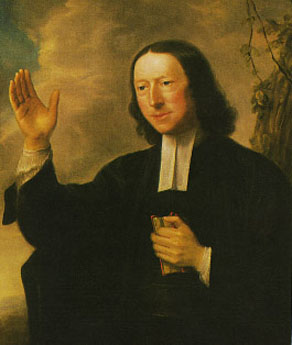 This work of oil on canvas was executed by Nathaniel Hone (1718-1784) in roughly 1766. He was an Irish painter of portraiture and miniature. Hone had no formal artistic education, but settled in London and was soon commercially successful. He was a founding member of the Royal Academy in 1768. Hone was an ardent proponent of Dutch, rather than Italian Classicism, which brought him into a number of personal conflicts with other RA members, most notably Joshua Reynolds. While Reynolds was President, Hone released for exhibition Pictorial Conjurer, a subtle attack on Reynolds' style. This painting alleged an affair between Reynolds and artist Angelica Kauffman. When this work was rejected from the Royal Academy, Hone responded by hosting a one-man show -- the first in the history of Western art.
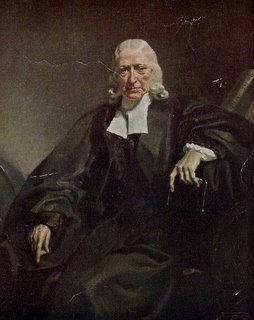 Frank O. Salisbury (1874-1962) obviously did not paint Wesley from life, but his depiction is a commonly-known one. Salisbury, a native of Herfordshire, created portraits, murals, and stained glass. His career began meagerly in a borrowed attic studio while he worked as a bicycle mechanic. Eventually, Salisbury became one of Britain's most prominent portraitists. He reached the height of his prominence during World War II, when he became the quasi-official portraitist of the Anglo-American political elite. Salisbury adored America and eventually five U.S. Presidents sat for him.
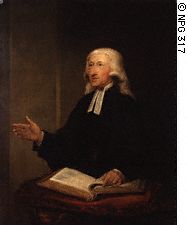 I wish that I could make a bigger picture of William Hamilton's (1751-1801) portrait of Wesley (1788), but this is the best that I could do. Born in Chelsea, he trained in Rome, Zurich, and London. Hamilton exhibited at the Royal Academy from 1774 until his death, becoming a member in 1784.
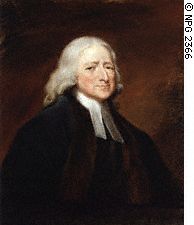 George Romney (1734-1802), a native of Cumbria, was initially apprenticed as a cabinet-maker. He later studied painting under Christopher Steele and set up a successful portrait business. Seven years later he abandoned his wife and son to seek his fortune in London. After a decade of unhappiness painting only portraits, he left for Rome where he studied the Old Masters. Returning to London, he became a great commercial success by painting portraits at nearly the quality of Reynolds and Gainsborough, but at much lower prices. Although offered membership in the Royal Academy, Romney declined the recognition. He composed this depiction of John Wesley in 1789.
 This work of oil on canvas was executed by Nathaniel Hone (1718-1784) in roughly 1766. He was an Irish painter of portraiture and miniature. Hone had no formal artistic education, but settled in London and was soon commercially successful. He was a founding member of the Royal Academy in 1768. Hone was an ardent proponent of Dutch, rather than Italian Classicism, which brought him into a number of personal conflicts with other RA members, most notably Joshua Reynolds. While Reynolds was President, Hone released for exhibition Pictorial Conjurer, a subtle attack on Reynolds' style. This painting alleged an affair between Reynolds and artist Angelica Kauffman. When this work was rejected from the Royal Academy, Hone responded by hosting a one-man show -- the first in the history of Western art.Frank O. Salisbury (1874-1962) obviously did not paint Wesley from life, but his depiction is a commonly-known one. Salisbury, a native of Herfordshire, created portraits, murals, and stained glass. His career began meagerly in a borrowed attic studio while he worked as a bicycle mechanic. Eventually, Salisbury became one of Britain's most prominent portraitists. He reached the height of his prominence during World War II, when he became the quasi-official portraitist of the Anglo-American political elite. Salisbury adored America and eventually five U.S. Presidents sat for him.
 I wish that I could make a bigger picture of William Hamilton's (1751-1801) portrait of Wesley (1788), but this is the best that I could do. Born in Chelsea, he trained in Rome, Zurich, and London. Hamilton exhibited at the Royal Academy from 1774 until his death, becoming a member in 1784.George Romney (1734-1802), a native of Cumbria, was initially apprenticed as a cabinet-maker. He later studied painting under Christopher Steele and set up a successful portrait business. Seven years later he abandoned his wife and son to seek his fortune in London. After a decade of unhappiness painting only portraits, he left for Rome where he studied the Old Masters. Returning to London, he became a great commercial success by painting portraits at nearly the quality of Reynolds and Gainsborough, but at much lower prices. Although offered membership in the Royal Academy, Romney declined the recognition. He composed this depiction of John Wesley in 1789.
Subscribe to:
Posts (Atom)

