Thursday, November 30, 2006

The Virgin Birth and the Resurrection as Doctrinal Essentials

Previously, I wrote about the relative importance of identifying heresy where it exists. This turned into a discussion about the idea of heresy, the impact of it, and how it can be defined. Jason Woolever brought up the subject over at MethoBlog as well.

Many of my readers are United Methodist, so I'd like to bring up this passage from the Articles of Religion of the Methodist Episcopal Church, which are permanently and forever protected from change by the First Restrictive Rule:

Article II -- Of the Word, or Son of God, Who Was Made Very Man
The Son, who is the Word of the Father, the very and eternal God, of one
substance with the Father, took man's nature in the womb of the blessed Virgin;
so that two whole and perfect natures, that is to say, the Godhead and Manhood,
were joined together in one person, never to be divided; whereof is one Christ,
very God and very Man, who truly suffered, was crucified, dead, and buried, to
reconcile his Father to us, and to be a sacrifice, not only for original guilt,
but also for actual sins of men.

Article III -- Of the Resurrection of Christ
Christ did truly rise again from the dead, and took again his body, with
all things appertaining to the perfection of man's nature, wherewith he ascended
into heaven, and there sittith until he return to judge all men at the last
day.

Therefore one cannot deny the virgin birth or resurrection of Christ and be faithful to the core doctrinal standards of the United Methodist Church.

UPDATE: I would like to add that I find these doctrinal standards very reassuring. Other denominations might struggle with theological unity, but thanks to these clearly-written statements in The Book of Discipline, that just isn't a problem in the United Methodist Church.

SECOND UPDATE: Handy links on the Virgin Birth by Dale Tedder.

[cross-posted]

Singin' In The Rain: The George Lucas Special Edition

George Lucas has re-mastered and restored the classic musical Singin In The Rain.


Featuring the vocal talents of Jabba the Hut.

Wednesday, November 29, 2006

Jesus Died for Your Kitsch

Has the Methoblogosphere Fallen Off a Theological Cliff?

Jason Woolever has concerns.

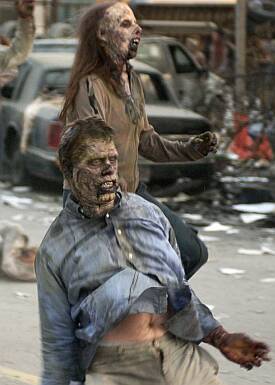
Caption Contest

Previous contest winner

WINNERS:

Danny G: Those darn engineering majors down at A & M are at it again!

Mark Winter: What a load of bunk.

Art Blogging: Ivan Nikolaevich Kramskoy

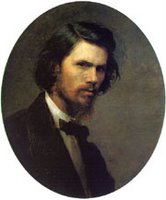
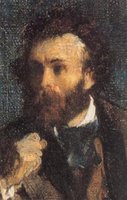
To my surprise, I discovered that I have not yet written about that genius of Russian Naturalism -- Ivan Nikolaevich Kramskoy (1837-1887) except for a Sermon on Canvas about his painting Christ in the Wilderness.

Kramskoy was a native of central European Russia born into a lower-middle class family. He was educated at the Imperial Fine Arts Academy. Kramskoy painted as an Academic, but rejected the rigidly-enforced Neoclassical subject norms of the Russian Academy. He believed that Russian art should not exist for its own sake, but to serve the cause of social and democratic reform. He organized artists to advance the cause of democracy in Russia.

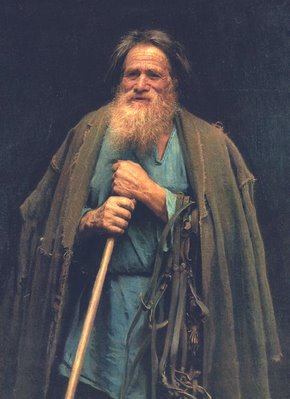
Peasant Holding a Bridle (1887) at the Museum of Russian Art in Kiev. Looks like a photograph, doesn't it? Right down to the veins and tendons on this man's hands. And notice how the light is depicted perfectly, glistening off the man's beard. The Neoclassical norms from which Kramskoy rebelled would never have considered this beautiful.


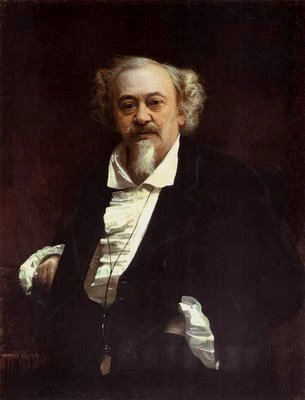
If you're an artist and you want your bling bling, then you've got to paint portraits. This is Portrait of Actor Vasily Samoilov (1881) at the Tretyakov.

Olive Morgan Has Returned

Olive Morgan, the Queen of the Methoblogosphere, disappeared for a while when her blogging platform collapsed. Here is her new site.

Tuesday, November 28, 2006

"It's Just A Flesh Wound!"

Mark Steyn on the decline of the Episcopal Church USA:

Which brings me to our second Jill: the new Presiding Bishop of the Episcopal Church, Katharine Jefferts Schori, the first woman to run a national division of the Anglican Communion. Bishop Kate gave an interview to the New York Times revealing what passes for orthodoxy in this most flexible of faiths. She was asked a simple enough question: "How many members of the Episcopal Church are there?"

"About 2.2 million," replied the presiding bishop. "It used to be larger percentage-wise, but Episcopalians tend to be better educated and tend to reproduce at lower rates than other denominations."

This was a bit of a jaw-dropper even for a New York Times hackette, so, with vague memories of God saying something about going forth and multiplying floating around the back of her head, a bewildered Deborah Solomon said: "Episcopalians aren't interested in replenishing their ranks by having children?"

"No," agreed Bishop Kate. "It's probably the opposite. We encourage people to pay attention to the stewardship of the earth and not use more than their portion."


Sure. The decline of the ECUSA is intentional -- brought about by ecological responsibility. Uh-huh.

Hat tip to someone, but I can't remember whom.

Was Ted Haggard's Real Sin Denying His Homosexual Nature?

Bad Methodist suggests that the problem with Ted Haggard wasn't homosexual sin, but denying his true nature as a homosexual. She contrasts him with a lesbian who grew up in a Christian home, faced rejection for her homosexuality, and then came to terms with who she was:

I know a lot of people like D. I know a lot of couples like D. and S. They make me wonder, what if Ted Haggard had decided not to struggle against his sexual orientation when he was younger? What if he hadn’t gotten married to a woman and had five kids with her? What if he had formed a healthy relationship with a man instead? Would that have kept him from the meth? Would that have kept him from visiting prostitutes? I don’t know, but I do know that’s exactly how healing happened for many other gay men and lesbians. And if the conservative church is wrong, if same-sex relationships are not inherently sinful, then the way we treat the issue, by urging people to change, to struggle against who they were meant to be and to pretend to be what they are not—that’s the root sin here. We the church are causing all this misery.

To this argument, Mitch Lewis has an excellent rebuttal (as usual):

If a wife comes to me with the complaint that her husband is attracted to another woman, my answer is never: well, his attraction to her means your marriage is a joke. He should have never married you to begin with. He should leave you and go to her. His attraction her represents his essential self. There are a number of different ways to approach this problem, but declaring the problem to be the solution isn’t one of them.

[Cross-posted]

Anti-Zombie Civil Defense in the 1950s

Here is an educational film from the 1950s about protecting your home and family in the event of a zombie attack.

Part 1
Part 2
Part 3

It shows how rather naive we were two generations ago. Ripping off a zombie's arm and beating him to death with it? Good luck. Only a severely necrotized zombie will have such weak tissue that you can easily pull its arm off, and that same arm will almost certainly be too soft to serve as an effective bludgeon. I understand Billy's idea that the close confines of the kitchen made swinging the baseball bat challenging, but the end of the bat could have been an effective jabbing weapon against the zombie.

UPDATE: Bad link fixed.

Monday, November 27, 2006

MethoBlogCon


Here is more complete information about the upcoming Methodist bloggers' meetup.

Shane Raynor is Back!

Right here.

List of Lesser-Known Football Rivalries

From The Onion:

Texas A&M vs. Rice: These Austin schools [? -- ed.] hate each other on principle, with A&M touting its tradition of football excellence and Rice its tradition of teaching people how to formulate complex thoughts and express them in complete sentences.

Visiting

I shall be in San Antonio from Dec. 22 through 31. If any area bloggers would like to meet, give me a holler.

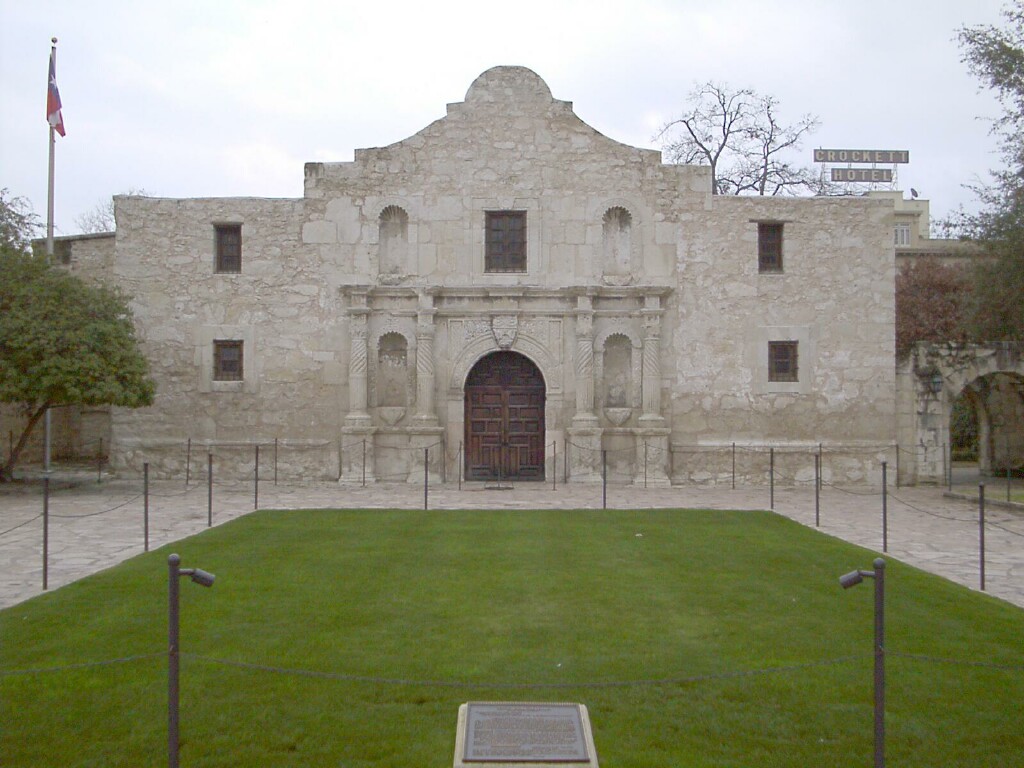
Caption Contest

Previous contest winner

WINNER: Greg Hazelrig:

Down to 175 megabytes...only 10 more to go.

Sunday, November 26, 2006

Does Heresy Matter?

Yesterday, I asked readers if the Church of Latter-Day Saints is heretical. Brian of The Faithful Skeptic commented:

I'd argue that the average joe and jane methodist/presbyterian/episcopal/catholic, etc. probably don't have a thorough understanding of their church's theology either.

I'd agree that mormon theology sounds downright wacky. But then sometimes I think the only difference between catholics and mormons is that the catholics had the good sense to stop making stuff up 1500 years ago.

But aside from all of the theology, I know a lot of mormons. And at the risk of stereotyping them, they tend to be very good, caring, hardworking and honest people that truly love God and frankly do a lot more to embody Christian love than many other Christians.

That being said, I don't have a lot of enthusiasm for deciding whether they are heretics or not. While Joseph Smith was probably a total kook, most of his followers today are not. I think God probably has room for them too.

Emphasis added. I can understand that an excessive focus on doctrinal purity can hinder the mission of the people of God, but defending correct doctrine from false matters at some level.

Given the massive amount of text in the New Testament devoted to the importance of identifying and combating heresy, particularly the epistolary writers, either calling out heretical ideas and practices matters, or the NT writers were wrong.

As for the specific errors of the LDS, I suggest this handy brief from the Watchman Fellowship.

Now, to the harder matter: differentiating varying opinions from heresy. How do we say that a certain view is a minor error which God will not hold against the believer (e.g. Calvinist soteriology), and another is one that will result in damnation (e.g. Mormon anthropology)?

What is heresy as an evaluative criterion?

The New Methodist Blogs Weekly Roundup

NOTE: This post will remain at the top until November 26. Scroll down for updates.

The MBWR will be continued by the brave Allan Bevere.

It will function as a blog carnival. To participate, e-mail your submissions every week by Saturday morning to umweeklyroundup at yahoo dot com.

The current rules apply until Allan changes them. I want to stress this point, because I think that some bloggers have never understood some of them, like the Personal Content Rule. So if you write a post about your weekend trip to the lake and e-mail it to Allan, do not be surprised if it does not appear in the next MBWR.

Saturday, November 25, 2006

Methodist Blogs Weekly Roundup #93

Here is the week in review in the Methoblogosphere.

Question of the Day

Is the Church of Latter-Day Saints heretical?

Friday, November 24, 2006

Test

Thursday, November 23, 2006

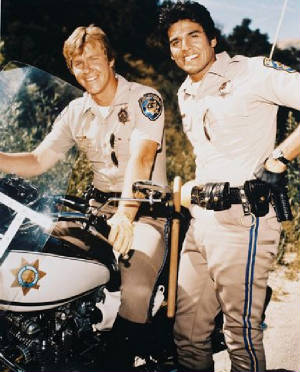
Caption Contest

Photo via Garfield Ridge

Previous contest winners

WINNER: Jim McKay:

Huey, Dewey and Louie help Uncle Donald support his "quack" habit.

Keep Lorna Koskela in Your Prayers

She lost her job at her church.

Good Disguise

BERLIN (Reuters) - German traffic police were shocked to see a California Highway Patrol car cruising along the motorway, driven by a man dressed as an authentic American cop, authorities said on Thursday.

But they recovered sufficiently to book the 35-year-old Goettingen resident, whose uniform badge read "T.J. Lazer", for possessing a replica Smith & Wesson revolver without a license and having out-of-date registration plates.

Story via Fark

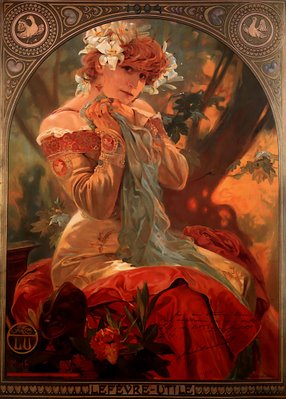
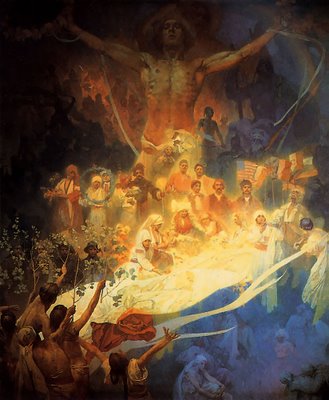
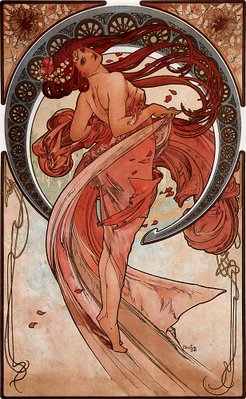
Art Blogging: Alfons Maria Mucha

Alfons Maria Mucha (1860-1939) was a Czech Art Nouveau painter and printmaker. He was born in the village of Ivancice and educated in Munich and Paris. Mucha starved for years and only rose out of the abyss of unemployment by creating posters advertising plays. These caught public attention in 1895, and he became an immediate success. After a few years in America, he returned to Czechoslovakia and devoted himself to the independence movement of that nation. Once it became a sovereign state in 1918, Mucha created works of patriotic art. When Czechoslovakia fell to Nazi Germany in 1939, he was among the first arrested. The ordeal weakened him, and he died shortly thereafter.

Lefevre-Utile (1903). This is an advertisement for Lefevre-Utile Biscuits, featuring popular French stage actress Sarah Bernhardt in costume for the play La Princesse Lointaine.


The Apotheosis of the Slavs (1926). Mucha was an advocate of Slavic ethnic pride, particularly Czech. After Czech independence, he designed the nation's stamps and currency.


Dance (1898), a lithograph. The repeated circularity of forms in this print remind me of Boucher's way of creating a private sphere of beauty.

Thanksgiving

Here at the Locusts & Honey corporate offices, we are preparing Platyturpig (a turkey, stuffed inside a pig, stuffed inside a platypus).

And at the church, we are hosting homeless families from Interfaith Hospitality Network.

The Perfect Church Sign


Position it so that it will be seen as people exit the parking lot.

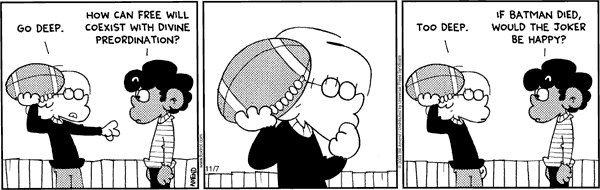
Go Deep


Hat tip: Thinklings

Wednesday, November 22, 2006

Art Blogging: Tamara de Lempicka

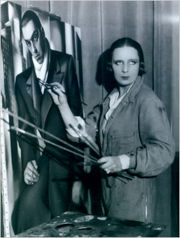
Tamara de Lempicka (1898-1980) was a Polish-American Art Deco painter. She was born into a wealthy family of Warsaw and educated in Switzerland. Her family sought refuge from the Russian Revolution in Paris, where she studied at the hip Acadamie de la Grande Chaumiere. Lempicka was an instant success and surged to fame during the Roaring Twenties. She was an acclaimed bohemian socialite whose wild affairs led to her eventual divorce. Marrying a Hungarian baron, she foresaw World War II and moved to New York City. After the baron died, she moved to Houston, Texas in 1962 and began exhibiting a new style in which she painted exclusively with a palette knife. After these new works were rejected by critics, she retired from public exhibition. Lempicka moved to Cuernavaca, Mexico in 1978 and died two years later.

Calla Lilies (1941). One of the aspects of Lempicka's style that I enjoy is that her two-dimensionality uses shadow to establish form, rather than shadow serving as an afterthought.


Mother Superior (1939). Have you ever seen Picasso's early renderings from art school? Terrible. The guy had no talent, or at least enough talent to succeed as a professional artist if he painted realistically. So he invented a style that he could execute without any talent in the technical aspects of the visual arts. But that is not the case with Lempicka. Her works have the texture of creased sheet metal, but that isn't from a lack of ability. You can see this vividly in the delicate tears on this nun's face.


Young Girl with Gloves (1929). You can almost feel the wind blowing through this scene.

Emerging Talk

De at Thinklings doesn't buy into the emerging church movement. For one thing, she finds its lingo bizarre:

But have you heard these guys talk?

For starters: if you still, frequently, have to explain to people the difference between emergENT and emergeING, perhaps you need to pick a new moniker. I still don’t know what the difference is. And I’ve never quite figured out what they are “emerging” from. And do you ever quit emerging? Lots of things emerge, but they eventually stop emerging, right (once fully emerged, I mean)? Will the movement change its name to “Emerged” when it’s done? And is this the first movement to have a participle for a name?

One key value of emergent/ing is “context”. You have to fit what you do and say into the context of the surrounding culture. I agree with this, for the most part. That’s why I’m a bit baffled by the college-professorish nature of emerge-talk.

Reading emergent writings in the blogosphere, I sometimes get the sense that they are written by stoned college students in basements staring at their hands and saying "Dude, look at my hand! It's so profound!" And as De points out, it is the height of irony that a movement that proports to speak the Gospel in different contexts has a such a baffling lexicon of ever-shifting meanings incomprehensible to the outside world. Much of this language exists for sheer obfuscation.

Caption Contest

Previous contest winners

WINNERS:

Gord: THe government was especially proud of its new "end to unemployment" policy.

Tim Sisk: "2005 Darwin award winner Yan Han-Su was unable to be present for tonight's ceremony..."

Tuesday, November 21, 2006

Art Blogging: Gustave Moreau

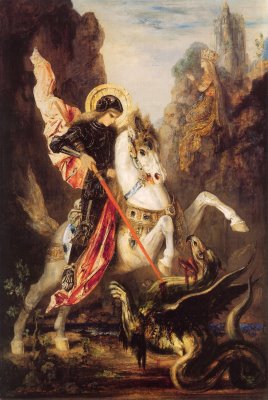
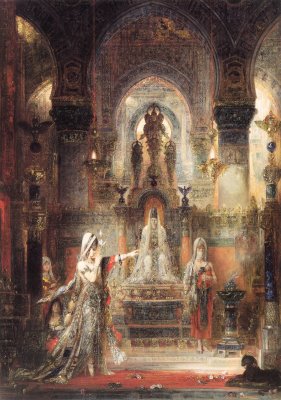
Gustave Moreau (1826-1898) was a French Symbolist painter. His work reminds me of the mesmerizing lumeniscent detail of Robert Venosa. Moreau was born in Paris and studied under Picot. He exhibited at the Salon in the 1860s, rose to prominence, and later became an instructor at the Ecole Des Beaux-Arts. Most of his works focused on Greek mythological and Biblical subject matter. Moreau is regarded as a forefather of Surrealism.


St. George (1890) at the National Gallery in London. What I like about Moreau is how he combines the dreamlike imagination of the Symbolist movement with the technical refinement of the Academic tradition.


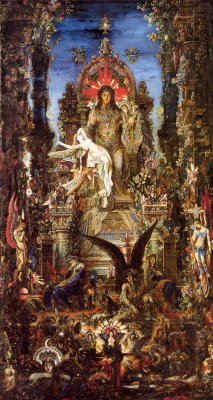
Jupiter and Semele (1895) at the Gustave Moreau Museum in Paris. There are not words to describe the splendorous detail in this painting. I strongly suggest that you consult this high resolution image.

Semele was a lover of Zeus and mother of Dionysius. Decieved by the jealous Hera, she demanded that Zeus reveal his true nature. Zeus did so, and she perished in the full sight of his godhood.


Salome Dancing Before Herod (1876) at the Armand Hammer Museum of Art in Los Angeles. Moreau was a master of lumeniscence.

Caption Contest

Previous contest winners

WINNERS:

Andy Bryan: (Insert Ted Haggard joke here.)

Kevin Knox: I'm STILL not getting you a puppy!

Wayne Cook: The IRD announced today that they found something positive about the United Methodist Church.

The Reply of the Zaporozhian Cossacks to Sultan Mahmoud IV

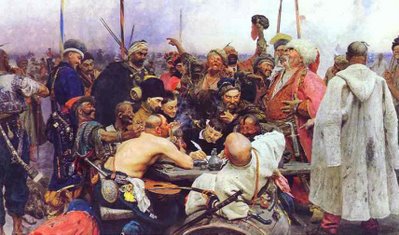
I wrote about this marvelous painting by Repin on Saturday. Tom Harrison has examined the history of the scene that it depicts, in which the Cossacks send an expletive-filled letter to the Sultan in response to his demand that they surrender to him.

Food Safety and the Eucharist

The FDA is moving to regulate the content of the Eucharistic elements.

Monday, November 20, 2006

The Last Methodist Blogs Weekly Roundup (#92)

Here is the week in review in the Methoblogosphere:

Christopher Gudger-Raines thought about the core values of his congregations, which have been labeled as a "welfare charge".

Allan R. Bevere wrote about the Arian controversy, John Wesley's Eucharistic theology, and the pervasiveness of greed, as shown most recently in the Playstation 3 craze.

Andy Bryan has suggestions for what the Board of Ordained Ministry should ask probationary members.

Andy Stoddard lectionary blogged for Nov. 13, 17 and 26.

Art Ruch wrote about businesses that will only do business in English and Microsoft's response to the iPod.

Beth Quick reviewed the book How (Not) to Speak of God.

Brad Smith preached on the little apocalypse in the Gospel of Mark.

Brian Russell wrote about how God revealed his holy presence to Jacob, dealing with rejection, and the importance of forgiveness in relationships.

Conservative Seminarian wrote that conservatives are to blame for the rise of liberal seminaries.

Richard Hall tried to find common ground between the Religious Right and the Religious Left.

Joel Betow wrote about the competition for US House Majority Leader and how much clergy people tithe.

Dave Faulkner preached on our responses to the missional call. He also wrote about the life and work of Henri Nouwen.

Dave Morris wrote that we should be content with being emptied instead of discontent.

EmergingUMC wrote that some of the best disciples are leaving the Church because they are the best disciples.

Sally Coleman wrote about Christmas consumerism, that Christians should unify spirituality and sexuality, whether alcohol should be served at church, and that Christian apologetics should be missional-focused.

Matt Friedeman wrote about why religious TV is so awful.

Steve Heyduck wrote that we often too quickly see cause and effect relationships.

Gavin Richardson wrote that a pilgrimage isn't necessarily a geographic journey, but a way of seeing the world. He also wrote that youth groups, ideally, should be self-run.

Andrew Thompson is going on a pilgrimage through Coptic Egypt.

Gerry Gharlotte Phelps wrote about the Islamic concept of revenge.

Daniel McLain Hixon wrote about the decision of the College of William and Mary to remove the cross from its chapel.

Greg Hazelrig wrote that God gives us all that we want, but expects us to produce fruit. He also examined the calling of Elisha into ministry.

Henry Neufeld wrote about taking the Bible literally and the excesses of tolerance.

John Battern wrote about local UMC churches controlling the distribution of their apportionments.

Jonathan Norman contemplated the life and work of Hildegard of Bingen on her feastday.

Josh Tinley said that the modern church needs to revive the practice of the Sabbath.

Just As I Am taught on the discipline of God.

Chris Kindle wrote about leadership lessons from Nehemiah and the Articles of Confederation and finding God at the crossroads of life.

Mark Winter wrote about Operation Christmas Child from Samaritan's Purse.

Keith McIlwain wrote that we can be confident of God's stability in the midst of disaster.

Michelle Hargrave suspects that many people who identify as Christians but won't attend church are just insufficiently impatient with others.

Mike Voigts wrote that churches shouldn't do, so much as they should be.

Mitch Lewis marvelled at the character displayed by a family that has lost a loved one in Iraq.

Padre Complex wrote about pastoral pay.

Todd Bergman wrote of a new Bible translation that removes the hard passages from the Gospels, like the command to give away all of your money.

Praise Habit exegeted Paul's term "sword of the Spirit".

Rereason wrote about food insecurity in American life. Food insecurity is when people experience times when they can't put food on the table.

Theresa Coleman examined the strengths and weaknesses of the UMC.

Richard Johnson wrote about Tony Blair's statement that the Iraq War has been a disaster.

Sandpiper wrote about what it means to be given strength by God, summarized her extensive examination of the Beautitudes, how conceptual idols (false mental conceptions of God) can deceive us, the financial connectedness of the UMC, and studied the term "And the Lord remembered...." as it is mentioned in the OT.

Sky Lowe-McCracken examined the decision that UMC pastors make to stay at their current charges or asked to be moved elsewhere.

Wayne Cook reflected on the Methoblogosphere.

Tony Mitchell wrote about people who are cancerous tumors in the local church and the little apocalypse in the Gospel of Mark.

Paul Martin preached on having the zest for living life fully as Jesus did. He also wrote about whether members of the British National Party should be denied communion, British Airway's mandatory secularism, and the professional ethics (or lack thereof) of Rupert Murdock.

Michael Daniel wrote about how Congresscritters view the voting public and living the Sabbath.

Caption Contest

Previous contest winner

WINNERS:

Codepoke: Together we can cleanse the galaxy!

Matthew Johnson: These aren't the droids I'm looking for!

Sunday, November 19, 2006

Are Christians Just As Likely to Divorce as Non-Christians?

It's often reported that Christians are just as likely to divorce as non-Christians. This necessarily speaks poorly of the ability of the American church to call believers to sanctified lives if the statistics are accurate. But as I noted a year ago, flawed methodological assumptions, such as how one defines a Christian, can result in inaccurate studies:

This is a theological definition. But evangelicals, in the sense that Gallup and Barna are using, are a social cohort -- a group of individuals with common and discrete characteristics. I preface with this distinction because I think that an evangelical, in the sociological sense, is someone who is strongly culturally tied to a church.

So how do Gallup and Barna identify evangelicals? Gallup defines it as someone who has had a 'born again' experience. Theologically, I agree. But if that self-identified person does not show up to church at least once a week, I do not think that he could be defined sociologically as an evangelical or, better put, a member of the evangelical culture. Gallup says that 41% of Americans self-identify as evangelical. Maybe so, but 41% of Americans aren't showing up to church on a weekly basis. Barna defined the Christians within their sample as those who have "accepted Jesus Christ as their savior"...and that's it, no other identifiers. So Gallup and Barna are theologically correct in their definition, but not sociologically correct.

We can debate, theologically speaking, what makes a Christian, but if one is engaging in sociological analysis then one must use sociological terms. And in this sense, someone who responds to a phone survey by saying "Yes, I'm a Christian" isn't necessarily a Christian.

So sociologist Brad Wilcox measured divorce against church attendance:

This idea that Christians are just as likely to divorce as secular folks is not correct if we factor church attendance into our thinking. Churchgoing evangelical Protestants, churchgoing Catholics, and churchgoing mainline Protestants are all significantly less likely to divorce.

[snip]

I estimate between 35 and 50 percent less likely than Americans who attend church just nominally, just once or twice a year, or who don't attend church at all. It is true that people who say they've had a born-again experience are about as likely to divorce as people who are completely secular. But if you look at this through the lens of church attendance, you see a very different story.

Certainly there is excessive divorce in the American church today, among other signs of broken relationships and sin. But the Chicken Little attitudes of many critics are unmerited.

Hat tip: David Wayne

Saturday, November 18, 2006

Art Blogging: Ilya Yefimovich Repin

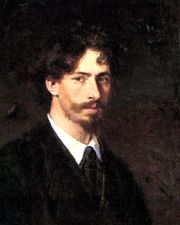
Ilya Yefimovich Repin (1844-1930) was a Russian painter of the Peredvizhniki school. These painters, known as "The Wanderers" in English, were naturalistic realists who broke from Russian Academicism and toured the country, exhibiting independently. They painted landscapes and peasant life in quiet protest of the poverty and oppression under the Tsars. The movement faded and divided by 1900, but its influences were strongly felt in later Soviet art.

Repin endorsed revolutionary politics, but shied away from affiliating with Lenin. The October Revolution placed his home on the Finnish side of the border, and he declined an invitation by Lenin to become an artistic leader in the new Soviet Union.

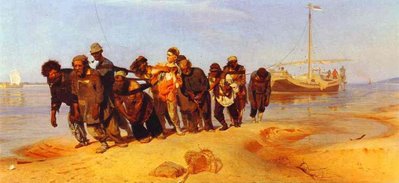
Barge Haulers on the Volga at the Russian State Museum in St. Petersburg.


The Reply of the Zaporozhian Cossacks to Sultan Mahmoud IV, also at the Russian State Museum. This intricately detailed canvas took 11 years to complete. The Zaporozhian Cossacks reached the peak of their military power in the 17th Century and are traditional heroes of Ukranian patriotism.


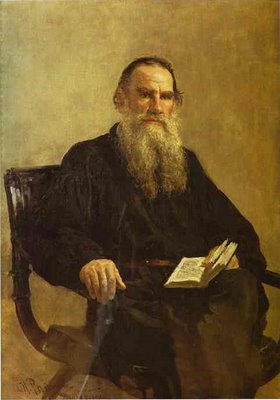
Portrait of Leo Tolstoy. Like every artist with a full stomach, Repin painted portraits for cash.

Why?

Because it's all about the Hamiltons, baby.

Friday, November 17, 2006

Belief in God, Rationality, and Irrationality

Last month, I stated that belief in God is irrational. That got me wondering why I believe in God. How did I arrive at that conclusion? And why the Christian God instead of another? I concluded that my belief was rooted in personal experience of God's presence -- one that confirmed himself as the Christian God.

This struck me as empirical knowledge, so I wrote it in a short post. To this, Keith McIlwain replied:

You're assuming that personal experience is objective, but it is not.

One definition of "empirical" is, "capable of being verified or disproved by observation or experiment."

The existence of God is experienced by different people in different ways; some would say not at all. God's existence, while I personally believe it to be absolutely true, cannot be objectively verified (or disproved, much to the chagrin of atheists).

This is an incorrect definition of empiricism. What Keith is defining is the Scientific Method, which is a subset of empiricism, but not the entirety.

I think that knowledge exists in three kinds:
1. logic
2. empiricism
3. faith

The first two I am labeling as "rationality". Now, assume Assertion A:

I saw Richard Hall run across my front lawn this morning wearing nothing but a smile.

Assertion A is not arrived at through formal logic. And it would only be arrived at by faith if, let us say, I said it to Dave Warnock and he believed it, although he did not witness the incident itself nor is familiar with Richard engaging in this activity. That leaves open only the possibility of empiricism. Under Keith's definition, it would only be empirical knowledge if I could verify it through observation and experimentation. But unless, like Jeff, one has a front lawn dotted with surveillance cameras and land mines, it will be impossible to verify Assertion A.

Yet the person who says Assertion A in full honesty nonetheless knows that it is true. It is not faith nor logic, so what kind of knowledge is it?

It is empiricism. What makes knowledge of an empirical nature is not that it can be verified, but that it has been experienced.

The following are empirical statements:
1. Water boils at 212 degrees.
2. Jonathon Norman has blue skin.
3. My dog just scratched himself.
4. An angel of the Lord appeared to me.
5. I love my wife.

Some of these can be verified through observation and experiment (1&2), but some cannot (3, 4&5). But even 1 and 2 are not known at first through observation and experiment. If this were not so, you would not be able to make these statements unless you had actually boiled water and examined Jonathon's skin under laboratory test conditions. Rather, we have either experienced the event ourselves or accepted the experiences of others (e.g. a science textbook).

Some of these statements are conducive to the level of verifiability of the Scientific Method, but all are empirical statements and are first known through experience. It is not even enough to say that they are known through sensory data. Statement 5, whether it is accurate or inaccurate (it is accurate), is nonetheless known.

Religious experiences are therefore, be they sensory or nonsensory, known. That is, they have been experienced. To those who have experienced them, the existence of that experience is undeniable. Religious experiences are thus empirical knowledge. This may not be sufficient reason for belief for anyone else (as my original argument proves), but it is sufficient reason for those who have experienced them.

Therefore:
1. Theism is rational for those who have had religious experiences.
2. Theism is irrational for those who have not had religious experiences.

Here is a more detailed explanation:

Art Blogging: Solomon Joseph Solomon

The award for original naming goes to the parents of Solomon Joseph Solomon (1860-1927), an English Pre-Raphaelite/Academic painter. I use the slash because he was completely versatile in both styles. He studied in the Royal Academy in London, the Munich Academy, and the Ecole Des Beaux-Arts in Paris under Alexandre Cabanel. He painted scenes from the Bible and Greek mythology. Solomon served as a Lieutenant Colonel in the British Army during World War I and made significant contributions to the development of camouflage.

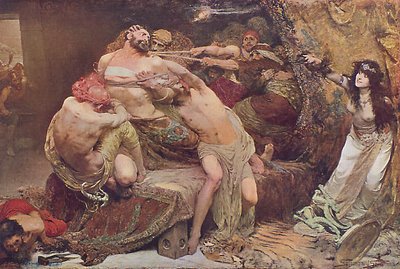
Samson and Delilah at the Walker Art Gallery in Liverpool. Samson is silent and grim as Delilah taunts him with by waving a lock of his hair. Cabanel's influence is pronounced in the fluid motion and perfect figure presentation.


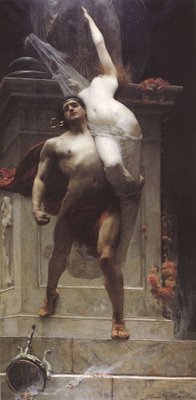
Ajax and Cassandra at the Ballarat Fine Art Gallery in Australia. Cassandra was daughter of King Priam of Troy and gifted with the ability of foretelling. But she spurned the love of Apollo, who cursed her so that no one would ever believe her oracles, including her dire warning about the wooden horse.

For this painting alone, Solomon was compared to Bouguereau. It's a good compliment, but his figure studies are more Cabanel-esque in execution. Bouguereau's figures are still, as though locked in a studio setting; Cabanel is almost always conveying mobility.

[UPDATE: Also, the detailed, naturalistic backgrounds are appropriate for a student of Cabanel. With Bouguereau's backgrounds, you know that you're looking at a painting that originated in a studio.]


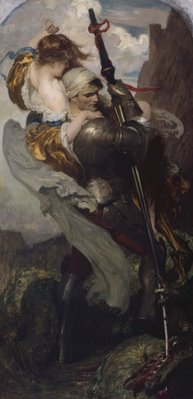
So you're probably asking "Now how is this guy a Pre-Raphaelite?" Here's one way: subject matter. This is St. George, the legendary dragon slayer. He did other works that are indisputably Pre-Raphaelite in composition, but I find it hard to regard them as interesting.

Last week, when I wrote about a Symbolist artist, Hypatia 370 commented:

I love that you feature different movements and artists in between the ever-intelligent but often mind-bending dialog. (a good thing).

I'm glad to examine various movements and styles, but my heart belongs to Academic painting. I may play well with others, but I'll always come home to the Academy where the Western tradition reached its apex.

Caption Contest

Previous contest winners

WINNER: Oloryn:

As pleased as Jake was at how much extra punch the new addition gave to his Bug, he physical exertion required to use it was getting to be a bit much.

Common Ground

Rarely do I agree with Paul Martin on any subject, but I agree that everyone should urgently sign this petition.

Thursday, November 16, 2006

The Beatification of John

I previously mentioned that I'm on my way to sainthood. To this, Gavin Richardson asked:

what miracles did you perform?

That's a good question. I'll need a few for saintly validation.

List some of my more fantabulous works in the comments.

Men and Contemporary Worship, Part II

There were many good comments in response to my post regarding an article by Dave Murrow on the alleged feminization of men in contemporary worship.

Mitch Lewis wrote:

Resistance to raising my hands in the air and singing emotional love songs to God doesn't have anything to do with humbling myself before God; it has to do with resistance to turning my life over to folks who think their style of worship is more spiritual than mine.

I never feel more humbled and dependent before God - sometimes to the point of tears - than when singing "A Mighty Fortress." Luther's words hardly encourage spiritual pride.

Some people are more emotion-focused, and some are more thought-focused. That is not a sin to be overcome, but simply a description of our varied natures. If I'm a "thinking" person at heart, it might be good for me to develop some flexibility by exercising my "feeling" side a bit (and the converse if I'm a "feeling" person), but that's a simply a matter of personal maturity, not a matter of Christian essentials. (And to call it a matter of gender misses the point. It's personality type, not gender, that is significant.)

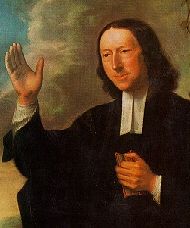
I'm more left brained, too (or so people tell me). Being a Christian means a certain amount of intellectual content. But it also has an emotional component in its full expression, as John Wesley wrote:

The nature of religion is so far from consisting in these, in forms of worship, or rites and ceremonies, that it does not properly consist in any outward actions, of what kind so ever. It is true, a man cannot have any religion who is guilty of vicious, immoral actions; or who does to others what he would not they should do to him, if he were in the same circumstance. And it is also true, that he can have no real religion who "knows to do good, and doth it not." Yet may a man both abstain from outward evil, and do good, and still have no religion. Yea, two persons may do the same outward work; suppose, feeding the hungry, or clothing the naked; and, in the meantime, one of these may be truly religious, and the other have no religion at all: For the one may act from the love of God, and the other from the love of praise. So manifest it is, that although true religion naturally leads to every good word and work, yet the real nature thereof lies deeper still, even in "the hidden man of the heart."

I say of the heart. For neither does religion consist in Orthodoxy, or right opinions; which, although they are not properly outward things, are not in the heart, but the understanding. A man may be orthodox in every point; he may not only espouse right opinions, but zealously defend them against all opposers; he may think justly concerning the incarnation of our Lord, concerning the ever-blessed Trinity, and every other doctrine contained in the oracles of God; he may assent to all the three creeds, -- that called the Apostles', the Nicene, and the Athanasian; and yet it is possible he may have no religion at all, no more than a Jew, Turk, or pagan. He may be almost as orthodox -- as the devil, (though, indeed, not altogether; for every man errs in something; whereas we can't well conceive him to hold any erroneous opinion,) and may, all the while be as great a stranger as he to the religion of the heart.


Emphasis added. Worship, regardless of the form, should produce a feeling of utter dependence on God. Because we are utterly dependent on him. Anyway, I didn't say that we shouldn' t sing traditional hymns like A Mighty Fortress is Our God -- quite the contrary. In fact, I didn't say that contemporary worship is superior to traditional worship, nor did anyone in this thread that is critical of Murrow's article.

Dale Tedder wrote:

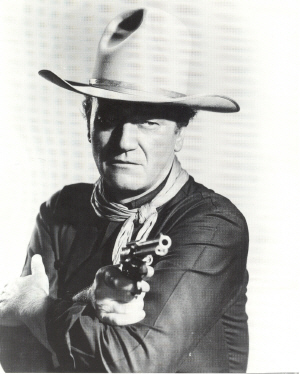
Well, I'm not sure I got that from the article. What I got was that, according to him, men are tired of going to Alan Alda Community Church where, to be "religious," they have to give up any traces of masculinity of the John Wayne variety.

Surely there must be some place in the middle.

And frankly, my experience with contemporary Christian "praise and worship music" doesn't speak to any of the things you listed. Would that that genre would say anything about mystery and holiness without just saying 46 times, "you are holy."

Like John Meunier, I don't think that I've ever been to a worship service that is emasculating. If such a thing exists, it should be stopped. Either way, John Wayne-style masculinity is a mixed bag. The characters that he played in movies had one quintessential quality: self-reliance. In many contexts, this is appropriate. A few months ago, one of my neighbors got drunk and tried to break into my apartment in the middle of the night. My wife, dog, and rabbits were depending on me to protect them from physical harm. I got all John Wayne on him, to my wife's delight/horror.

But when I am in church worshipping God, I'm thinking about my relationship with God. Here, self-reliance has zero place. I am totally depraved and cannot resist sin without his grace. I am dead in my sin and cannot live but for his salvation. I'm not self-reliant in these domains; I'm totally helpless.

Stephen Fife wrote:

To defend Murrow (and hope I don't get stoned), I believe that he his trying to study the anthropology of the male species in general when it comes to worship. He is not studying submission to God or what that involves. He is only studying how men respond to worship styles. To be fair he admits that there are a few men who are willing to take on this style of worship, but I challenge you to find men willing to engage in liturgical dance. (What Murrow would term a feminine style of worship)

I should have defined my terms more carefully. When I used the term "anthropology" in my post, I didn't mean the modern social science of human behavior. I mean how we, theologically, understand humanity. My anthropology starts with Total Depravity, which is why I think that fully expressive worship induces an emotive (as well as intellectual) sense of humility before God.

Are we really in disagreement about this? I doubt it. That's why I think that Murrow's argument is just a proxy battle in the eternal bickering between advocates of traditional vs. contemporary worship. Let me echo what Dan Trabue says here:

Why can't they just say, "I don't like these particular songs. I do like THESE particular songs..."? instead of suggesting it has something to do with manliness if we don't sing songs that sound like war chants?

I'd suggest it most likely has to do with personal preference, not "manliness," or some macho-flavored version of what it means to be a man.

Exactly. This is about personal preferences, not masculinity and femininity.

Here are other opinions from Oloryn and Henry Neufeld.

St. John of Orlando

The United Methodist Church is moving forward with a plan to declare me a saint.

Wednesday, November 15, 2006

The End of the Methodist Blogs Weekly Roundup

Next week will be the last MBWR.

Sorry, but I'm out of time.

I'll link every week to anyone who would like to continue it.

Caption Contest

Previous contest winners

WINNERS:

Andy Bryan: Lost in thought, Janet was unaware that her final minute of life was to be spent trying to remember whether or not she had turned off her coffee pot that morning.

DannyG: A little bit country, a little bit rock and roll.

Allan R. Bevere: As a matter of fact, I do own the road!

Men and Contemporary Worship

Via Dale Tedder comes this article by Dave Murrow, asserting that American Protestant men tend to reject contemporary worship music (which he calls the Praise and Worship Movement or 'PWN') because it feminizes them:

I believe PNW is having the unintended result of feminizing the worship experience – and making it harder for men to connect with God in church...As a result, women are worshipping robustly while most men stand for 20 minutes with their hands in their pockets, dutifully mouthing words that fail to resonate with their hearts.

His arguments:

1. Worship is now led by musicians instead of by priests. "Musicians are often right-brained, which makes them more sensitive and outwardly emotive than your average guy...But most musicians bring a certain softness – even flamboyance to their leadership."

2. Worship leaders tend to encourage a feminine response to a masculine God. "Great worship results in sensation, passion and good feelings. The worship leader’s job is to help the people generate a warm, gooey feeling in their hearts about Jesus. Tears are the best gauge of God’s presence...I’m merely pointing out the fact that if ooey-gooey feelings are what we’re shooting for, worship will be much easier for women than men. Women are much less inhibited about showing emotion in public. They can access their emotions more easily than men. So a worship leader who’s trying to get the congregation to feel something will subconsciously target women, because gals are more likely to respond emotionally."

3. Worship leaders notice the men at the front of the sanctuary embracing contemporary worship instead of men at the back expressing discomfort with it in their body language. "Every church has one or two guys who are totally into musical worship. They usually sit up front...Worship leaders look out at these two guys and think, 'The guys are totally into this. Look at Lenny and Steve!' But due to the bright lights in their eyes, worship leaders can’t see the row-upon-row of men who are standing with knees locked, hands in pockets."

Murrow then follows with several suggestions, most of which are sound for encouraging variety in worship, such as singing classic 'manly' hymns like A Mighty Fortress is Our God and worshipping in non-musical ways. I don't object to any of these recommendations. But I do think that he has largely misdiagnosed the problem.

He is describing an image of masculinity in which a man is tall, strong, tough, and proud. He engages God intellectually, not emotionally because that would be totally gay (yes, Murrow says that). He doesn't raise his hands or cry out to God because he is an equal of God and speaks to him man-to-man. He's not some frightened wuss who is dependent upon someone else -- like that sissy David who wrote the Pslams. A real man takes care of himself.

Needless to say, Murrow's arguments are premised on a flawed anthropology. If men in your church have trouble humbling themselves before God and feeling dependent upon him, you have bigger problems than the worship style.

FYI

Unlike their counterparts from Spain, everyone expects the Norwegian Inquisition.

Tuesday, November 14, 2006

Bouguereau of the Week Feature Now Changed

I've had a good run since June showing different works of William Adolphe Bouguereau at the top of my sidebar. But it's time for something new and different, so for a while, I'm going to exhibit works by the great Anglo-Dutch Neoclassical painter Sir Lawrence Alma-Tadema. Most of his corpus consists of idealized portraits of Greco-Roman society. This week's is A Coign of Vantage. A coign is a corner of a building, this one apparently granting people a good view of the harbor below.

The Rationality of Believing in God

I wrote on this subject earlier, and I've now realized a hole in my argument: clear, personal religious experience of God constitutes empirical evidence for the existence of God, making belief therein rational.

UMC General Conference Resolution -- Holding Clergy Accountable for Doctrinal Standards

For the UMC polity class here at Asbury, we were assigned to write Resolutions for the next General Conference. My partner and I reflected on this question posed to candidates for the ordained ministry by the presiding bishop during the liturgy of ordination:

In covenant with other elders, will you be loyal to The United Methodist Church, accepting its order, liturgy, doctrine, and discipline, defending it against all doctrines contrary to God’s Holy Word, and accepting the authority of those who are appointed to supervise your ministry?

In reference to this question and the Beth Stroud affair last year, Chris Morgan wrote this masterpiece of blogging:

And now to Beth Stroud. I do not doubt that Rev. Stroud is a person of faith or that she conducts her ministry with compassion and professionalism. I do not doubt that her congregation loves her deeply. But she is a member of a covenant community, having pledged loyalty to the Church’s doctrine and discipline. And despite the legal maneuvering and squabbling over language, the will of the General Conference as expressed in the Church’s Discipline is quite clear: “self-avowed, practicing homosexuals are not to be accepted as candidates, ordained as ministers, or appointed to serve in The United Methodist Church.” This was not news to Rev. Stroud, neither at the time or her ordination nor on the day of her coming out. Beth Stroud knew.

Clearly, one of two scenarios brought us to this point: (1) Beth Stroud was in a committed lesbian relationship at the time of her ordination and chose to be ordained under the radar; or (2) Beth Stroud became an Elder and only later entered into the relationship. If the first is the case, Rev. Stroud was disingenuous. If the second is the case, then she chose to defy the discipline she had pledged uphold. Either way, her public acknowledgment eventually reached the level of chargeable offense.


[snip]

The case here is quite simple: Beth Stroud knew the expectations of the covenant community of elders in The United Methodist Church, and she intentionally disregarded one of them. If the covenant means anything, she must be held accountable. Those who disagree with these expectations should take the matter up with General Conference. No one is well-served by those who enter quietly, then say, “Surprise!”

It is odd that this very important question -- the willingness to submit to the UMC system -- is asked only at the final stage of candidacy. Jason Woolever recently informed us (in an unverified account) of a probationary member of the Oklahoma Conference recommended by the BOOM there to be accepted into full membership even though she denied the divinity of Christ. Perhaps she was unaware that United Methodist clergy are expected to uphold the order, liturgy, doctrine, and discipline of the UMC until the presiding bishop asks this question completely out of the blue. The United Methodist connection should not assume that candidates for the ordained ministry are aware of this requirement.

Therefore (after 7 pages of theological reasoning), our resolution was that candidates for the ordained ministry would be asked this same question by their District Committees on the Ordained Ministry prior to becoming a certified candidate -- and that an affirmative response is desirable.

CORRECTION: The story that Jason links to says that the woman was seeking probationary membership, not full. Thanks, Wayne!

Monday, November 13, 2006

Caption Contest

Previous contest winner

WINNERS:

Keith McIlwain: Babe the Blue Ox gave his all for humanity...

Jeff the Baptist: Reports say the hamburger was large enough to feed an entire Mongolian village or a single Texan.

Sunday, November 12, 2006

Methodist Blogs Weekly Roundup # 91

Here's the week in review in the Methoblogosphere:

Abi Carlisle-Wilkes wrote about creativity in the sermon creation process.

Allan R. Bevere wrote about the early Christological controversies, whether the Bible is flawed because of textual variants, that Christians should bond as closely as cops do, and in praise of political gridlock.

Allen Grant wrote about the importance of forgiving Ted Haggard.

Amy Yarnall wrote about the saints who have impacted her life: Oscar Romero and Clarence Jordan.

Andy Bryan wrote about the Wesleyan Quadrilateral (ordination question).

Andy Stoddard lectionary blogged for November 6 and 7.

Art Ruch is pleased by the Ted Haggard scandal and justifies his glee. He also wrote about the confusing language of the gay marriage amendment in Tennessee, the new Methoblog portal, and the theology of punk rock.

Bad Methodist wrote about the election results, particularly in Arizona. She also wrote about re-baptism in Methodism.

Richard Heyduck says that the UMC (and specifically, the Central Texas AC), needs a bold ecclesiology that depends on God to make the church succeed. He reviewed the book Crossing the Threshold of Divine Revelation. He also wrote about whether Islam is compatible with democracy, defining victory in Iraq, and critiqued NT Wright's analysis of foreign policy.

Betty Newman prayed that God make her tolerant of other people.

Brad Smith preached on the greatest commandment and on selfishness.

Brian Russell wrote that Christians should be like geckos, that is, hunters. He also wrote that having a missional focus does not mean losing focus theologically and that we need chatechismal teaching, not expert teaching.

Bruce Alderman wrote that American Christianity is heavily syncretized.

Dave Faulkner preached on war and the demands that Jesus expects of his followers.

Dave Camphouse would prefer that the church not suck.

Sally Coleman wrote about what it means to be healed by Christ, the way that we communicate uniquely through blogging, how the Church silences Christ my marginalizing certain people, the death of her cat, her experiences evangelizing to New Age people, and why she uses Tarot cards in meditation.

Matt Friedeman wrote about what the GOP needs to do to regain the support of its base.

Steve Heyduck wrote about the responsibility of voting.

Gavin Richardson wrote about being a write-in candidate.

Andrew Thompson wrote about Shane Raynor's legacy and how evangelicals are often stereotyped.

Gerry Charlotte Phelps wrote that pulling out of Iraq prematurely would be disasterous, how GOP federal spending hurts the GOP, and asked readers to pray for the new Democratic leadership.

Daniel McLain-Hixon wrote about what we can learn from the Lord's Prayer.

Greg Hazelrig wrote about the falseness of the prosperity gospel, the importance of not letting the devil get your irritable at people, and that tithing is just the beginning of giving.

Greg Lee preached on going back home to God and wrote about the difficulties that UMC local pastors have in working with their mentors.

Guy Williams reviewed the week in college football.

Henry Neufeld wrote about how Christians should respond to Ted Haggard and deliberate, willful ignorance among homeschoolers.

Holy Pirate wrote about the most recent set of UMC Judicial Council decisions.

Jay Voorhees wrote about Ted Haggard.

John Battern wrote about the new, evangelical atheism.

Jonathan Norman wrote a latter to Harold Ford asking him to consider find a way for the US to leave Iraq.

Josh Tinley would like to change the way that college football playoffs are formed, Tennessee's gay marriage amendment, and what he is hoping for from the new Democratic leadership.

Judy Callarman wrote about the findings of neurological studies on people speaking in tongues and the fall of Ted Haggard.

Just As I Am wrote that following Christ includes the discipline of study.

Ken Carter paraphrased Tip O'Neill to say that all missions are local.

Larry Hollon wrote about poverty issues in Mozambique, the Council of Bishops meeting in that country, a visit to that meeting by Nelson Mandela, that 9/11 showed Americans what other people around the world have to deal with on a daily basis, that the UMC really is growing if you look at the global perspective, that most people don't fit into political boxes, and the rise of religious moderates in American politics.

Michael Daniel wrote that we can only have one god in our lives and analyzed the commandment against taking the Lord's name in vain.

Michelle Hargrave wondered if saving historic church buildings is important for the Kingdom of God.

Mitch Lewis looked at Ted Haggard and considered the pervasiveness of sin and the meaning of his oath of enlistment. He also reflected on Veteran's Day and preached on how the incident of the Widow's Mite shows that something had gone fundamentally wrong in Judean society.

Rick Mang says that we're rushing too fast through Advent.

Jason Woolever reviewed the movie The Second Chance.

Praise Habit reviewed the book Velvet Elvis.

Richard Johnson is disturbed by decreasing free speech in Britain, but pleased by the US Congressional elections, of which he made some predictions.

Credo Orthodox wrote about some of the dangers occasionally found in Pentecostalism, Julian of Norwich's description of Christ as a mother-figure, and the theology of the Rapture.

Sandpiper wrote about the appropriateness of wearing a cross, standing up for your faith and the vulnerable humanity of Jesus.

Lorna Koskela wrote about the importance of not yearning for people to suffer karmic backlash, the potential for the Christian church to be driven into extinction, and that evangelism is the consequence of being a Christian, not the purpose of it.

Richard Hall wrote about the death sentence against Saddam Hussein and the way that faith and politics interact not only in America, but in the rest of the world.

Take My Hand wrote about sexism in the UMC.

Jonathan Marlowe wrote about torture of terrorism suspects.

Dale Lature wrote about Bush's faith-based initiatives.

Brian Vinson rejects the notion that blogging is unChristian. He also wrote about how youth ministry prepared him for the pastorate.

Wayne Cook wrote about why he voted for Harold Ford and then looking back at the election results.

Todd Miller wrote about how God draws people to him.

Tony Mitchell preached on the Biblical concept of neighbor and reflected on his grandfather's experience in World War I.

Paul Martin wrote about Saddam Hussein's death sentence.

Jim McKay wrote something about college football, but I'm too ignorant about football and too tired to even begin to understand it. He also noted that Saddam Hussein was convicted of war crimes that he committed while serving as a US ally.

Willie Deuel reviewed a new Bruce Springstein album of Pete Seeger's songs.

What was the Best of the Methoblogosphere? Check out Methoblog tomorrow morning and find out!

The Robot Menace

Great. Not only do we have to deal with flesh-eating zombies, but flesh-eating robots: Robot Identifies Human Flesh as Bacon.

Like cows, once robots taste blood, their hunger for human flesh can never be satiated.

Hat tip to Kurt Boemler. This isn't the first warning that we've had.