Wednesday, January 31, 2007

Caption Contest

Previous contest winners

WINNERS:
Jeff the Baptist: Just when you thought Ben and Jerry were the biggest ice cream sellouts, Haagen-Dazs brings you...

Or for the RPG nerds in the room:

Flavors so mind-boggling you'll have to make a Sanity check!

Keith McIlwain: For all the days that end with, ""Eh-y-ya-ya-yahaah - e'yayayaaaa... ngh'aaaaa... ngh'aaa... h'yuh... h'yuh... HELP! HELP! ...ff - ff - ff - FATHER! FATHER! YOG-SOTHOTH!"

Matt: Also available :
-Extra-dark Cthocolate
-Calamari!
-NEW! "Elder"-berry (with extra eldritch bits and ooey-gooey caramel ichor)

Stephen Colbert Tears into Postmodernism

Put A Trigger Lock On Your Light Saber

Art Blogging: Winston Churchill

Winston Churchill (1874-1965) was a British Impressionist painter of landscapes and still lives. He was self-trained and engaged in painting as a hobby. Churchill's works were noted for their vibrant, sweepingly romantic colors with wide variations within a canvas. Under pseudonyms, he exhibited in France and then later at the Royal Academy in London. He held large, public exhibitions from 1947 to his death, and his reputation as an artist has steadily grown. Recently, one of landscapes sold at Sotheby's for $1.2 million.

Flowers In a Green Vase (c. 1930s, oil, private collection).


Blue Room in Trent Park (1930, Sao Paulo Museum of Art).

Tuesday, January 30, 2007

Star Wars Acted Out By Mimes

Specifically, their hands. Really clever and careful choreography.

Art Blogging By Request: Howard Finster

Theresa Coleman requested that I artblog about Howard Finster (1916-2001), an American creator of Outsider Art. Outsider Art is that which is composed by people traditionally not seen as artists, or otherwise untrained or unaffiliated with the fine arts. Finster, a native of Georgia, was a Baptist preacher who created 46,000 works of art, mostly reflective of Christian themes. He began exhibiting publicly after 1975. In the 1980s, he received numerous commissions to create album covers, including those of R.E.M. and the Talking Heads. Most of Finster's works are on display at Paradise Gardens, a chapel complex that he built near Summerville, Georgia.

Empty Road (1988, Columbus Museum of Art; silkscreen). Finster rarely left an inch of open space in his compositions, such as this print filled with evangelistic messages comparing the roads to Heaven and Hell.


Coca Cola and Big Coke at the Anton Haart Gallery. Finster was particularly fond of Coca Cola and developed much of his art around a Coke theme, such as these five-foot tall wooden cutouts. He was eventually commissioned by the Coca Cola company to create works directly for the firm.


So, Theresa: tell us what Howard Finster's art means to you.

Monday, January 29, 2007

Locusts & Honey Investigative Reports: Asbury Theological Seminary Completely Unprepared for Full-Scale Zombie Attack

It gives me no pleasure to release this Special Report of the Locusts & Honey Network, but the public has a right to know: the Florida Campus of Asbury Theological Seminary is hopelessly unprepared to resist an onslaught of the flesh-eating undead.

Despite the warnings of citizen action groups, students, and alumni, Asbury has made no efforts to improve the defensive posture of the Florida Campus. Now Locusts & Honey Investigative Reports takes you inside the wide-open Florida Campus.

How is the main entrance to the building defended? With steel bars? Metal shutters? Even wood? No -- only an automatic glass door which slides open for the convenience of even the laziest zombie.

Just inside: the welcome desk. What do we find inside? A security guard armed with a repeating shotgun? No -- only a "student assistant" carrying not so much as a slingshot. This is the first, and sadly, last line of active defense in the seminary.

Huge, floor-to-ceiling windows span the length of the first floor. Against a zombie siege, or even a few determined zombies, these would come down within minutes. Yet the administration has done nothing to protect students, faculty, and staff from this obvious weakpoint.

This is the tiny pantry in the kitchen. Its present stocks are capable of providing perhaps 50 meals at most. Also: it is in an exposed area on the first floor, so that if you have to fall back upstairs, you've lost your food supply. Not a smart design to say the least. It is almost as though the architects deliberately ignored all of the conventions of anti-zombie defensive design.

The campus does not have to be the deathtrap that it currently is. The campus could be, theoretically, a veritable fortress against the armies of the undead. It is, unlike most seminaries, a single building. The second floor in particular is very defensible if the administration makes changes now. The rear stairwell, for example, can be readily barricaded from inside, preventing zombie access to the upper floor.

The front stairwell is another matter: it requires substantial modifications before it is defensible. I would suggest a portcullis with a crank on the wall so that any passing student could immediately seal off the top floor in the event of a zombie attack.

Two sets of heavy interior doors on the second floor could provide a further fall-back position, should the staircase be overrun, as well as provide opportunities to attack zombies from two directions in a pincer movement.


So what does Asbury Theological Seminary need to do to secure the Florida Campus from zombie attacks? Here are a few items:

  • Brick up all glass on the first floor and replace the front door with steel.

  • Stock up with food, medicine, and ammo necessary to maintain 200 people (local students, faculty, and staff) for two months.

  • Make structural changes necessary to secure the second floor in case the first falls to the undead.

Will these modifications be expensive? Of course. But I think that most students would be more than willing to pay the extra tuition necessary to zombie-proof the campus so that in the worst-case scenario, we could survive.

Do you want to contribute to the cause? Call or e-mail ATS administrators and faculty, demanding the immediate implementation of my proposals. Tell them to take the zombie menace seriously.

Methodist Blogger Profile: DogBlogger (Amy Forbus)

Amy Forbus of The Best Dog Ever


Born, baptized and raised in United Methodism, I grew to love it and claim it as my own faith because of its theology of grace, rich tradition and encouragement to nurture faith in Christ throughout life’s journey. In 2001, I answered a calling to active lay ministry in the form of a staff position at my local church. I’m currently Digital Community Builder for UMR Communications, home of the UMPortal and the United Methodist Reporter.

A taste of my life: Married for 10 years to John Forbus, mechanical engineer and 7th & 8th grade Sunday school teacher extraordinaire; dog-parent to Cub and Angus; a native of Arkansas; a graduate of UM-related Hendrix College; living my dream of always wanting to be in a band as part of the Aldersgate UMC worship band MorningSong. Assorted district, conference, and jurisdictional activities qualify me as a full-fledged church nerd.

Why do you blog?
I started a blog so I could have a creative exercise that had nothing to do with church. But, of course, I began commenting on various church-related blogs anyway. My desire for a creative outlet remains evident because I rarely blog about Methodism, preferring to use my blog as a repository for the imagined reflections of Cub, my beloved German Shepherd mutt. She’s far more entertaining than I am, anyway.

What has been your best blogging experience?
I absolutely loved being able to attend the MethoBlogger meetup at Congress on Evangelism in January. As valuable as online connections can be, it was far more valuable to extend them to in-person relationships

What would be your main advice to a novice blogger?
Even if you don’t post regularly yourself, comment on others’ posts regularly. Conversation is the best part of blogging.

If you only had time to read three blogs a day, what would they be?
Okay, I’m not even going to say Locusts & Honey – just like I’m not gonna list Jesus as one of my dinner guests (he’s already there, anyway). Three blogs…only three…? I guess I’ll have to go with some of the most frequently-updated ones:MethoBlog, Set Free, and Billy Reeder (B, don’t get the big head over being on the short list… it’s just the easiest way to keep up with you and all your projects, bro).

Who are your spiritual heroes?
My friend Liz, from whom I learned so much when we served together on our church staff and from whom I continue to learn as she moves ever closer to ordination as an Elder.- Guys like Tony Campolo and Brian McLaren, who often out-Wesley us United Methodists – we can learn a lot from them.- Of course, some theologians to round out the list: Bonhoeffer, Hauerwas, C.S. Lewis…

What are you reading at the moment?
I’ve finished one chapter each of several theologically-centered books lately (“Hello, I’m DogBlogger and I’m a serial bookstarter.”), so I think it might be time to move to fiction for a while. Things I actually finish reading on occasion include the Oxford American, the United Methodist Reporter, and drafts of college scholarship application essays from one of my nephews.

What is your favorite hymn and why?
This question was the last one I answered. It’s such a difficult choice when your life’s been wrapped in music of the church... At the moment, I’m leaning toward “Wash, O God, Our Sons and Daughters,” as much for the lyrics as for the tune, Beach Spring. Why? One reason is because I’m intensely moved by observance of the sacraments, and our congregation sings this hymn after baptisms.

Can you name a major moral, political, or intellectual issue on which you've changed your mind?
I’m now completely opposed to the death penalty. I honestly don’t know what my parents’ opinions on it are/were, but my upbringing took place in an area where I got plenty of exposure to a let-‘em-fry kind of attitude; over a period of years, I’ve come to believe that’s not how God wants us to deal with each other.

What philosophical thesis do you think is most important to combat?
That it’s possible for any group or human (myself included) to possesses a complete set of true and right beliefs. We don’t have all the answers. And there’s something to be said for acknowledging the mystery.

If you could effect one major change in the governing of your country, what would it be?
National health coverage. I know too many folks with no health plan, whose lives could be (or have been) torn apart by one illness.

If you could effect one major policy change in the United Methodist Church, what would it be?
I’d like to see an overhaul of our outdated approach to the itinerant system. Related to that issue, some standardization of clergy salaries, to reduce the current under-the-table emphasis on ladder-climbing through the appointive system to secure an adequate retirement income.

What would be your most important piece of advice about life?
Don’t worry.

What, if anything, do you worry about?
Dang near everything.

If you were to relive your life to this point, is there anything that you'd do differently?
Nope. No point in dreaming backwards.

Where would you most like to live (other than where you do now)?
New Mexico.

What do you like doing in your spare time?
What’s spare time? Oh, yeah, the times when I have music rehearsals, or do a little dog-blogging, or hang out with my husband, or attempt to learn to knit.

What is your most treasured possession?
Someone suggested I say my dogs, but they are God’s creatures, not my possessions. I certainly feel blessed to have them in my life. As far as owned objects, I guess the first gift from my then-boyfriend, now-husband would be right up there. (I take it everywhere I travel – just ask Reverend Mommy and RevAbi, my RevGalBlogPal roommates at Congress on Evangelism.) It’s a gray-and-white stuffed dog, and it was the only thing I snagged before evacuation when my dorm caught on fire in college, which I guess says something about its importance.

What talent would you most like to have?
I’d like to be able to play the guitar like my friend Rik. But first I’d have to make the time and develop the discipline to do it (she says as she wipes the dust off her six-string in the corner).

If you could have any three guests, past or present to dinner, who would they be?
Martie Maguire, Bill Clinton, and William Faulkner. (Provided we could each have a guest, making a nice cozy dinner for eight until Mr. and Mrs. Faulkner start going at each other.)

The Aqua Teen Hunger Force Movie Trailer

Sunday, January 28, 2007

Caption Contest


Previous contest winners

WINNERS:

Allan R. Bevere: The only options left after the Administrative Council meeting.

Mark Winter: When traffic planning is left to a United Methodist committee.

Quipper: Stymied by the Senior Day prank, the principal just sat in his car for the rest of the school day.

Ironic Catholic: Be still. Know that I am God. Really.

Reruns of Classic Iowahawk

Bored? Read these classic humor columns by the enigmatic Iowahawk:

The secrets of successful blogging.


The teenager/zombie peace process has been broken again.


The existentialist art film Hazardous Dukes by Ingmar Bergman.


Redneck haiku.


There's a rainforest in Iowa. Seriously.

Hillary Clinton and the Emerging Church

David Wayne has interesting thoughts about how Hillary Clinton is shaping her Presidential campaign for a postmodern electorate.

Saturday, January 27, 2007

What the UMC Can Learn from Star Trek

Sky Lowe-McCracken:

My parents grew up in the depression. I heard my father say more than once, "If you expect the worst, you'll never be disappointed, and perhaps pleasantly surprised." I suspect I inherited some of that attitude.

Star Trek flew in the face of that. It's a story set in the future, where we survived all of the world wars, conquered poverty, unified governments, and made peace. The acquisition of wealth was replaced by a drive for knowledge, truth, and bettering the human condition. Nearly every episode, book, novel, and movie dealt with moral and ethical dilemmas. Just the fact that the human race made it into the 22nd, 23rd, and 24th centuries gave me hope enough, and that things like racism and poverty had been conquered.

This time of the year, at least for UM pastors, is a time where hope is needed. Pastors and churches wonder who their next preacher is going to be, or where their next church is going to be, if they're going to get to keep the pastor they have or get ready for a new one. Will budgets be met? Will audits come out right? All of these and other matters of minutia often have us wondering if we believe that God is really in charge and are we really doing Kingdom work?

Art Blogging: Jose Clemente Orozco

Jose Clemente Orozco (1883-1949) was a Mexican Social Realist painter, muralist, and printmaker. Social Realism is an artistic movement which protests societal injustice from a socialist or Marxist perspective. Originating in France, it spread to Latin America and reached its apex in the Soviet Union. Orozco was educated at the Academia San Carlos and composed an extensive body of works critical of industrialism and mass capitalism, depicting them as dehumanizing.


Zapata (1930; oil on canvas) at the Art Institute of Chicago. Orozco contributed to the apotheosis of Mexican Revolutionary General Emiliano Zapata with this depiction of his assassination. Zapata stands erect, unmoving, and stoic before his fate, like a hero should. In the foreground (and foretime), the peasants that he championed mourn his loss.


The Masses (1935; lithograph) at the Museum of Modern Art in NYC. Though a strong supporter of the Revolution, Orozco was at the same time very skeptical of it. He saw the intense violence of the period as more tragic than glorious.


Prometheus (1930; mural) at Pomona College. Orozco's Prometheus is not the symbol of optimism that was that of his contemporary Paul Manship, but a tragic figure representing all people of new ideas and dreams, both crushed by the gods above and ignored by the people below who benefit from their heroism.

Are There Klingons in the White House?

Rep. David Wu (D-OR) recently compared the Bush Administration with Klingons. Jon Stewart of The Daily Show had fun the with analogy:

Wu, of course, is a decorated Starfleet veteran, and as such, bears absolute moral authority on the subject.

Man Law

A funny list, but I don't recommend trying to enforce them at home. Caution: foul language in the comments.

Ten Things You Never Hear at Church

Via Allan Bevere:

1. Personally, I find witnessing much more enjoyable than golf.
2. I hate it when someone takes our spot in the front pew.
3. The annual stewardship campaign is so inspirational!
4. I really love it when we sing hymns we don't know.
5. Let's pay our pastor so he can live like we do.

Friday, January 26, 2007

Methodist Blogger Profile: Andrew Thompson


Andrew Thompson of Gen-X Rising

Why do you blog?
For two primary reasons. One is that it is a way for me to connect with real concerns in the church despite not currently holding a pastoral appointment. In June of 2005, I left my church appointment to return to school. Since I knew I would not be preaching and teaching on a weekly basis, starting a blog seemed like a natural way to continue to engage faith issues in a public way. The second reason is that it offers me a way to elaborate on some of the issues I raise in my United Methodist Reporter column.

What has been your best blogging experience?
Actually, it was just a couple of weeks ago. I posted about the dearth of Gen X leadership in the church, from both laity and clergy. I didn’t expect to get a lot of feedback. But much to my surprise, it generated a lively conversation both on the blog itself and through e-mail with some of my readers. It made me realize how much people out there are thinking about this issue.

What would be your main advice to a novice blogger?
Well, I’ve only been blogging since last August, so I guess I’m still something of a novice! But if I were to offer advice to others, it would be to orient their blogs toward issues that they are passionate about. I don’t think most people want to read somebody’s random thoughts about life, the universe, and everything. They want to read cogent, thoughtful commentary on issues of relevance. Related to that are two other small pieces of advice: post regularly and develop a primary subject matter. I think that those elements are key to developing a consistent readership.

If you only had time to read three blogs a day, what would they be?
Generous Orthodoxy Think Tank, Ben Witherington, and the Methoblog.

Who are your spiritual heroes?
John Wesley, Athanasius, Ambrose, John Chrysostom, Augustine, Benedict of Nursia, Francis and Clare of Assisi, Thomas à Beckett, John Fisher, Pedro Uchuya-Torres, the early Methodist circuit riders who rode themselves to death carrying the gospel along the American frontier, and the Methodist women in the 19th and 20th centuries who fought tirelessly to faithfully respond to God’s call into ministry in a church that did always recognize the legitimacy of that call.

What are you reading at the moment?
For school: Alisdair MacIntyre’s After Virtue, Ambrose of Milan’s The Sacrament of the Incarnation of Our Lord, and Jean Miller Schmidt’s Grace Sufficient: A History of Women in American Methodism. For fun: Marilynne Robinson’s Gilead and Lauren Winner’s Real Sex: The Naked Truth About Chastity.

What is your favorite hymn and why?
That’s a really tough one. I’ve actually got three: “The King of Love My Shepherd Is,” because of its beautiful and poetic rendering of Psalm 23; “How Firm a Foundation,” because of its affirmation of absolute reliance on Jesus Christ; “Praise to the Lord, the Almighty,” because of its exaltation of the sovereignty of God.

Can you name a major moral, political, or intellectual issue on which you've changed your mind?
Abortion. I used to be pro-choice, and over the course of a few years, I came to see how inconsistent that position is with the sanctity of life that is communicated in Scripture. I do not believe an individual can be responsibly anti-death penalty and pro-choice, or pro-death penalty and pro-life. If all life is sacred, then we have no right to intentionally end it.

What philosophical thesis do you think is most important to combat?
Relativism. Its acceptance leads inevitably to atheism, abject hedonism, consumerism as the central value system in society, legitimation of various forms of oppression, and eventually, chaos. Plus it’s wrong.

If you could effect one major change in the governing of your country, what would it be?
That the government would commit itself to developing and implementing the use of alternative, sustainable energy sources. Eliminating our reliance on fossil fuels would both contribute significantly to global peace (especially in the Middle East) and would combat climate change. It would give private corporations the economic incentive to pursue ‘green’ policies. It would contribute to much, much better stewardship of God’s earth. And it would free up so much of our national budget for combating problems like poverty and healthcare (primarily through a reduction in military spending).

If you could effect one major policy change in the United Methodist Church, what would it be?
The stringency of membership requirements. We should go back to quarterly tickets, with regular attendance at a class meeting, small group, or Sunday school required to maintain membership. I believe this would help us get serious about discipleship more than anything else.

What would be your most important piece of advice about life?
Start studying foreign languages at a young age.

What, if anything, do you worry about?
My willingness to fully and totally commit my heart and soul to Jesus Christ. It requires a daily repentance and renewal of commitment, and I fear that some days I am not up to the challenge.

If you were to relive your life to this point, is there anything that you'd do differently?
Treat my friends and family with more love, respect, and forgiveness. Try to live with more humility.

Where would you most like to live (other than where you do now)?
Back home in Arkansas.

What do you like doing in your spare time?
At this stage in my life, it is mostly reading. When I am able, my favorite out-door activity is hiking in the mountains.

What is your most treasured possession?
My wife! (“My beloved is mine, and I am [hers]…” (Song of Songs 2:16)

What talent would you most like to have?
The ability to learn and speak languages easily and well. That is a rare and wonderful talent.

If you could have any three guests, past or present to dinner, who would they be?
St. Paul, Harold II of England, and the Guy or Girl Who Invented the Wheel.

Stephen Colbert on the SMU/Bush Library Controversy

Commenting Glitch

I've moved my blog over to the new edition of Blogger, and it seems to have mostly worked. The only problem is that many comments are now listed as "anonymous" even when a person has signed in to make it.

Hopefully the situation will resolve itself soon. In the meantime, it's not an issue for me (such as awarding caption contest winners) because I get an e-mail everytime someone leaves a comment, and a name is attached to each comment.

Pet Diaries

Jeff the Baptist has found diaries from pets.

The dog:

Day number 180

8:00 am - OH BOY! DOG FOOD! MY FAVORITE!
9:30 am - OH BOY! A CAR RIDE! MY FAVORITE!
9:40 am - OH BOY! A WALK! MY FAVORITE!
10:30 am - OH BOY! A CAR RIDE! MY FAVORITE!
11:30 am - OH BOY! DOG FOOD! MY FAVORITE!
12:00 noon - OH BOY! THE KIDS! MY FAVORITE!
1:00 pm - OH BOY! THE YARD! MY FAVORITE!
4:00 pm - OH BOY! THE KIDS! MY FAVORITE!
5:00 PM - OH BOY! DOG FOOD! MY FAVORITE!
5:30 PM - OH BOY! MOM! MY FAVORITE!

The cat:

DAY 752 - My captors continue to taunt me with bizarre little dangling objects. They dine lavishly on fresh meat, while I am forced to eat dry cereal. The only thing that keeps me going is the hope of escape, and the mild satisfaction I get from ruining the occasional piece of furniture...Tomorrow I may eat another houseplant.

DAY 761 - Today my attempt to kill my captors by weaving around their feet while they were walking almost succeeded, must try this at the top of the stairs. In an attempt to disgust and repulse these vile oppressors, I once again induced myself to vomit on their favorite chair...must try this On their bed.

What is Candler Like?

I go to Asbury, so I don't know what Candler is like. But Dale Tedder starts out his post on Paul Tillich like this:

When I attended seminary at Candler School of Feminist Anthropology

Wednesday, January 24, 2007

My Heart Has Joined The Thousand, For My Friend Stopped Running Today


Inlehain died today. He was four years old.

He was Inlehain, which in Lapine means "Song of the Night".

He was Inlehain-Rah; the Chief Rabbit of his little warren. He had a regal air, carrying his posture carefully in what Katherine called "Bunny Yoga", confident of his status.

He was a loyal and loving companion to his mate and sister Hyzenthlay. The two have never been more than three feet apart for more than two hours. They loved each other, as bonded rabbits do; snuggling closely even when there is plenty of room in the cage, gently licking each other's ears, face, and eyes. Now Hyzenthlay is alone in the world.

He was my friend.

This morning, I was about to head out to the gym. There was a strange sound, but I assumed that it was crickets outside chirping. Then I realized that it was coming from the direction of the rabbit cage.

I stuck my head inside to listen closely. It was Inlehain. He was breathing laboriously, as though it took tremendous effort.

I woke up Katherine. A few minutes later, I was on my way to the emergency vet. He died on the way.

We were within perhaps a mile of the clinic when Inlehain, wrapped in a towel in the laundry basket in the passenger seat, went into convulsions.

Rabbits are silent creatures. They lack vocal cords and so do not bark or shout. But I have heard it said that a rabbit makes one sound in its life: the deathscream. I figured that this was folkwisdom; a mere legend.

It's not.

Inlehain's deathscream was a horrible, horrible sound. He coughed up his last breath in it, and died.

One of my colleagues here at Asbury is a respiratory therapist; a kind of nursing field that trains people with respiratory illnesses how to strengthen their breathing.

She says that the very first time that a baby breathes, it takes in a volume of air which is never exhaled. Lungs are never truly empty; they always have this first breath within them. They carry this same air for the full duration of life, only to be emptied in death.

It is, in the Hebrew, the bara -- the breath of life. God breathed it into Inlehain at his birth. And I saw it -- with my own eyes -- leave his body. He visibly shrunk as the deathscream ended.

I am grateful to Inlehain for the way that he died. I mourn that he died in agony. But he did two things for me. When I decided to get him to the emergency vet, I opened up the cage. Hyzenthlay hopped out immediately and went for their favorite hiding spot. Then, suddenly, Inlehain struggled to get out of the cage. He barely made it out, tripping over himself. I hadn't expected that in his condition, he would try to get out of the cage.

His gait was a bit irregular, but he galloped around the living room in a circle and headed back to the cage. This told me something important. Every rabbit owner had a deep dread in his mind: that he will accidentally break one of his own rabbit's bones. Rabbits are very fragile creatures. But Inlehain's lap around the room informed me that he did not have any broken bones. There would be no need to torture myself with questions of what I did wrong that could have caused this calamity.

The second thing that Inlehain did for me is that he did not die quietly in his cage. I did not have to reach into the cage in the morning to get them food and water and then find, inexplicably, a dead friend. Inlehain let me be present in the moment of his death.

He died well, as the Klingons might say. Or perhaps, to use a better metaphor, as the Efrafans might say. He did not slide into unconsciousness and thence into the forever sleep. He was conscious, fighting for his life, right up until the moment that that horrible sound came out of his shaking body.

That unearthly scream is reverberating in my head. It will likely be there for a long time. But Inlehain died well, and he let me be present when he died.

One chilly, blustery morning in March, I cannot tell exactly how many springs later, Hazel was dozing and waking in his burrow. He had spent a good deal of time there lately, for he felt the cold and could not seem to smell or run so well as in days gone by. He had been dreaming in a confused way -- something about rain and elder bloom -- when he woke to realize that there was a rabbit lying quietly beside him -- no doubt some young buck who had come to ask his advice. The sentry in the run outside should not really have let him in without asking first. Never mind, thought Hazel. He raised his head and said, "Do you want to talk to me?"

"Yes, that's what I've come for," replied the other. "You know me, don't you?"


"Yes, of course," said Hazel, hoping he would be able to remember his name in a moment. Then he saw that in the darkness of the burrow the stranger's ears were shining with a faint silver light. "Yes, my Lord," he said. "Yes, I know you."

"You've been feeling tired," said the stranger, "but I can do something about that. I've come to ask whether you'd care to join my Owsla. We shall be glad to have you and you'll enjoy it. If you're ready, we might go along now."

They went out past the young sentry, who paid the visitor no attention. The sun was shining and in spite of the cold there were a few bucks and does at silflay, keeping out of the wind as they nibbled the shoots of spring grass. It seemed to Hazel that he would not be needing his body any more, so he left it lying on the edge of the ditch, but stopped for a moment to watch his rabbits and to try to get used to the extraordinary feeling that strength and speed were flowing inexhaustibly out of him into their sleek young bodies and healthy senses.

"You needn't worry about them," said his companion. "They'll be all right -- and thousands like them. If you'll come along, I'll show you what I mean."

He reached the top of the bank in a single, powerful leap. Hazel followed; and together they slipped away, running easily down through the wood, where the first primroses were beginning to bloom.

Come, O El-ahrairah, and carry away my beloved Inlehain to where the sun is warm, the grass is sweet, and the elil are slow.

Tuesday, January 23, 2007

Art Blogging On Request

Theresa Coleman commented:

I request Art Blogging on my personal favorite genre -- Outsider Art, as in Rev. Howard Finster. He was from around here and he was a hoot. I have a Last Supper and a angel from early on.

Sure. I'll work on it tomorrow morning.

Any other requests from anyone?

Caption Contest

Photo via Purgatorio.

Previous contest winner

WINNERS:

Matthew Johnson: [In russian accent] : In Mother Russia, Sally Fields would star in "SPYing Nun"

Jeff the Baptist: My sinner sense is tingling...

Moral Fences

Pastors -- well, all Christians -- need to have mental walls separating themselves and sin. But James McDonald has eloquently written about the need for moral fences which serve as early-warning barriers before temptation arrives at the wall. Here they are:

1) I will not, under any circumstances, ride alone in a car with a female other than my wife or an immediate family member.
2) I do not counsel women in a closed room or more than once.
3) I do not stay alone in a hotel over night.
4) I speak often and publicly of my affection for my wife, when she is present and when she is not.
5) Compliment the character or the conduct - not the coiffure or the clothing.

Very sensible. I have stayed alone in a hotel room, such as at MethoBlogCon, but it's pretty rare that I travel anywhere other than to relatives, so it's not a regular event.

One of McDonald's points is that these fences need to exist in public, even though clergy misconduct is not something that we like to talk about:

When the message came to the "how to prevent" part, I simply downloaded the five moral fences to everyone. At the staff level we require a more detailed list of moral fences. From pastors to ministry leaders, to custodians and bookstore staff, every paid staff member is regularly held accountable for this moral code. A former singles pastor found it very difficult not to have lunch alone with women in his ministry, and often "forgot." That is, until we told him we would "forget" to pay him if he "forgot" again.

These fences are handy to not only avoid temptation, but false accusation. A pastor should avoid not only impropriety, but even the appearance of it.

Not that gossiping ever occurs in the Church, of course.

Hat tip: Jason Woolever

MBWR Archive

The Methodist Blogs Weekly Roundup archive is now up-to-date.

Monday, January 22, 2007

True Love

PALOS HEIGHTS, Ill. -- Nine months pregnant and married to a fervent Bears fan with tickets to Sunday's NFC Championship Game, Colleen Pavelka didn't want to risk going into labor during the game against the New Orleans Saints.

Due to give birth on Monday, Pavelka's doctor told her Friday she could induce labor early. She opted for the Friday delivery.

"I thought, how could [Mark] miss this one opportunity that he might never have again in his life?" said Pavelka, 28, from the southwestern Chicago suburb of Homer Glen.

Story Link. Hat tip: Garfield Ridge

Zombies Should Not Be Bullied


Hat tip: Theresa Coleman

Sunday, January 21, 2007

Art Blogging: Warner Sallman

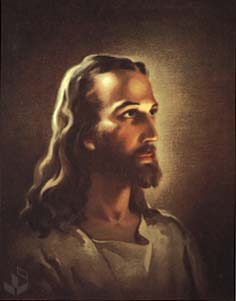
Warner Sallman (1892-1968) was an American painter of Christian subject matter, particularly scenes depicting Jesus Christ. He spent his life in Chicago, attending the Art Institute of Chicago. He was a devout Christian and a member of the Evangelical Covenant Church. Sallman became a commercial success in the 1930s and thereafter, creating a number of Christ scenes for distribution by Christian publishers.

Head of Christ. This famous Protestant icon began as a charcoal sketch composed in 1924 for the official magazine of Sallman's denomination. A publishing firm affiliated with the Church of God (Anderson) saw potential in his work, and began mass-marketing them. He created several versions over the years, the last and most popular of which was this one created in 1941.


Christ at Heart's Door. The lightly concealed heart of Jesus literally glows in reflection of a Biblical passage. It is a distinctively Protestant image, as art historian David Morgan wrote "For American Protestants whose spirituality is premised on the acceptance of a call and “born again” experience and its subsequent testimonial, this image articulates a central theological principle and has served to commemorate such experiences. "


Christ in the Garden. Here, Warner makes a theological statement about the divine persons present within the Garden. Light radiates from two sources: Jesus the Son and the Father above.

Pop Art Blogging: Andy Warhol and the Beauty of Capitalism

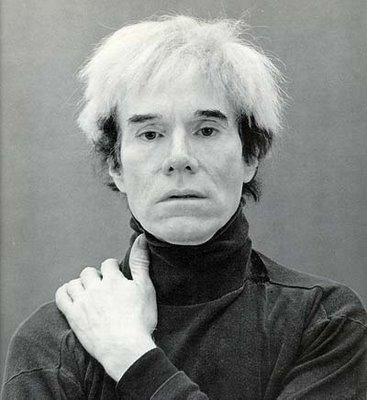
Any week-long series of posts addressing Pop Art must make mention of the famous American artist and filmmaker Andy Warhol (1928-1987). Warhol was born to Rusyn immigrant parents in Pittsburgh. He studied commercial art at Carnegie Mellon University before moving to New York City to become a commercial illustrator. During the 1960s, he launched to fame through his paintings of popular American products, such as Campbell's Soup and celebrities, such as Marilyn Monroe and Elizabeth Taylor. He founded "The Factory", a studio complex, which became the heart of the avant-garde NYC scene, all centered around Warhol's radiating celebrityhood and his entourage of artists, writers, and musicians. One of them, a mentally ill writer, shot him in 1968.

Warhol never fully recovered from these injuries, and the remaining two decades of Warhol's life were spent in increasingly commercial endeavors. He successfully predicted the rise of Neo-Expressionism in the 1980s and invested accordingly, becoming very wealthy. Weakened by complications of gallbladder surgery, he died in his sleep 1988.
210 Coca Cola Bottles (1962) from the Daros Collection.

As a Christian and especially as a seminarian, I hear consumerism under constant attack. This is mostly sound when it attacks excess, but foolish when it advocates poverty; that is, consumerism sounds terrible to those who are fabulously wealthy and can afford such blather. But to the poorest in the world, the idea of having mass-produced food, clothing, and medicine (all elements of consumerist economies) is wonderful. I've yet to hear someone who lives in a house with a dirt floor attack consumerism.

In a similar vein, Andy Warhol saw consumerism as a leveling force in capitalist society:

What's great about this country is that America started the tradition where the richest consumers buy essentially the same things as the poorest. You can be watching TV and see Coca-Cola, and you know that the President drinks Coke, Liz Taylor drinks Coke, and just think, you can drink Coke, too. A Coke is a Coke and no amount of money can get you a better Coke than the one the bum on the corner is drinking. All the Cokes are the same and all the Cokes are good. Liz Taylor knows it, the President knows it, the bum knows it, and you know it.

This week, I've disciplined myself to learn about an artistic movement that I knew nothing about. I was very skeptical at first because of what I perceived as a lack of technical artistic skill among its practitioners of the variety unmistakably present in Academic art. And it is truly possible that a creator of modern art forms may be able to hide a lack of technical talent behind pretended profundity. And in spite of my desire to be open-minded and not languish in Academicist provincialism, I insist that technical skill must play some role in discerning art from non-art. An artist must be capable of replicating in physical form the vision within his mind instead of shaping his vision to fit limited technical abilities. Bouguereau could create an Indiana if he so desired; Indiana could not create a Bouguereau in his wildest dreams.

But I must nonetheless express admiration for the Pop Artists. I may be misreading their movement through ignorance (I am not an art historian by any stretch), but I see in their works a vigorous defense of capitalism -- that art (and everything else) need not be restricted to the elites, but possessed by the masses. This is the beauty of capitalism: it is not perfect, but does the most good for the most number of people.

Saturday, January 20, 2007

Zombies: The Only Natural Predator of the Shark


It's a fake, of course. It's not a zombie, but a man dressed as a zombie. You can tell because he shows too much intelligence, retreating and then slipping under the shark to attack its belly. True zombies lack the necessary brain power for even the most elementary ruses.

Methodist Blogs Weekly Roundup # 101

Is now posted. My thanks to Allan for including me even though I forgot to send him my submission.

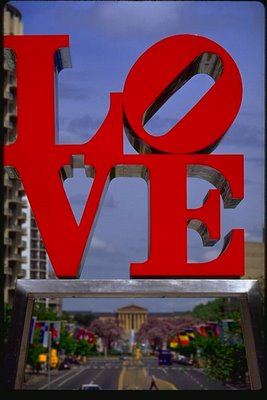
Pop Art Blogging: Robert Indiana

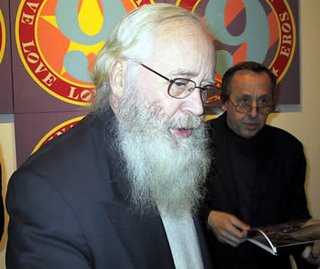
Robert Indiana (1928- ) is an American Pop artist. Born as Robert Clark, he studied at the Art Institute of Chicago and the Edinburgh College of Art. He developed a fascination with Americana, particularly signs and called himself a mere "sign painter". Indiana believes that the legacy of Pop Art is that it is available to the masses, not reserved to the elites of technical skill. In an interview:

Q: Is Pop Art easy art?
A: Yes, as opposed to one eminent critic's dictum that great art must necessarily be difficult art. Pop is instant art.

LOVE (1964) at LOVE Park in Philadelphia -- one of the dominant icons of Pop Art.


South Bend (1978) at the National Gallery of Art. Indiana has devoted much of his life to the creation of prints reflecting the text, numbers, symbols, and shapes of roadside signs, representing the Midwest that he grew up in.

What is Printmaking?

My only experience in printmaking is with linoleum blocks, so I found this interactive video describing the process of making a woodcut, etching, lithograph and screenprint from the Museum of Modern Art fascinating.

Friday, January 19, 2007

Should President Bush Be Put on Trial?

The protest against President Bush establishing his presidential library at Southern Methodist University began as a small petition from a handful of faculty, but has grown much, much larger:

The petition includes the signatures of two current and eight retired bishops out of about 170 current and retired bishops worldwide. Five other Methodist ministers also signed.

In one day, the online petition drew more than 4,000 names. While many signed in jest, comments from others show the petition became a touchstone for feelings about President Bush. Some key Methodist clergy and campus leaders quickly denounced the petition, saying it didn't represent the views of a majority of Methodists.

The petition itself reads:

As United Methodists, we believe that the linking of his presidency with a university bearing the Methodist name is utterly inappropriate.

It seems to me that if George Bush has not conducted himself as a United Methodist should, a first step should be to put him on trial in a church court. If convicted, then the petitioners would be correct.

¶ 2702.3 of The Book of Discipline (2004) reads:

A professing member of a local church may be charged with the following offenses, and, if so, may choose a trial: (a) immorality; (b) crime; (c) disobedience to the Order and Discipline of the United Methodist Church; (d) dissemination of doctrines contrary to the established standards of doctrine of The United Methodist Church; (d) sexual abuse; (f) sexual misconduct; (g) child abuse; (h) harassment, including, but not limited to racial and/or sexual harassment; (i) racial or gender discrimination; or (j) relationships and/or behaviors that undermine the ministry of persons serving within an appointment.

¶ 2703.4 describes judicial process specific to the laity:

In all cases, the pastor or district superintendent should take pastoral steps to resolve any complaints. If such pastoral response does not result in resolution and a written complaint is made against the professing member for any of the offenses in ¶ 2702.3, the pastor in charge or co-pastors (¶ 205.1) of the local church, in consultation with the district superintendent and the district lay leader, may appoint a committee on investigation consisting of four professing members and three clergy in full connection (both clergy and professing members must come from other congregations, exclusive of the churches of the respondent or the complainant). Committee members shall be in good standing and should be deemed of good character. The committee should reflect racial, ethnic, and gender diversity. When the pastor in charge is (or co-pastors are) bringing the charge, the district superintendent, in consultation with the district lay leader, shall appoint the committee on investigation. Five members shall constitute a quorum.

¶ 2705.4 details how the complaint process shall proceed for a layperson and ¶ 2714 describes the trial of a layperson.

So if the petitioners think that Bush has failed to be a faithful United Methodist, they should initiate this process.

So, a few questions for my readers:

  • Why has The Book of Discipline never been put online? I have to type out all of this stuff whenever I quote the BoD.
  • Should George Bush be prosecuted in the church courts?
  • And if so, on what basis?

Further thoughts from Dan Trabue and Stephen Fife.

(cross-posted)

Caption Contest

Previous contest winners

WINNER: Allan R. Bevere:

The new and improved Little Friskies with a mild sedative, works just a little too well.

Pop Art Blogging: Edward Ruscha

Edward Ruscha (1937- ) is an American Pop artist working in paint, printmaking, and film. Raised in Omaha and Oklahoma City, he was educated at the Chouinard Art Institute in Los Angeles. He began exhibiting in 1963 at the Ferus Gallery and rose within the Pop movement.


Standard Station (1966) at the MOMA. Ruscha hailed from the American heartland, dotted with the iconic Standard Oil station. With sleek, angular shapes, Ruscha depicts a modern colossus in our midst.


Lisp (1968) at the National Gallery of Art. Ruscha is fascinated by the visual appearance of sounds, such as the word 'lisp'. This ribbon of sound slides across the surface like a serpent, ending in droplets of spittle at the end of the letter p.


Hollywood is a Verb (1983) at the MOMA. No disagreement here.

Thursday, January 18, 2007

Bible Verse Memorization

Beth Quick heard Adam Hamilton speak about the importance of memorizing Scripture:

Hamilton also wondered why we don't teach people to memorize scripture anymore. Actually, I had a great deal of scripture memorization in my childhood church. Hamilton knew a Sunday School teacher who used the same approach as mine: bribery. I got paid a nickel for memorizing verses, which I did with dedication because of this incentive. I think on of the biggest mistakes liberals make actually is not knowing their scriptures well. I know my bible pretty well - it doesn't make sense to speak from it or argue for or against certain interpretations or whatever if you don't even have ready access in your mind to what you are talking about.

Although I'm a voracious reader of the Bible, I've never attempted to memorize parts of it. But it's time for a change. I'll memorize one verse a week, starting with Romans 3:23:

for all have sinned and fall short of the glory of God

Girl With Gloves by Tamara de Lempicka

Be sure to check out the Lempicka of the Week feature in my sidebar, which presently displays Girl With Gloves -- my favorite of Lempicka's work.

What's Your Personal Theme Song?

If your life had its own theme song, what would it be? Mine's Dreams by The Cranberries. I'm not sure why, but it's resonated with me strongly for fourteen years.


UPDATE: In the comments, Gavin Richardson writes:

i've always thought of something by 'they might be giants' maybe "birdhouse in your soul." not as intimidating as "shaft" but it'll do.

Having met Gavin, I agree that Shaft is definitely appropriate for him.

Buying In Bulk

Pop Art Blogging: Wayne Thiebaud

Wayne Thiebaud (1920- ) is an American Pop painter. He is most famous within that movement for his depiction of mass produced objects on assembly lines. He began executing such works in the 1950s, and rose to fame in the 1960s after Pop emerged as a distinctive movement. Thiebaud finds beauty in the everyday, especially the endless variety of everything present in an industrial, commercial age.


Cakes (1963) at the National Gallery of Art.


Lipstick Row (1970) at the Mary Ryan Gallery.


Gumball Machine (1971) at Craig F. Starr Associates. I especially like Thiebaud's careful creation of shading through straight lines.