Sunday, May 31, 2009

Art Blogging: Brandon Bond

Brandon Bond is an Atlanta-based tattoo artist. He began working at the age of seventeen and rose to fame in the tattooing world. Recently, he scaled back his productivity and opened up an elite parlor appropriately named A.N.T.I Art Elite.

You can view an interview of Brandon Bond here (language warning):

[Video Link]


Here are some examples of his work:


The GOP Death Spiral Ends

Tila Tequila, MTV reality TV show/porn star, will register as a Republican.

HT: DoublePlusUndead

Saturday, May 30, 2009

Static and Dynamic Views of Ecology

I read this Reuters article about the growing population of Burmese pythons in the Florida Everglades:

Wildlife biologists say the troublesome invaders -- dumped in the Everglades by pet owners who no longer want them -- have become a pest and pose a significant threat to endangered species like the wood stork and Key Largo woodrat.

"They eat things that we care about," said Skip Snow, an Everglades National Park biologist, as he showed a captured, 15-foot (4.6-meter) Burmese python to U.S. Interior Secretary Ken Salazar, who was on his first fact-finding mission to the Everglades since the Obama administration took office.

Emphasis added. I found it fascinating that this scientist labels the python as "bad" and the wood stork as "good". Why? Why does the python not have a place in the Everglades ecosystem?

Yes, humans introduced these snakes when pet owners decided that they grew too large. So what? Humans are a part of nature, too, right?

Right? Well, perhaps not everyone agrees. There seems to be a view of ecosystems as static entities, pristine Edens in which inhabitants leave in peace until Big Mean Humans intrude. Species die out only because of human activity. Change, such as the introduction of new species to an area, is inherently bad.

Why? I'd like to know exactly why it is important to kill off the python population. Why does this species have to die to make room for others?

Why is change bad?

Related thoughts: On Earth Day, Geek With A .45 pointed out that eventually, Mother Nature is going to kill us all. The sun will go nova and kill all life on earth:

I submit therefore, that while stewardship of our resources is a laudable and necessary thing, that ultimately, our planet is 100% expendable, down to the very last molecule towards the goal of our ultimate escape...Nature is pleased to eat us, or kill us in any of a number of lingering, nasty, painful ways.

I Love This Intel Commercial


[Video Link]

Friday, May 29, 2009

Star Wars Would Have Been Different If It Had Been Made by Benny Hill

There are no half-naked Gungans in this clip. I swear.

[Video Link]

I Must Buy and Consume This Product

Brawndo has got to be the awesomest energy drink ever created. It will not only quench your thirst, it will mutilate it.

[Video Link] HT: Stress Penguin

Thursday, May 28, 2009

Reblogged: Louis Favreau's Love Songs of the Real Man

Perhaps a more realistic version of romantic love.

[Video Link]

Two Girls, One Piano


[Video Link] Two very talented musicians/dancers play music on a giant piano. I think that it's a Bach organ piece, but I'm not sure. HT: Neatorama

Wednesday, May 27, 2009

The Soul of/in Work

Matthew B. Crawford is the author of the upcoming book Shop Class as Soulcraft: An Inquiry Into the Value of Work, as well as this fascinating essay in The New York Times.

The essay is an exploration of his careers, jobs, trades, and missions. Crawford holds a Ph.D. in political philosophy from a prestigious university and is currently employed as a motorcycle mechanic. He contrasts the unreality of work in the information age with the objective physical realities of manual trades. Success is less subjective and more tangible when repairing a motorcycle.

This is not your typical I-was-dying-in-my-cubicle story. Crawford is writing about the need to do important, or at least useful things; tasks that make the world a better place, even in a very small way.

I went through a phase like that during, well, most of my life, I suppose. But I've outgrown it. Now I only care about getting a paycheck, whether or not the work is consequential. I'm more Tyler Durden than Matthew Crawford.

Well, maybe not Tyler Durden. I don't seek to sabotage society; I just don't care about it. Still, I can understand Crawford's point of view and the mental space that he presently occupies. And it's always a good idea to learn a trade, anyway.


HT: Arts Journal

Tuesday, May 26, 2009

The Lyrics to the Theme Song of The Andy Griffith Show

I'm sure that most of my readers are familiar with this whistled tune:

[Video Link]

The tune is that of the song called "The Fishin' Hole". Here are the lyrics:

Well, now, take down your fishin' pole and meet me at The Fishin' Hole,
We may not get a bite all day, but don't you rush away.

What a great place to rest your bones and mighty fine for skippin' stones,
You'll feel fresh as a lemonade, a-settin' in the shade.

Whether it's hot, whether it's cool, oh what a spot for whistlin' like a fool.

What a fine day to take a stroll and wander by The Fishin' Hole,
I can't think of a better way to pass the time o' day.

We'll have no need to call the roll when we get to The Fishin' Hole,
There'll be you, me, and Old Dog Trey, to doodle time away.

If we don't hook a perch or bass, we'll cool our toes in dewy grass,
Or else pull up a weed to chaw, and maybe set and jaw.

Hangin' around, takin' our ease, watchin' that hound a-scratchin' at his fleas.

Come on, take down your fishin' pole and meet me at The Fishin' Hole,
I can't think of a better way to pass the time o' day.


Here is a recording of Andy Griffith singing the song:

[Video Link]

A Twitter Feed Worth Reading

I'm fairly skeptical of the utility of twitter, which would seem to me to have limited applications. But one such application is rapid-fire one-liner comedy, such as that on Favrd. Here's an example of one of their tweets:

A man in my town robbed a convenience store wearing a Bud Light box over his head. We are a resourceful people.

How to Fake an Appreciation of Art

A clear and thoughtful instructional guide on bluffing your way through an aesthetic conversation.

[Video Link] HT: Juxtapoz

How Juxtapoz Magazine Changed the World

Greg Beato has a new article up at Reason about the upcoming 100th issue of Juxtapoz, the magazine that ushered in the Lowbrow Art movement. This led to an egalitarianization trend in the art world:

They evoked movie posters, tattoos, comic books, and pulp novels, and while they contained plenty of surrealist ambiguity, they didn't require an aesthetic translator from Artforum to decode them. Fine art, Juxtapoz insisted, could speak to more than just curators, collectors, gallery owners, and critics. It could speak to a much wider audience, and not just from the tastefully generic walls of the nation's most corporate-sponsored museums. A Zippo lighter, a skateboard, a pair of sneakers—they were all potential canvases.

I wrote about this subject previously here. Beato notes that Juxtapoz currently has a higher circulation than any other art magazine in America, including more highbrow fare. Art is for everyone, regardless of artificial social distinctions. Juxtapoz is helping to erode those barriers.

Monday, May 25, 2009

A Nursery Rhyme That I Have Modified for My Daughter

Five little zombies
I once knew
Big ones, small ones, skinny ones, too
But the one little zombie

That was missing an arm
He led the others with his
"Rhrarr, Rharr, Rhrarr!"

Down to the village
They would go
A-stagger, stagger,
Stagger, stagger
To and fro

But the one little zombie
That was missing an arm
He led the others with his
"Rhrarr, Rharr, Rhrarr!"


My thanks to my mother-in-law, an elementary school music teacher, for introducing me to this song.

In other undead news: the Boston Police Department used its official twitter feed to confirm that it would warn the public if officers suspected that a zombie outbreak had occurred. (HT: DPUD)

Sunday, May 24, 2009

Johnny Got His Gun by Dalton Trumbo

I first encountered this book on Pop Crunch's list of the ten most disturbing books of all time. It is the story of Joe, an American soldier from the First World War whose arms, legs, and face are blown off by an artillery shell in the final weeks of the war.

He wakes up to find that he is completely immobile. Joe has no sense of hearing, sight, taste, or smell. He is trapped inside of his own mind, unable to tell dreams from reality or know about the world around him.

This book was apparently very controversial when first released in 1938. It was immediately picked up by the pacifist movement in America as a voice against war and, eventually, U.S. entry into World War II. Trumbo was a Communist, and in the introduction of the edition that I read, noted the irony that it was initially unpopular with his colleagues until the Nazi-Soviet pact, when they reversed themselves and instead sang its praises.

Trumbo himself saw the second war as quite different from the first, and was not inclined to oppose it. After it ended, however, he was convicted of contempt of Congress (is that a crime? I have nothing but contempt for Congress) for refusing to testify before the House Un-American Activities Committee.

Johnny Got His Gun is not a pacifist book in the sense that it morally opposes violence. Rather, it is extremely skeptical of war and its advocates. For example, while in the prison of his mind, Joe contemplates:

No sir anybody who went out and got into the front line trenches to fight for liberty was a goddam fool and the guy who got him there was a liar. Next time anybody came gabbling to him about liberty -- what did he mean next time? There wasn't going to be any next time for him. but the hell with that. If there could be a next time and somebody said let's fight for liberty he would say mister my life is important. I'm not a fool and when I swap my life for liberty I've got to know in advance what liberty is and whose idea of liberty we're talking about and just how much of that liberty we're going to have. And what's more mister are you as much interested in this liberty as you want me to be? And maybe too much liberty will be as bad as too little liberty and I think you're a goddam fourflusher talking through your hat and I've already decided that I like the liberty I've got right here and the liberty to walk and see and hear and eat and sleep with my girl. I think I like that liberty better than fighting for a lot of things we won't get and ending up without any liberty at all.

Joe is a victim of World War I, and if there is ever a war worthy of skepticism, it's that one. His fate, trapped inside of his mind in a senseless body in what he thinks is a hospital bed, actually gets worse at the end of the book. There is no happy ending. Johnny Got His Gun is a grueling depiction of human suffering and human evil. It is brilliantly written.

Metallica released a song entitled "One" in 1988 based on this book:


[Video Link]

Saturday, May 23, 2009

Art Blogging: Isabel Samaras

Isabel Samaras, a native of New York City, attended the Parsons School of Design, where she studied illustration. She lives and works in San Francisco, and is noted for her juxtapositions of Baby Boomer pop culture and iconic images from Western art. A fine example is the painting The Birth of Ginger, a reflection of Gilligan's Island and Sandro Botticelli's The Birth of Venus.

Wish, which is modeled on La Grande Odalisque by Jean-Auguste-Dominque Ingres. In an interview, Samaras said:

So I hope people looking at the paintings enjoy them as objects of beauty, mystery and humor. How many onion layers they can peel is sort of up to them but I hope they work for people who have no TV/pop culture or art history background just as something interesting, intriguing and lovely. (Even if you knew nothing of Batman or mythology, it should be a compelling image. Who are these people? What are they doing? And why?)

The Judgment of Batman, featuring all three women who played Catwoman on the 1960s TV show. It's modeled on The Judgment of Paris by Peter Paul Rubens. This is one of Samaras' works of oil on a metal tray -- one of her common media.

Pounding Feet, II

Today, I beat my old record and ran six miles in sixty minutes.

Thursday, May 21, 2009

TuSpock: Half Vulcan, Half Gangsta Rapper


A video from Jimmy Fallon, kickin' it Mount Tar'Hana style. Featuring the Enterprise (NCC-1701) converted into a lowrider.

HT: Topless Robot

How Scientific Information Moves Through the News Cycle

A funny explanation from PhD Comics. As a blogger, I play a critical role in this model by exaggerating correlations and conflating them with causality in order to drive up traffic.

HT: Hit & Run.

Sometimes It's Better to Remain Uninformed than Misinformed

A couple of weeks ago, I checked out the book Emergency: This Book Will Save Your Life by Neil Strauss. It is one writer's tale about how he decided to learn to cope with all sorts of emergencies. He learned how to shoot effectively, escape from a country, slip out of bonds, survive in the wilderness, fly an airplane, and many other survival skills.

I really looked forward to reading it. But about three chapters in, I stopped.

Strauss' story seemed suspicious. It's not really an instruction manual, but his story about how he came to adopt a survivalist attitude and equip himself appropriately. It was a gripping and often funny story. And that's what made me suspicious. It was written like a novel, and real life doesn't look like a novel plotline, nor people like novel characters.

Or rather, Strauss' book is such a seamless narrative and filled with such rich characters as too be unlikely to be factual. The story was just too good to be true.

Which made me wonder if any of the practical information that he provided was accurate. Probably some of it was. But it was also likely that he made up a lot of his experiences because it would make a good story.

How could I tell the difference? I couldn't, and I wouldn't want to incorporate faulty survival knowledge into my own mind, especially when I couldn't tell Strauss' fiction apart from his non-fiction.

It was similar to Dutch: A Memoir of Ronald Reagan by Edmund Morris. This 1999 book was something of a biography, and something of a novel, or sometimes called a "fictionalized biography". It was controversial at the time because it was unclear exactly which elements were intended to be factual and which were imaginative.

But at least Morris was forthright about the fuzzyness of the truth of his book. Not so Strauss.

Of course, I could be wrong, and maybe everything in Emergency really did happen as the author describes it. But I'm skeptical.

So I stopped reading the book. Because sometimes it's better to not know -- and to know that you don't know something -- than to know what isn't so. It's like the old proverb "It's not what people know that causes problems; it's what they know that isn't so." And I'd rather know that I don't know, than know what isn't so.

My First Advertiser

Whoo-hoo! I'm getting paid to blog! Travel Time, a travel information site, is my very first advertiser. It appears to be a gateway site to TA and booking agencies. Check it out. And thanks to their sponsorship, I have a few more dollars in my trip-to-Tahiti fund!

Wednesday, May 20, 2009

Beef Jerky Underwear


Well, now I have a gift for my wife on our anniversary.

What, you guys have never bought lingerie for your wives?

HT: Geekologie

Legalize Drugs and Prostitution...Then Tax Them!

Like Nick Schulz, I find the notion that government should legalize the activities of consenting adults in order to financially exploit them...philosophically insufficient.

Sodomy laws, for example, should be repealed if for no other reason than that it's none of your damn business what consenting adults do in the privacy of their bedrooms.

[Although I haven't heard anyone propose that sodomy laws be repealed so that gay sex can be taxed. That would be an interesting piece of legislation.]

I'm glad to hear of people who favor drug and prostitution legalization. But those who do so with a taxation proviso aren't truly supporting limited government. They're just advocating a different flavor of government intrusion. The farmer who doesn't kill the golden goose, but still takes its eggs, is still exploiting the goose.

And that's not going to cut it in a free society.

New Study: 1 in 4 Americans Send Text Messages While Driving

Crazy. I can't imagine even attempting to text while driving. How could I hold my beer?

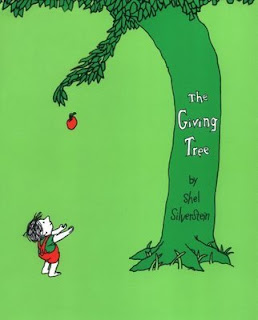
The Giving Tree by Shel Silverstein

It's a children's classic. But I don't like it. Nay, I loathe it, and have for years.

It is a story about a lifelong abusive relationship, and the story implicitly endorses submitting to an abusive relationship -- in the name of love -- as a good thing.

I got to thinking about The Giving Tree after reading this parody of it (H/T). It's more concerned with politics than relationships, but the final page has the tree quite properly telling the boy "You're a real dick."

He sure is.

I've heard it said that it's really about the unconditional love that a parent has for a child. And I'm glad for the unconditional love that my parents have for me. Shoot, they've bailed my adult ass out on more than one occasion. For that, I am grateful, and ashamed that it was necessary for them to do so. But I am certainly not, as the boy is to the tree, never thanking them and only looking for new ways to exploit them.

A better analogy for the story is an abusive spouse. The boy is a husband who orders their lives according to his selfish desires, and regards his wife as only a resource to be drained, physically, emotionally, and financially. And then runs off and has his fun.

Some people get trapped into abusive relationships, and the bonds that trap them are unconditional commitments that they make to love a person, no matter how unworthy that person becomes of that love. The victim sees him/herself as somehow ennobled by a willingness to endure abuse and live a lie for the sake of an ideal.

But there is nothing noble about slavery. There is nothing noble about enduring abuse for its own sake. There is, on the contrary, a moral duty to oneself; to say "I am more than a victim, and I will act accordingly."

This is basically the same rationale I followed when I left Christianity. What I was doing, quite consciously at the time, was exiting an abusive relationship with the Church. There may have been reasons to endure the abuse in silence (e.g. financially provide for my family), but one of those reasons was not that I had an inherent moral duty to do so.

And neither do you. You're a human being, and you're valuable. Whether you want to arrive at that conclusion from an imago Dei perspective, a humanist perspective, or something else entirely, you have intrinsic worth to yourself merely by being human.

You don't have to stay in an abusive relationship. And if anyone tells you otherwise, just say "You're a real dick."

Tuesday, May 19, 2009

How to Save the GOP

Although I don't have a dog in this fight, I admit that this is the most practical plan that I've encountered so far that retains core Republican principles.

HT: Instapundit

Canons of Great Literature

I remember back in seminary a professor excoriated me for selecting unpopular, if not virtually unknown books as influential in my life. I had demonstrated a lack of spiritual maturity by not agreeing with his choices.

There's a lot of literary spinach out there -- stuff that's supposed to be good for you, even if it's boring. Well, I don't really care what people think of my tastes in art, literature, or anything else. Every now and then I get the bug to try out heavy literature. Recently, it was Kerouac's On the Road. Before that, it was Nabokov's Lolita. But if it doesn't grab me, I put it down and read something else.

Years ago, I met a high school girl who kept a copy of Atlas Shrugged around. She would pull it out and conspicuously read from it so that people would be impressed by her intelligence. And I think that many of the works that make it into and stay in the canon of great literature do so only because rejecting them would make a person like a dullard. Sort of like abstract art.

As for me, I don't apologize for what I like and what I don't like.

Which is not to say that there is not an advantage to a culture asserting an aesthetic canon. A common body of literature (or other arts) gives cohesion to members of that culture. Darmok and Jalad at Tanagra and all that. But at a certain point, it's time to strike out on one's own and set one's own aesthetic values.

The 10 Greatest Libertarian Science Fiction Stories

I have not read any of these books. I've read a bit of Heinlein, but not Stranger. Alfred Bester's The Stars My Destination looks interesting.

HT: Hit & Run

Monday, May 18, 2009

Get Ahead in the Blogging World

So it's been going around the Internet that The Huffington Post is offering an internship at the price of $15,000. That's right -- not only will you not be paid for this internship, you have to pay. A lot!

It seems to surprise a lot of folks that a lot of internships require cash payment, and not the reverse. Still, I can understand why many people are balking at HuffPo's steep price.

That's why I'd like to offer readers a year-long internship here at The Zeray Gazette for a mere $7,500. You'll have the opportunity to work at a premier blogging enterprise and among some of the blogosphere's most thoughtful and insightful public intellectuals, such as myself. Take advantage of our benefits, such as free criticism and clothing-optional Fridays. Live the dream that you've held since you first started reading this blog.

Just hit the tip jar in the sidebar and copy/paste your resume in the comments.

Zombie Jamboree

A cute Caribbean song performed by the Kingston Trio.


[Video Link] HT: Instapundit


In other news: Zombie Ants! We are utterly screwed now. (HT: Ben)

Question of the Day

Frank Warren, the artist behind Post Secret, recently delivered the commencement address at St. Mary’s College in Maryland. In preparation for it, he asked members of the graduating class to write a one-sentence response to the question “What do my classmates, and I, need to hear on Graduation Day?” Here are a few of his responses:

Be wise enough not to be reckless, but brave enough to take great risks.

It’s okay to fail – learn from it and you will succeed.

It’s better to be pissed-off than pissed-on.


If you were to asked to deliver a commencement speech that was only one sentence long, what would it be?

Sunday, May 17, 2009

Il Gatto

An excellent short film by Peter Atencio. It's about the love that a woman has for her kitty cat -- and her quest for vengence against the man who accidentally drove over it. Clearly modeled on Tarantino's Grindhouse films.
Il Gatto - watch more funny videos


Did ya'll ever see Tarantino's Death Proof? Awesome movie.

Star Trek vs. Star Wars

I'll always side with Trek on this debate, but this College Humor video points out that their plots are basically the same.

UPDATE: Okay, the embed code isn't working. Here's the hard link to the video.

Saturday, May 16, 2009

Art Blogging: Antonio Canova

Antonio Canova (1757-1822) was an Italian Academic sculptor. He was born in the foothills of the Venetian Alps, but soon moved to Rome after the death of his father. There, his grandfather taught him stone cutting, which was the family profession. Canova showed prodigious talent for carving devotional statuary and acquired a wealthy patron in Venice. This enabled him to seek further formal training. Archaeological studies captivated him, launching his Neoclassical focus that would dominate his life's work. Canova became the most sought-after sculptor of his age and attracted offers from across the Continent.
Theseus and the Centaur (marble, Kunsthistor- isches Museum in Vienna). A product of the Enlightenment, Canova rendered perfect versions of an idealized human form. He could capture a single moment in time and make it look like a moving scene. Look at the centaur's body -- you can almost see his legs collapse under him.
Cupid and Psyche (marble, the Hermitage at St. Petersburg). Jealous of the beauty of mortal girl Psyche, Venus ordered her son Cupid to cause her to fall in love with the most vile creature on earth. Cupid tried to do as his mother wished, but fell in love with Psyche upon seeing her for the first time. Distracted by her beauty, he accidentally pierced himself with his own arrows. Canova captured this romantic icon magnificently.
Letizia Ramolino Bonaparte (marble, private collection). Canova was in high demand for portraits and sarcophogal sculptures, such as this one of Napoleon Bonapatre's mother. Bonapatre was an admirer of Canova and patronized his services heavily.

Thursday, May 14, 2009

Awkward Family Photos


An archive of family photos that went hilariously wrong.

What Causes an Internet Meme?

Gavin asks a very interesting question:

it has me thinking, what gives some web sensation staying power?

What makes some video, idea, or motif a predominant meme? Why do people blog about bacon, zombies, and lolcats, but not so much about pork shoulder roast, mummies, and parakeets? Why does one guy mouthing the words to Numa Numa in front of his PC become famous, while almost all others who do likewise do not?

I don't have any answers, but I'm thinking out loud. Perhaps commentors and bloggers can bounce these ideas around:

Penetrability. Modern Internet life virtually obliterates geographic barriers and invents new communities based upon common interests. Language remains a barrier in cyberspace (for now), but otherwise cuts across physical boundaries. But netizens still tend to focus their activities in their niche communities, limiting contact outside of them.

For example, I read a variety of conservative and libertarian political blogs, as well as geekery and gun blogs. So if a meme gains traction within those communities, I have a good chance of encountering it. But if, for example, a meme moves through the Canadian blogosphere, I'm unlikely to encounter it because I rarely read Canada-focused blogs.

Some fora retain enormous reach through a vast variety of niche communities. Neatorama is an example, pulling interest from very different communities. It is highly unusual of me to encounter a commentor there that I have read from or heard of anywhere else. Neatorama and similar fora transcend these already-permeable cyber community boundaries to bring strangers into contact with each other. Such fora have enormous penetrability, and the presence of memes on these fora can vastly increase their scope.

Instantaneous Comprehensibility. Can a meme be grasped in under 10 seconds -- or summarized in under ten words.

Example: Britain's Got Talent singer wallflower single homely inner beauty.

What Internet meme do these keywords describe? The Susan Boyle video. Which, by the way, I've never actually seen. But tell me that that isn't what the meme is about.

An Internet meme thrives if it can be understood within the short attention span of netizens.


Those are just my thoughts for the moment. What do you think? What causes an Internet meme?

Wednesday, May 13, 2009

The 10 Most Disturbing Books of All Time

Pop Crunch has a great list up. It's more like the most disturbing books written in the 20th Century, but still quite intriguing.

I read The Turner Diaries in college after the Oklahoma City bombing.

William Burroughs' Naked Lunch is already on my short list of upcoming reads.

Blindness by Jose Saramago looks interesting, so I've ordered it.

And my wife has already recommended Cormac McCarthy's The Road to me.

What have you read that's on the list?

HT: Neatorama

Tuesday, May 12, 2009

My Current Read: The Fellowship of the Ring

Okay, I'll just come out and admit it: I've never read The Lord of the Rings.

Go ahead and try to revoke my geek credentials. I won't hide in shame any longer.

I will, however, remedy this situation, now that I have time to read on a regular basis.

When I was 14, I tried to read The Hobbit, and found it quite dull. My wife suggested to start on Fellowship, and it has proven reasonably engaging.


Ahhh....

Confession is good for the soul.

Monday, May 11, 2009

Staring Down Trekkie Thugs

In this Saturday Night Live clip, two stars of the new Star Trek movie discuss being harrassed by fans.

HT: Topless Robot

Dog Urine Lowers Heart-Attack Risk, Say Snickering Researchers

A great story from The Onion.

Star Trek/Monty Python Mashup

This has been around the intertubes for a while, but some of you readers may have missed this gem that mixes scenes from the original Star Trek and the Camelot song from Monty Python and the Holy Grail.

[Video Link] Hat tip to BoingBoing via Popped Culture

The Liberalism of Star Trek

Michael Westmoreland-White has written a lengthy and thoughtful analysis of life in the Star Trek universe. It's a very liberal view of the future. He uses the term "progressive", which I tend to avoid as somewhat misleading, but, like, whatever. It's still a fine post:

But I do think that Star Trek is a fairly progressive/liberal science fiction franchise. It’s a basically hopeful vision of the future. It offers up a future earth that has survived war, terrorism, and ecological disasters and forged a global government of representative democracy (we are never told this, but it must be some form of federalist system to avoid tyranny). Hunger and poverty have been overcome. Most diseases have been conquered and high quality universal healthcare is available for all. Education is free and the world is highly literate with most people going beyond secondary education. It’s a clean energy society that is eco-friendly. (In Star Trek IV, the Enterprise crew in their stolen Klingon ship actually go back in time to the 20th C. to keep whales from going extinct–and in the process save the earth of their future.) There is finally global racial harmony. And, despite the micro-mini-skirted uniforms that reflected the fact that the original series was made in the ’60s, we finally have gender equality, too.

My own thoughts on the subject are here.

Question of the Day

Which season is it?
Duck season
Wabbit season
  
pollcode.com free polls

Sunday, May 10, 2009

Bloody Mary

Remember the bit of folklore that say that if you say "Biggie Smalls" three times into a mirror on a Halloween night, Biggie Smalls will come out of the mirror and put a cap in your ass? It has wider implications. A compilation of short short films by Dutch West:
Dutch West Short Shorts: Zombies Interrupt Family Dinner

Saturday, May 09, 2009

Metallica's Enter Sandman

Performed on kazoos. (HT: YBNBY)

(YouTube Link)

Performed by a cello quintet (Apocalyptica).

(YouTube Link)

Performed by a bluegrass band (Iron Horse).

(YouTube Link)

And the original by one of the awesomest bands ever.

(YouTube Link)

UPDATE: In the comments, DMinor directs us to the Pat Boone version of Enter Sandman. Thanks, DMinor!

Friday, May 08, 2009

My Little Pony: The Action Movie

It's like Independence Day, but for little girls or Tom Jackson.

[Video Link] HT: Topless Robot

A Catchy Song about the Zombie on Your Lawn

It's stuck in my head.

[Video Link] HT: Topless Robot

An Excellent Episode of The Outer Limits

The newer series, which is good. The original was pretty bad.

I remember seeing this episode back when it originally aired. It seems rather relevant to my life right now.

It is a story of a religious commune led by a charismatic man who is addressed as "Father". They decide to build a new and simpler life for themselves in a wilderness area of the American West. At least, that's what the rank and believe, until three men discover a terrible secret.

It is a story that expresses my own emerging view about how faith can be used to control and dominate others


[Video Link]

Thursday, May 07, 2009

Highbrow, Lowbrow, Mebrow, Youbrow

John Derbyshire laments the decline of high art in America:

Well, pop culture has always been there; and while it's now pretty much all filth, there are still a few diamonds in amongst the dung — a movie, a song, a sitcom that is fun, even instructive, even moving. It sure has swamped high culture, though, with a mighty assist from the "Higher Superstition" of those college flim-flam courses in literary deconstruction, post-colonial studies, and the like. High culture just ran out of gas some time in the early 20th century. It is now a museum culture: pictures painted 400 years ago, symphonies written 200 years ago, operas, poems, and novels written 100 years ago.

Somewhere in Goebbels' diaries there is a passage that haunts me. He's going down into the bunker for one of the last times, as the allies close on Berlin, and he expresses his joy at the sight of "bourgeois civilization" disappearing in flames. (How they loved their Wagner!) He was of course right. Now we have Madonna, Damien Hirst, Milton Babbitt, Regietheater, and Maya Angelou.

There ain't no such thing as high art and low art, as I've written before. In terms of the work of art itself, there are no distinguishing criteria between fine and commercial arts (tell me why a Jackson Pollock is aesthetically superior to a Mitch McConnell). What separates highbrow culture and lowbrow culture are context and audience.

Was the work created for its own sake, or to sell something? Was it created for a gallery or a magazine? Was it a solitary work or mass produced? These questions determine the context in which the work of art was created.

The answers point us to the audience of the work: who created it and (more importantly) for whom? Was it created for commoners or the elites? This is the only true distinction; the sole reason that there is a motivation to separate high culture from low culture: classism. It is the fear that the lower classes might prefer arts of their own; that they might make aesthetic decisions on their own; and worst of all, that even if given the choice, they might prefer not to hear the aria in the symphony hall or read the confusion of a Joyce novel.

The lower classes might cease to envy the elites. And that would be intolerable.

A Brief History of the Klingon Language

Linguist Arika Okrent has written an article for Slate about the origins and structures of the Klingon language:

As if that weren't complicated enough, Klingon also has a large set of suffixes. Attached to the end of the verbs SIQ and chep is the ending -jaj, which expresses "a desire or wish on the part of the speaker that something take place in the future." Klingon has 36 verb suffixes and 26 noun suffixes that express everything from negation to causality to possession to how willing a speaker is to vouch for the accuracy of what he says. By piling on these suffixes, one after the other, you can pack a lot of meaning on to a single word in Klingon—words like nuHegh'eghrupqa'moHlaHbe'law'lI'neS, which translates roughly to: They are apparently unable to cause us to prepare to resume honorable suicide (in progress).

Just saying a word like this one requires Klingon-like discipline and fortitude. To the layman, the time commitment involved in studying this invented language may seem ridiculous—why not take up a language with practical value, one that might earn you a little respect, or at least not encourage jeers? But Klingon isn't about practicality, or status, or even about love for the original Star Trek series. It's about language for language's sake, and the joy of doing something that's not easy, without regard for worldly recognition. Hence the Klingon Hamlet, which took years to compose and which maybe 100 people can appreciate. What a piece of work is man indeed. Or as Wil'yam Shex'pir would put it, toH, chovnatlh Doj ghaH tlhIngan'e'—"A Klingon is an impressive specimen."

I tried to teach myself Klingon when I was twelve. Now, like my Spanish, I remember just enough to get into a bar fight in Tijuana.

The Future and Its Enemies by Virginia Postrel

My current read is The Future and Its Enemies: The Growing Conflict Over Creativity, Enterprise, and Progress by Virginia Postrel. Written in 1998, its analysis has proven prescient.

Postrel divides people, particularly public intellectuals, into two groups: those who embrace the future and those who fear it. Or, more largely, those who are willing to live in a world of constant, dynamic change, and those who prefer stasis.

So far, she outlines these two camps according to their responses to perceived needs in the future. The dynamist point of view (a term that, I take it, she coined) thinks that the best outcome will emerge from the spontaneous order created by the free market of goods and ideas. The stasist perspective thinks that the future should be regulated by an elite that will know what is best for society as a whole.

Her ideas are familiar to me, as I have encountered the view that poverty is better than wealth. I reject it.

Wednesday, May 06, 2009

Finishing On the Road

Last night, I finished reading Jack Kerouac's On the Road.

It's said to be a semi-autobiographical novel in which Kerouac is represented by the narrator, Sal Paradise. Numerous other characters have been identified by scholars as different figures in the Beat movement.

But Kerouac did something that I don't think I've ever seen in another novel. In most novels, the reader knows who is the main character within the first chapter or two. The conventional structure of a novel makes it plain early on who is the focus of the plot. I hadn't realized this until Kerouac presented a different way of structuring his novel.

But On the Road isn't an autobiographical novel -- not in the strictest sense. It's not about Sal Paradise. It's about Dean Moriarty.

This is not plain at the outset of the novel, when Dean is simply one of many people in Sal's life. But as it progresses, Dean increasingly becomes the topic of the bulk of the text. And while one can infer much about Sal's personality, Kerouac describes Dean's nature directly and repeatedly.

Critics think that Dean is based upon Beat icon Neal Cassady, which makes the novel even more interesting. If true, On the Road is, in a way, a hagiography of Cassady. He is a deeply flawed hero. But no matter how irresponsible Dean is -- even when he abandons the dysentery-stricken Sal in Mexico City -- Sal reveres him. Dean is the "Holy Goof" -- whose joy captivates Sal and inspires only devotion.

So On the Road is a tribute by Kerouac to one of his friends. I wonder what Cassady thought of the novel when he read it?

Armed College Student Prevents Massacre

You probably won't hear much about this news story because ten students weren't slaughtered by lunatics. That's why it's important to give it as much publicity as possible and point out that armed, trained, responsible citizens prevent crime.

Tuesday, May 05, 2009

Warning Labels from the U.S.S. Enterprise

From Cracked.com, where you'll also find a flowchart explaining how Captain Kirk makes decisions.

Question of the Day

Should the United States replace the electoral college with the direct, popular election of Presidents?

Not Another Trek Movie

Star Trek reimagined as a teen movie.

[Video Link] HT: Topless Robot

More of My First Dictionary

There are more additions to My First Dictionary, a hilarious satirical children's dictionary by Ross Horsley. Just keep scrolling.

Monday, May 04, 2009

More from On the Road

I have continued to read On the Road by Jack Kerouac, and I am fascinated by the character of Dean Moriarty. He is Sal's primary traveling companion across the highways. Dean is perennially self-destructive, irresponsible, and even criminal. Yet he expresses one truly laudable trait: at every moment of his life, he is trying to squeeze out every last drop of joy. He is a truly happy person who takes delight in everything he sees. Dean spends much of the novel literally whooping with glee at the most ordinary things, envisioning beauty where others would only see ugliness.

Toward the end of the novel, Sal, Dean, and Stan are journeying through Mexico:

"Yes," said Dean and drove right on at five miles an hour. He was knocked out, he didn't have to do the usual things he would have done in America. "There's millions of them all along the road!" he said. Nevertheless he U-turned and came by the girls again. They were headed for work in the fields; they smiled at us. Dean stared at them with rocky eyes. "Damn," he said under his breath. "Oh! This is too great to be true. Gurls, gurls. And particularly right now in my stage and condition, Sal, I am digging the interiors of these homes and we pass them -- those gone doorways and you look inside and see beds of straw and little brown kids sleeping and stirring to wake, their thoughts congealing from the empty mind of sleep, their selves rising, and the mothers cooking up breakfast in iron pots, and dig them shutters they have for windows and the old men, the old men are so cool and grand and not bothered by anything. There's no suspicion here, nothing like that. Everybody's cool, everybody looks at you with such straight brown eyes and they don't say anything, just look, and in that look all of the human qualities are soft and subdued and still there. Dig all the foolish stories you read about Mexico and sleeping gringos and all that crap -- and crap about greasers and so on -- and all it is, people here are straight and kind and don't put down any bull. I'm so amazed by this." Schooled in the raw road night, Dean was come into the world to see it.

Bad News About the New Star Trek Movie


Trekkies Bash New Star Trek Film As 'Fun, Watchable'

Sunday, May 03, 2009

Question of the Day

Should polygamy be legalized?

President Evil

President Evil is a new comic book from Antarctic Press about Barack Obama leading the fight against the armies of the undead. Similar to Planet Terror, the zombies are the results of experiments performed on soldiers to enhance their combat abilities.

Nuke 'Em

In this magnificent 17-minute video, Bill Whittle demolishes the idea that the U.S. atomic bombing of Hiroshima and Nagasaki was unnecessary. (H/T)

Previous related discussion here.

FYI

If you capture a James Rummel, tie him up with red-colored rope, and rub his belly, he has to grant you three wishes.

I swear it's true. Try it.

Why do you think that he engages in concealed carry? It's because he doesn't like to give out wishes. The 'personal safety' shtick is just a cover story.

Saturday, May 02, 2009

Art Blogging: Mitch McConnell

Mitch McConnell is an American lowbrow artist who works in printmaking, painting, illustration, and tattooing. He's 48 years old and lives in Chicago. That's all of the information that I can find, so this won't be one of my more informative art blogging posts. Still, his stuff is quite cool, so it's worth looking at. There's no information about individual images, so I'd only be guessing about media, date, etc. Who cares? Pretty pictures -- just enjoy.


Friday, May 01, 2009

Is Anyone Surprised?


Which Disney Princess Are You?

You are Belle. You are strong, deep, and you are not a slave to petty superficial things. You are independent and allow yourself to see inner beauty without sacrificing your values. You are almost too good of a person.

Find Your Character @ BrainFall.com