Showing posts with label science. Show all posts

Monday, February 22, 2010

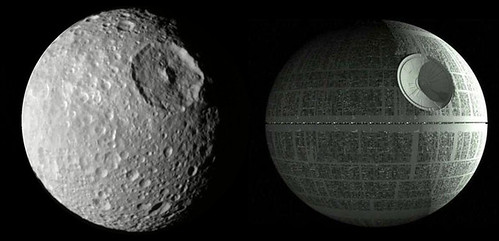
Moon of Saturn Looks like the Death Star

saturn moon


This picture of Mimas, a moon of Saturn with an 88-mile wide crater across its surface, looks like the Death Star.

Link via YBNBY

Physicist: Sci-Fi Movies Should Be Allowed Only One Major Violation of Laws of Physics

Sidney Perkowitz, professor of physics at Emory University and scientific advisor on the set of many movies, argues that Hollywood should reign in the bad science:

Professor Perkowitz said he liked Starship Troopers, but criticised its giant insects, saying if you scaled up a real bug to that size it would collapse under its own weight. He hated The Core, in which a team of scientists travel to the centre of the Earth and detonate a nuclear device to start the planet's core spinning again.[...]

''I am not offended if they make one big scientific blunder in a given film,'' Professor Perkowitz said. ''You can have things move faster than the speed of light if you want. But after that I would like things developed in a coherent way.

''If you violate that you are in trouble. The chances are that the public will pick it up and that is what matters to Hollywood. The Core did not make money because people understood the science was so out to lunch.'

via reddit

Wednesday, February 17, 2010

Scientists: Stray Hydrogen Atoms Can Kill Starships Traveling Faster Than Light

Some 'scientists' are arguing that single atoms in space become deadly hazards at faster-than-light speeds:

Interstellar space is an empty place. For every cubic centimetre, there are fewer than two hydrogen atoms, on average, compared with 30 billion billion atoms of air here on Earth.[...]

Special relativity describes how space and time are distorted for observers travelling at different speeds. For the crew of a spacecraft ramping up to light speed, interstellar space would appear highly compressed, thereby increasing the number of hydrogen atoms hitting the craft.[...]

The spacecraft's hull would provide little protection. Edelstein calculates that a 10-centimetre-thick layer of aluminium would absorb less than 1 per cent of the energy. Because hydrogen atoms have a proton for a nucleus, this leaves the crew exposed to dangerous ionising radiation that breaks chemical bonds and damages DNA. "Hydrogen atoms are unavoidable space mines," says Edelstein.
Well, duh, Edelstein. That's what the deflector dish is for.

Sheesh. When I read articles like this, I can only conclude that the peer-review system is completely broken.

via Popular Science

Monday, January 25, 2010

A Song About the Scientific Method


(YouTube Link)


"Put It to the Test" is a short, cute song by They Might Be Giants about the scientific method. The video is nice, too -- presented as an old eight-bit video game.

via Nerdcore

Thursday, January 21, 2010

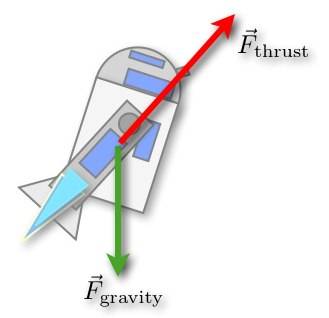
The Physics of R2D2

R2D2
R2D2flight


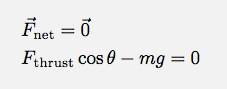
In the most recent Star Wars movies, the droid R2D2 can fly using jets on the bottom of his legs. Physics professor Rhett Allain points out that he flies contrary to science. At the link, a very math-heavy explanation.

Link via BoingBoing

Sunday, October 04, 2009

The Proclamations of Malthusian Prophets

Among the Jehovah's Witnesses, there is a pervasive sense of impending, eminent, armageddon. But in the early decades of this movement's history, the eschaton was not only eminent, but tied to specific dates. The first date was 1914. Observers noted at the time that the world did not end. So the leaders of the movement concocted an explanation for why the world had not ended but that they were not actually wrong to say so, and pushed the real date forward to 1918. Later, the same prediction was rolled forward to 1925, 1941, and 1975. At none of these points did the world end, and the failure of these predictions to come true did much to discredit the Jehovah's Witnesses -- at least among critics. Alas, the failed prophecies did not do enough to discredit the movement, and it is presently thriving and growing around the world.

I was reminded of this slice of history upon reading an article in Scientific American entitled "Another Inconvenient Truth: The World's Growing Population Poses a Malthusian Dilemma." It contains the usual doomsday predictions made by Malthusians for more than a century: that the world cannot support an increased human population, and that mass famines are inevitable. You may have heard of Paul Ehrlich, a major eschatologist of the 1960s and 70s, whose book The Population Bomb was a best-seller. His dire predictions, extended decade after decade, did not come to pass, yet he still thrives as a paid writer and speaker.

And now another generation of prophets makes the same predictions, based upon the same models, for the near future. Despite their track record, I'm willing to hear them out.

But this is absolutely critical: the current crop of prophets must explain why previous predictions have never come true. They must explain why the Malthusian methodology was flawed, and how their methodology is substantially different.

Otherwise, there's no reason to take them seriously.

Thursday, September 03, 2009

Ethical Question of the Day

Biotechnology and genetic engineering have created ethical dilemmas that previous generations never imagined.

As an omnivore, I'm mildly concerned about whether or not the animals that I eat are raised and slaughtered in a way that minimizes their suffering.

Now let's say that scientists create livestock that are incapable of feeling physical pain:

In 2006, researchers found six Pakistani children who felt no pain due to an inactivated gene, and who constantly had bruises and cuts. One fell into the habit of putting knives through his hand and walking barefoot on coals, before his untimely death.

Still, scientists already know that humans can intellectually dissociate the sensation of pain from how much it bothers them. Lab experiments with mice have also suggested a way to disconnect that pain sensation without totally leaving animals vulnerable to a world of hurt.

All of which leads Jeremy Hsu to ask the question:

Is it ethical to engineeer delicious cows that feel no pain?

How do you respond?

Saturday, May 30, 2009

Static and Dynamic Views of Ecology

I read this Reuters article about the growing population of Burmese pythons in the Florida Everglades:

Wildlife biologists say the troublesome invaders -- dumped in the Everglades by pet owners who no longer want them -- have become a pest and pose a significant threat to endangered species like the wood stork and Key Largo woodrat.

"They eat things that we care about," said Skip Snow, an Everglades National Park biologist, as he showed a captured, 15-foot (4.6-meter) Burmese python to U.S. Interior Secretary Ken Salazar, who was on his first fact-finding mission to the Everglades since the Obama administration took office.

Emphasis added. I found it fascinating that this scientist labels the python as "bad" and the wood stork as "good". Why? Why does the python not have a place in the Everglades ecosystem?

Yes, humans introduced these snakes when pet owners decided that they grew too large. So what? Humans are a part of nature, too, right?

Right? Well, perhaps not everyone agrees. There seems to be a view of ecosystems as static entities, pristine Edens in which inhabitants leave in peace until Big Mean Humans intrude. Species die out only because of human activity. Change, such as the introduction of new species to an area, is inherently bad.

Why? I'd like to know exactly why it is important to kill off the python population. Why does this species have to die to make room for others?

Why is change bad?

Related thoughts: On Earth Day, Geek With A .45 pointed out that eventually, Mother Nature is going to kill us all. The sun will go nova and kill all life on earth:

I submit therefore, that while stewardship of our resources is a laudable and necessary thing, that ultimately, our planet is 100% expendable, down to the very last molecule towards the goal of our ultimate escape...Nature is pleased to eat us, or kill us in any of a number of lingering, nasty, painful ways.

Thursday, May 21, 2009

How Scientific Information Moves Through the News Cycle

A funny explanation from PhD Comics. As a blogger, I play a critical role in this model by exaggerating correlations and conflating them with causality in order to drive up traffic.

HT: Hit & Run.

Monday, May 11, 2009

Wednesday, April 01, 2009

Arguing with Scientists

Over at The Corner, Jerry Taylor writes about a recent public letter signed by over 100 scientists who are skeptical about global warming. This was written in response to President Obama's assertion that there is no serious dispute over anthropogenic global warming among scientists.

Leaving aside the global warming debate, I want to focus in on one of Taylor's statements, in which he accuses critics of these global warming skeptics of fallacious reasoning:

More experts disagree with so-and-so than agree — So what? Not only is this a variation of the argument above, it also assumes that truth can be reliably determined by a show of hands. Nothing — especially in science — could be further from the truth.

An argument’s merit has nothing to do with the motives of the arguer, the credentials of the arguer, or the popularity of the argument. Full stop.
No exceptions.

Emphasis in the original. Now I agree with Taylor in principle that it is illogical to judge an argument based upon the number of people who support it. Truth is truth, whether no one believes it or everyone believes it. If everyone rejected the notion that the tides are caused by the moon's gravitational pull, but were instead caused by water pixies, then everyone would be wrong.

But it's not that simple.

When a non-scientist is examining scientific assertions -- or, more broadly, a layperson is dealing with the assertions of highly specialized scholars -- the non-scientist is always addressing other people's facts.

Like it or not, we scientific laypeople are not equipped with the knowledge to make reasonable judgments on anthropogenic global warming (contra another one of Taylor's more bizarre arguments: that a scientist does not need to have personally studied global warming in order to assess it). We can't judge the information because it's too complex without undertaking many years of study. So all we can do is evaluate the source of that information.

Doing so involves, despite Taylor's wishes, a popular consensus. If 99 scientists say that a certain thing is true, and 1 scientist says that it is false, and we cannot assess the information ourselves, we can only conclude that the lone scientist is a crackpot and the 99 are correct. We and the 99 scientists might be wrong, but we laypeople have no better way of evaluating scientific information.

As Taylor argues, this is a logical fallacy. It is, however, the only option open to us. Unless, of course, Taylor would like to prove -- without consulting outside sources -- that tides are caused by lunar gravitation instead of water pixies.

Could this be done? Possibly. But as a layperson in the natural sciences, I would have no idea how to do so without examining the work of scientists -- that is, I would have no way of personally knowing without that knowledge being based upon other people's facts. And without many years of dedicated study, I could never understand lunar gravitation well enough to assess its reality better than the scientists who would be teaching me. Again, as in global warming, I would not be understanding the scientific phenomena myself, but evaluating the judgment of people explaining those scientific phenomena.

Taylor concludes his post with:

I don’t mean to suggest that climate alarmists are (necessarily) any more prone to this sort of thing than any other policy crusader populating the blogosphere. But I find it rich to see these people loudly tell me that they’re the smart experts whose judgment should govern when even at the most fundamental level they can’t seem to think straight.

Over the years of blog debating, I've found that it's possible to toss out logical fallacy accusations like rhetorical hand grenades. That may lead to logical thinking, but it doesn't always lead to reasonable thinking. Taylor's post is a good example. It may not be logical to attribute truth to the popular consensus of qualified experts, but it is a reasonable action to take if becoming an expert oneself is not feasible.