Showing posts with label history. Show all posts

Monday, April 26, 2010

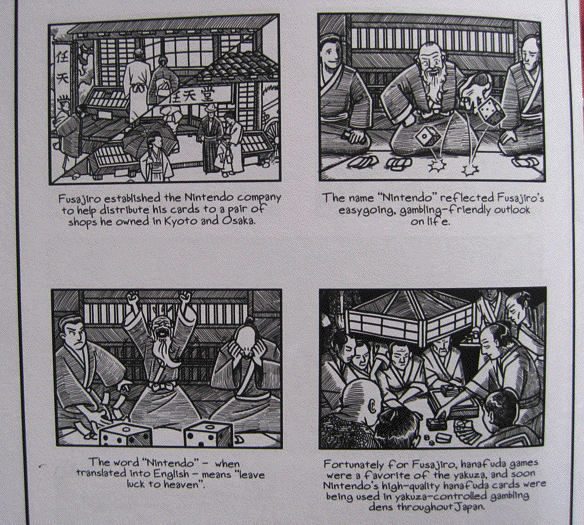
A Comic Book History of Nintendo

Did you know that the Nintendo company was founded in 1889 and originally sold playing cards and operated brothels? Comic book artist Bill Mudron is composing a comic-form history of the company.

via Comics Alliance | Artist's Website

Sunday, January 31, 2010

Abraham Lincoln: Vampire Hunter by Seth Grahame-Smith

Seth Grahame-Smith, the man responsible for Pride and Prejudice and Zombies, has written a book about President Abraham Lincoln's lesser-known career (and true passion) as a vampire hunter. It will come out in March, and will provide lost documentary and photographic evidence of the true, darker war hidden behind the carnage of the Civil War.

This only adds to the body of work about Lincoln's war against the undead and the supernatural.

vampires


HT: my wife

Friday, November 20, 2009

Visualizing the Rise and Decline of Four Empires


(Video Link)


Pedro M. Cruz, a graduate student in information visualization and interaction design, created this time-elapsed representation of the rise and decline of the British, French, Portuguese, and Spanish overseas empires from 1800 to 2000. He writes:

The data refers to the evolution of the top 4 maritime empires of the XIX and XX centuries by extent. I chose the maritime empires because of their more abrupt and obtuse evolution as the visual emphasis is on their decline. The first idea to represent a territory independence was a mitosis like split — it’s harder to implement than it looks. Each shape tends to retain an area that’s directly proportional to the extent of the occupied territory on a specific year. The datasource is mostly our beloved wikipedia. The split of a territory is often the result of an extent process and it had to be visualized on a specific year. So I chose to pick the dates where it was perceived a de facto independence (e.g. the most of independence declarations prior to the new state’s recognition). Dominions of an empire, were considered part of that empire and thus not independent.

via Hit & Run

Monday, November 02, 2009

How Superman Defeated the Ku Klux Klan

Mark Juddery of Mental Floss brings us a fascinating story from American history. After World War II, the Ku Klux Klan was thriving. Writer Stetson Kennedy infiltrated the organization in the hopes of writing an exposé about its activities and beliefs. Unable to find a outlet willing to publish the story, Stetson approached the producers of the Superman radio show:

In a 16-episode series titled “Clan of the Fiery Cross,” the writers pitted the Man of Steel against the men in white hoods. As the storyline progressed, the shows exposed many of the KKK’s most guarded secrets. By revealing everything from code words to rituals, the program completely stripped the Klan of its mystique. Within two weeks of the broadcast, KKK recruitment was down to zero. And by 1948, people were showing up to Klan rallies just to mock them.

via io9

Sunday, May 03, 2009

Nuke 'Em

In this magnificent 17-minute video, Bill Whittle demolishes the idea that the U.S. atomic bombing of Hiroshima and Nagasaki was unnecessary. (H/T)

Previous related discussion here.

Wednesday, April 29, 2009

Replacing Grant on the $50 Bill

Nate DiMeo has an interesting idea. Ulysses S. Grant was an effective general, and a nice guy, but an ineffective President. Boot him off and replace him with Frederick Douglass:

But setting the power of the actual image aside, Douglass is the man for the moment because he embodies a different kind of American power. It's a community organizer's power, in a way. He built constituencies. He went door to door, if only metaphorically. As an essayist, as a self-aware symbol, as a speaker, as a (nonregistered) lobbyist, Douglass moved the country toward an anti-slavery position. One could argue that the story of Harriet Tubman did the same thing or that, in its way, the storytelling of Harriet Beecher Stowe did, too, but Douglass was there at the center of a most critical and hallowed chapter in America's past. Recruiting African-American soldiers. Glad-handing politicians and then forcing theirs. Persuading the president to become the Great Emancipator. Pushing America to live up to its creed. That kind of track record is hard to argue against on a Sunday-morning roundtable.

Born into slavery, self-educated to high erudition, he held America up to its own rhetoric on liberty. He'd be a fine choice for the face of America.

Sunday, April 19, 2009

If the Shoe Fits

At the recent Summit of the Americas, Nicaraguan President Daniel Ortega went on a 50-minute diatribe, much of which addressed the United States' historic oppression and exploitation of weaker Latin American countries.

President Obama did nothing to rebut or refute this attacks, causing some consternation among right-leaning bloggers.

But the thing is, we were imperialist jerks in Latin America for a century and a half. Maybe not so much anymore, but it's reasonable for Latin Americans to be kinda pissy about our periodic looting of their resources and interference in their governance.

Saturday, April 04, 2009

Fun Facts You'll Learn from Presidential Historian Doris Kearns Goodwin After You Get Her Drunk

Calvin Coolidge was nicknamed “Silent Cal” due to his talent for sneaking up behind political opponents and garroting them with piano wire.

The Baby Ruth candy bar was, in fact, named for Grover Cleveland’s daughter Ruth, the first baby born in the White House. Coincidentally, the Clark Bar was named for President James Buchanan’s “very special friend” Clark.

Lyndon Johnson famously angered pet lovers by lifting his beagles up by the ears for the amusement of the press, despite having been repeatedly admonished for pulling the same stunt with his daughters.

Read the rest.

Monday, February 16, 2009

Question of the Day: President's Day Edition

Today, on Presidents' Day, the National Review solicited short answers from contributors about their favorite Presidents. Washington and Lincoln, of course, feature prominently. But there is also tongue-in-cheek praise for the contributions of William Henry Harrison, who was President for only one month before dying. Jacob Sullum lifts up Harrison "because he left office before he could do much damage."

Two contributors, quite rightly, praise the underrated Chester A. Arthur, who served less than one term in office after President Garfield died. Although he was a product of New York machine politics, Arthur created the civil service system to replace the open spoils system of government employment. And after a diplomatic crisis with Chile, Arthur led the reconstruction of the badly-decayed U.S. Navy.

There is not a lot written about Arthur, compared to other Presidents. In part, this is because he had his private papers burned shortly before his death and rarely discussed personal business. Arthur did not have vain exhibitionism which has led so many modern Presidents to record their every conversation or build enormous libraries as monuments to themselves.

Which U.S. President is your favorite?

Saturday, February 14, 2009

Antiques Roadshow in the Year 2550

In this CollegeHumor video, antiques appraisers in the future examine artifacts from the 21st Century.

[Video Link]

Thursday, February 12, 2009

George Washington, Entrepreneur

I have a decent knowledge about Washington's political and military careers, but what I didn't know was that he was a highly successful businessman. Here's a fascinating article about his entrepreneurial ventures.

Washington's reputation suffered among historians of the previous century. I think that that's because he was self-educated and left behind few writings from which we may perceive a witty intellect. But he had a remarkable sense of prudence and intuition about the forces at work in Revolutionary period. And this was topped by a quite extraordinary physical courage. The American people were extremely fortunate to have him when we did.