The Drunken Moogle is a geek humor blog that regularly features cocktail recipes inspired by video games. Pictured above is the "Barrel of Bananas", which is taken from Donkey Kong. Here's the recipe:
3/4 shot of 99 Bananas 3/4 shot of Coconut Rum about 1/2 a highball glass of Root Beer about 1/2 a highball glass of Fuze - Banana Colada
Directions: Throw some ice into a nice, large highball glass. Pour in the 3/4 shots of 99 Bananas and coconut rum. Then, simultaneously pour in the Banana Colada Fuze and your favorite root beer evenly until it reaches the top of the glass. Stir and enjoy.
This reminds me of a time when I went into a grocery store on a chilly December day a few years ago. The store's speakers were playing music and I thought, "OMG! They're playing the theme music from Hitman! This is cool!" Then my brain cranked away little bit and I realized "Oh, wait, that's just 'Ave Maria', which Eidos used as theme music in Hitman."
Start 'em young. The Cub Scouts now have an award for playing video games. Here are some of the requirements:
1. With your parents, create a plan to buy a video game that is right for your age group. 2. Compare two game systems (for example, Microsoft Xbox, Sony PlayStation, Nintendo Wii, and so on). Explain some of the differences between the two. List good reasons to purchase or use a game system. 3. Play a video game with family members in a family tournament. 4. Teach an adult or a friend how to play a video game. 5. List at least five tips that would help someone who was learning how to play your favorite video game. 6. Play an appropriate video game with a friend for one hour. 7. Play a video game that will help you practice your math, spelling, or another skill that helps you in your schoolwork. 8. Choose a game you might like to purchase. Compare the price for this game at three different stores. Decide which store has the best deal. In your decision, be sure to consider things like the store return policy and manufacturer’s warranty. 9. With an adult’s supervision, install a gaming system.
I like video games, and I don't think that they're necessarily harmful, but there's nothing constructive in these requirements. What useful skills or values is a boy learning from this list? Okay, maybe a little technical ability by installing a game. But that's it. Here's what I would suggest:
1. Present an argument to your scout leader about how a particular game that you have played improves your critical thinking skills. Win the argument. 2. Interview a game designer. Discover and list the skills necessary to become a game designer. 3. Unless physically disabled, run one mile in under ten minutes.
The pharmaceutical company Bayer has created a blood glucose meter that plugs into a Nintendo DS. It's called the DIDGET. This gadget includes a game that is both (allegedly) fun and educational for children living with diabetes.
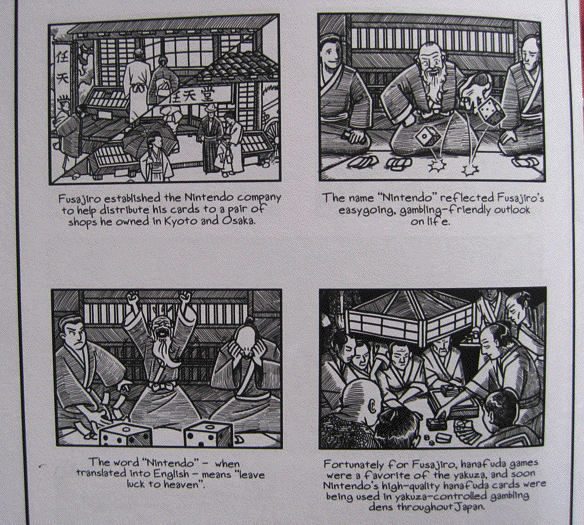
Did you know that the Nintendo company was founded in 1889 and originally sold playing cards and operated brothels? Comic book artist Bill Mudron is composing a comic-form history of the company.
Film critic Roger Ebert kicked in a hornet's nest in the geekosphere when he asserted that video games are not and never can be art (via Nerd Bastards).
Having once made the statement above, I have declined all opportunities to enlarge upon it or defend it. That seemed to be a fool's errand, especially given the volume of messages I receive urging me to play this game or that and recant the error of my ways. Nevertheless, I remain convinced that in principle, video games cannot be art. Perhaps it is foolish of me to say "never," because never, as Rick Wakeman informs us, is a long, long time. Let me just say that no video gamer now living will survive long enough to experience the medium as an art form.
Ebert wrote in response to a TED talk from game designer Kellee Santiago on the subject.
I would prefer to do a straight fisking of Ebert, but he wrote largely in response to Santiago, who I think provided an inadequate definition of art and thereafter proceeded in the wrong rhetorical direction.
So rather than defending Santiago's perspective and rebutting Ebert, let me argue positively that video games can be art.
We begin with the most foundational question: "What is art?" Here, I think, Santiago makes an early mistake by defining it as "the process or product of deliberately arranging elements in a way that appeals to the senses or emotions."
Without consulting other sources, let me offer this alternative: art is the outward expression of an inward conception of an ideal condition, such as beauty or terror. If a person thinks of something beautiful, it is not, in and of itself, art. If that person can effectively communicate it through text, performance, or a physical rendering, then he has created art.
It is necessary to note that some degree of technical skill is required. If a person is able to fully externalize his inner vision, then he has created good art. If he is hampered by a lack of technical skill, then the product represents a limited and obscured expression of the image trapped within the confines of the mind.
A person may attempt to disguise his lack of technical ability by choosing an expression that does not require great technical skill and claim that the original intent has been fulfilled. This is how we can discern the difference between Bouguereau and Pollock. Pollock chose more abstract expressions because he lacked the technical skill necessary for concrete expressions. Bouguereau, if he wished, could have created a Pollock. Pollock could never have created a Bouguereau.
So art is not fully egalitarian. A talented few, with training to hone their raw talent, will be able to outwardly express their inner vision. The rest of us will not. Or as Rudy Giuliani has been quoted "If I can do it, it's not art."
Therefore, one test of an activity as a medium of art is to ask "Can anyone, with sufficient training, do it?"
I'm inclined to think not.
Ebert suggests that the anonymity of game designers evidences their unworthiness of mention:
Yet she concedes that I was correct when I wrote, "No one in or out of the field has ever been able to cite a game worthy of comparison with the great poets, filmmakers, novelists and poets." To which I could have added painters, composers, and so on, but my point is clear.
Quick -- name ten composers. Now name just three game designers.
How well did you do? I'm not a musical person, but I came up with ten composers and not a single game designer. Does this mean that they are not artists? Does fame denote true art?
No -- and for a reason that Ebert of all people should understand. If game design may be compared to any medium, it is filmmaking. Both media are enormous collaborative projects that require between dozens and hundreds of specialized workers. Give Spielberg the job of creating a film entirely by himself, and he'll create something as mediocre as a game designed entirely by a solitary producer at Ubisoft. If filmmaking is an artistic medium, then so is game design. If art can be created collaboratively on film, then it can be created collaboratively in pixels.
But we can name Steven Spielberg. And Oliver Stone and the Coen Brothers and many more. But no game designers. Why? Because game production is a very rapidly changing industry, and viciously cut-throat. The technology that empowers it is growing so fast that the market rolls over any designer who can't keep up with the frenetic pace. A game made ten years ago is as crude as Georges Méliès' 1902 Le Voyage Dans la Lune. But a movie made ten years ago can be better than current releases because the medium is comparatively stagnant. Filmmakers can rest on their laurels; game designers cannot.
Both Santiago and Ebert actually mention Méliès and his film Le Voyage Dans La Lune. Ebert writes:
Now she shows stills from early silent films such as George Melies' "A Voyage to the Moon" (1902), which were "equally simplistic." Obviously, I'm hopelessly handicapped because of my love of cinema, but Melies seems to me vastly more advanced than her three modern video games. He has limited technical resources, but superior artistry and imagination.
How so? Ebert does not explain. To Santiago's most effective argument -- that video games are at an early stage of artistic development comparable to the earliest movies -- Ebert is almost silent.
But I won't argue from Santiago's perspective, which, as I've said, starts with a somewhat faulty definition of art. I define art -- and specifically good art -- as the effective outward expression of an inward conception of an ideal condition. If a person thinks of a story, and can express that story fully in text, that person is an artist and has produced art. If a person thinks of a sound and can fully express that sound in music, that person is an artist and has produced art. If a person thinks of a movement and can fully express that movement in dance, that person is an artist and has produced art. If a person thinks of an image and can fully express that image in paint, that person is an artist and has produced art.
If a person can envision a video and gather a team together that can accurately express that inner vision, that person is an artist and has produced art.
If a person can envision an interactive video and gather a team together that can accurately express that inner vision, that person is an artist and has produced art.
And that's what video games are -- interactive visual and auditory environments that express an inner vision. Not everyone is capable of producing good video games. I can't and Roger Ebert can't. The task requires people with a natural talent sharpened by formal training. They can create artificial worlds where we can experience their inner vision. Such people are artists.
And the product of an artist is art.
Now yesterday this post began as a comment at Nerd Bastards, and it grew and grew until I realized that I should write an entire post on the subject. While composing it, I encountered this excellent response from Jerry Holkins of Penny Arcade (via reddit). An excerpt of its brilliance:
so there's nothing here to discuss. You can if you want to, and people certainly do, but there's no profit in it. Nobody's going to hold their blade aloft at the end of this thing and found a kingdom. It's just something to fill the hours.
Also, do we win something if we defeat him? Does he drop a good helm? Because I can't for the life of me figure out why we give a shit what that creature says. He doesn't operate under some divine shroud that lets him determine what is or is not valid culture. He cannot rob you, retroactively, of wholly valid experiences; he cannot transform them into worthless things.
He's simply a man determined to be on the wrong side of history, the wrong side of the human drive to create, and dreadfully so; a monument to the same generational bullshit that says because something has not been, it must not and could never be.
All of this is true. Ebert, film critic, is no different from the people a century ago who proclaimed that film could never amount to anything; that it was not real art. His views will end up on the ash heap of history, and we know it, and he knows it.
Anna the Red made this lovely bento box featuring a Bioshock Big Daddy and Little Sister. You can read more about the project and see in-process photos here.
So here's the idea for this Splinter Cell video game viral marketing stunt: hire a guy to dress up in bloody bandages, run around in public pointing a fake gun at people. What could possibly go wrong?
The police showed up. Their guns were not fake.
About 20 revellers drinking outside Degree bar dived for cover after the promotions worker threatened them with a black imitation pistol about 8pm on Friday.
Witnesses said they heard someone shout “he’s got a gun” and outdoor drinkers dived behind their tables.
Degree manager Steph Kurtovich said: “This guy with bandages on his hands pointed a gun at customers sitting outside. They were pretty terrified.”
The stunt, to promote the release of Xbox title Splinter Cell Evolution, was condemned by police.
Senior Sergeant Ben Offner said officers could not tell the gun was made of plastic until they had taken it from the actor.
This funny short film by Studio Joho provides a more realistic and certainly more cynical view of what happens to the video game hero after he rescues the princess.
When Tanner Sandlin of Austin, Texas was 12 years old, he bought a cartridge for the Atari 2600 video game Air Raid. He spent about 5 or 10 dollars. He just sold it for $31,600:
Oddly enough, Sandlin remembered that this much sought after game wasn't really all that great. In fact, the only reason he still had it was because it was so bad. He and his friends used to borrow games from each other all the time --sometimes you'd get your game back, sometimes you wouldn't, and that was OK. But no one wanted to keep Air Raid, so it kept coming back to him.
He's not complaining now.
While it's impressive that Sandlin had the thirteenth known copy of Air Raid, he also had the original packaging, which changed everything. Why? Because his was the only known Air Raid box in the world, making it the only known complete copy of the game in existence.
Phil, a computer gamer and programmer, hacked into a game that his girlfriend was playing and altered it to create a romantic scenario. Here's how he popped the question:
Long ago I met someone very special here, on the top of this mountain near Haven’s Fair. Our love blossomed into something more splendid than the sun. Once, I tried to capture the sun and bring it to my maiden, but it escaped my grasp before she could receive it. Although I could not bring her the sun, the joy she felt for the gift was so strong, it pressed the spirits of our memories on this mountain forever. Perhaps you found some of them familiar, after a fashion. I hope they evoked fond memories of your past. My time here is limited. Before I pass there is one more thing I must do. One thing I promised to pass on. I love my maiden more than anything in the world, and I am her knight. I’m sure she would recognize me under all this armor. Phill: Anna will you marry me?
 What you're looking at is a compressed image of seven large game worlds, laid over each other to scale. They are: