Showing posts with label literature. Show all posts

Saturday, May 08, 2010

New Harry Turtledove Short Story

Harry Turtledove, master of alternate history, has penned a short story about life on Earth, decades after it has been partially conquered by aliens.
The President of the United States looked out of an Oval Office window at Grand Junction, Colorado. The Oval Office was square, but the President’s workplace kept its traditional name. Harris Moffatt III sighed and bent to his paperwork again. Even in Grand Junction, that never disappeared.

Washington, D.C., remained the de jure capital of the United States. Harris Moffatt III had never been there. Neither had his father, President Harris Moffatt II. His grandfather, President Harris Moffatt I, got out of Washington one jump ahead of the Krolp. That the USA was still any kind of going concern came from his ever-so-narrow escape.

Harris Moffatt III was also Prime Minister of Canada, or of that small and mountainous chunk of Canada the Krolp didn’t control. The two countries had amalgamated early on, the better to resist the invading aliens. That, of course, was before they realized how far out of their weight they were fighting.

Tuesday, May 04, 2010

Alternate Histories That I'd Like To See

I've pondered this issue before, but after reading Red Inferno: 1945, I've thought of some other scenarios that I'd like to see explored in alternate history novels:
  • White Russian forces are victorious in the Russian Revolution, squashing the Bolsheviks.

  • After British interference in neutral shipping and at the agitation of Irish immigrants, the US enters World War I -- on Germany's side.

  • The Congressional vote to annex the Republic of Texas fails and Texas continues to be an independent state.
What alternate history scenarios would you like to read about?

Friday, April 30, 2010

Red Inferno: 1945 by Robert Conroy

Ugh. I have a fever of 102.1°F.

But I'm a blogger, dammit. You depend on me to entertain you, and I'm not going to let you down. So let's do this.

Today, I offer a review of Red Inferno: 1945 by Robert Conroy. It's an alternate history novel in which war breaks out between the US/UK and the USSR in the closing days of World War II in Europe.

Unfortunately, there isn't enough published alternate history to keep up with my appetite, so I've had to read mediocre authors rather than deprive myself of my favorite genre of fiction. His first novel, 1901, about a surprise German invasion of New York City, was historically preposterous. 1862, about the British entry into the American Civil War, and 1945, about the US ground invasion of Japan, were somewhat improved. But in all of these novels, major characters acted and thought like socially conscious 21st Century Americans, and lapsed into sanctimonious moralizing about the evils of American racism.

1945 is largely free of these problems. He takes a few swipes at racism, homophobia, and McCarthyism, but the novel features few preening lectures about social inequalities in American society. The characters act like real people.

Realism is the most essential quality in alternate history, and Robert Conroy has greatly improved. 1945 makes sense, both in historical variation and individual behavior. It's exciting and worth reading.

Monday, April 19, 2010

A Gallery of Awful Science Fiction Book Covers


Good Show Sir is a photoblog of bad science fiction novel cover art. Here's the annotation for Will Shetterly's The Tangled Lands:
It was my late teens and I was studying hard at some top notch university. Then came the LSD and it was all, floating semi translucent men surrounded by magical orbs in a forest being watched by unicorns. I suppose that has something to do with the world of cats, right?

via io9

Wednesday, March 24, 2010

Question of the Day

What is your favorite science fiction novel, and why?

Thursday, March 18, 2010

Star Wars as an Icelandic Saga

Jackson Crawford, a graduate student studying Old Norse literature, argues very persuasively that George Lucas lifted the Star Wars story directly from an Icelandic saga. Specifically, it is Tattúínárdœla Saga, which means "The Saga of People of the Tattooine River Valley". Here's a selection of Crawford's summary:
Lúkr is saved from drowning by the intercession of Leia and Hani’s men in the Þúsundár Fálkinn. Following this memorable climax, there is an extended lacuna in the manuscript, and the action picks up again with an episode wherein Lúkr rescues Hani and Leia from the corrupt (and grossly obese) Danish merchant Jabbi, a rather comical figure on the whole, and this entire incident is probably to be reckoned an interpolation from a later chivalric saga. Unfortunately the saga shows its repetitive nature at this point, and we once again learn that Veiðari is building, under the auspices of Falfaðinn, a great ship to be named Dauðastjarna in meiri. At a great feast, Lúkr and Hani swear that they will kill Veiðari and Falfaðinn, burn Dauðastjarna, and conquer Kóruskantborg. Their boasts are considered binding and the sworn brothers lead several warships loaded with men to the position of the Dauðastjarna. There Hani is assisted by what the saga describes as “birnir” (literally “bears,” but in context probably to be understood as “Shetlanders” – the German version confusingly seems to understand these as actual bears) in his great assault on Falfaðinn’s fleet, but Lúkr is captured by Veiðari and brought to an audience with Falfaðinn.

via Miss Cellania

Previously on The Zeray Gazette:
The Saga of the Faroe Islanders

Tuesday, March 09, 2010

Review: Pride and Prejudice and Zombies: Dawn of the Dreadfuls by Steve Hockensmith

It all started with Pride and Prejudice and Zombies. Editor Seth Grahame-Smith took the original text by Jane Austen and altered it into a Regency Romance set in the middle of a zombie plague. It was quite fun to read, given the juxtaposition of the tedium and banality of Austen with the seriousness and fast action of a zombie novel.

Now there's sequel to that book, or rather, a prequel, entitled Pride and Prejudice: Dawn of the Dreadfuls. Quirk Books, the publisher, sent me a copy in exchange for a review.

Dawn of the Dreadfuls is set about three years prior to the events of the first book. It centers on the Bennet family, especially on the sisters Elizabeth and Jane. The reader learns that Britain had fought a major war against the undead about a generation prior, but the nation has since become lax in his security. An outbreak occurs in Hertfordshire, and the Bennet sisters acquire a crash course on the martial arts from a young sensei. It's a fairly funny book, as the stuffiness of aristocratic life is feasted upon by Hockensmith. Here's a sample passage about the bloated and overindulged Lord Lumpley:

Then he rang the bell and sat back, wrist aching from the strain of unaccustomed toil, and waited for his man Belgrave.

"My Lord?" Belgrave said blandly when he walked in a moment later. He was a studiously stoic little fellow of forty-and-some years with gray at his temples and a pale gray complexion and a gray, gray soul. If he noticed that his employer was lolling about without a stitch on, he didn't show it. He never seemed to notice anything, which was one of the reasons why Lord Lumpley depended on him so. As a test, the baron had once strutted around an entire morning with half an apple clenched between his naked cheeks, and when at last Belgrave commented upon it, it was only to say, "Pardon me, My Lord, but you seem to have bruised your fruit. Shall I fetch something fresh?"

Now 287 pages of this would start to get dull after a while, but Hockensmith fortunately includes many impressive battle scenes, particularly in the last thirty pages. It's not World War Z quality, but Dawn of the Dreadfuls is a pretty good zombie apocalypse.

Grade: B+

Sunday, March 07, 2010

Short Story: "Lucky Thirteen" by Marko Kloos

I read blogger Marko Kloos on Mondays for his fun Monday Search Term Safari feature, in which he responds to unusual search strings used to find his blog. Kloos is a professional writer, and has a new science fiction short story. Go forth and read "Lucky Thirteen":
The Fleet has a tradition: the rookie drop ship commander in the unit always gets the ship nobody else wants anymore.

My hand-me-down was Lucky Thirteen. There was nothing wrong with her, technically speaking. She was an older model Wasp, not one of the new Dragonflies, but most of our wing was still on Wasps back then. But pilots are a superstitious bunch, and it had been decided that Lucky Thirteen was an unlucky ship. Before they gave her to me, she had lost two crews with all hands, one of them with the entire troop compartment loaded to the last seat. Both times, they recovered the ship, hosed her out, and patched her up again. A ship surviving an all-hands loss without being destroyed is very unusual—surviving two of them is so rare that I’ve never heard of such a thing before or since.

Friday, March 05, 2010

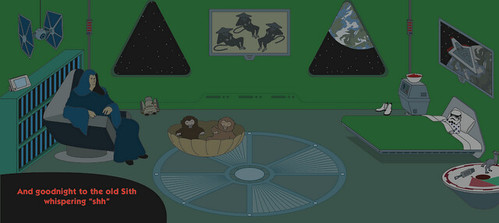
A Star Wars Version of "Goodnight, Moon"

moon


Noah Dziobecki rewrote/redrew the classic children's book Goodnight Moon from a Star Wars perspective. Awesome!
In the great metal room
There was a comlink
And a tautaun
And a holo-picture of —
The Executor flying over the forest moon

via Popped Culture

Tuesday, March 02, 2010

Tupac Shakur and the End of the World

That's the title of a good post-apocalyptic short story by Sandra McDonald. A selection from the full text:

Jack and Chris are standing nearby awkwardly, hands in their pockets, while Lamar and Tina talk in low whispers. I’m already a dozen feet away. Distant. Distanced. I’m thinking of Tupac, blissfully ignorant of his impending death. He was sitting in a car in Las Vegas when someone pulled up and fired a dozen bullets through the window. The cops never caught his killer. You could say that Tina at least has the comfort of knowing her killer, if that’s really a comfort. Whoever pulls the trigger, the real villain is her own body gone haywire. Mutating beyond control because of a virus, or a some secret weapon from space aliens, or Mother Nature finally giving up on the human race.

Lamar and Tina kiss. Then he asks Chris to do the dirty deed.

Chris’s gun hand doesn’t waver.

It starts to rain. Lamar has a portable shovel he’s been carrying since New Jersey and we dig Tina a shallow grave. Her short dark hair is a mess as she goes into the muddy ground. I comb it out before the dirt gets filled back in. Afterward, in true apocalyptic fashion, we divvy up the contents of her backpack. At the bottom, wrapped in a blue dishtowel, is a wedding photo. Tina and her husband. He looks a little like my brother-in-law, Mike. I peel the picture out of the frame and add it to my souvenir collection.

“How do you feel?” Jack asks me later, and that’s a crazy question. Who feels anything these days?

Besides, he knows I probably won’t answer. Since Brooklyn, I haven’t had the urge to speak much. My nickname is Silent Susan.

via BoingBoing

Monday, March 01, 2010

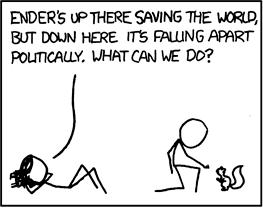
If Ender's Game Was Realistic

locke and demosthenes


In a three-panel strip, xkcd explains how the plot of Ender's Game by Orson Scott Card would really play out.

Sunday, February 28, 2010

The 16 Best Dystopian Novels

Pop Crunch has a list of sixteen great dystopian novels. The list, I think, inappropriately incorporates post-apocalyptic fiction wholly into the genre. Still, it has some interesting suggestions for future reads. One that's missing is Ayn Rand's novella Anthem, a marvelous assertion of the dignity of the individual.

Well, I guess that could then be taken as not dystopian, but it definitely starts out as a classical dystopia.

What books on the list have you read? What would you add to it?


via Digg

Saturday, February 27, 2010

Morlock or Eloi?

A selection from a short-short story by Marcel of Monday Evening:

The traveler slept and dreamed, and waking knew not if he was a Morlock who had dreamed of being an Eloi, or if he was an Eloi dreaming of being a Morlock. Then he realized he must be an Eloi, because a Morlock wouldn’t care, he’d just get on with eating Eloi. Or wait; he might be an Eloi and not know it.

He thought to himself, Do the Eloi not know they’re Eloi, or do they just not care? But I care, so I’m a Morlock. I mean an Eloi. Wait; I’m outside, and the sun’s up, so I must be an Eloi. Maybe one of these guys will know. Okay, Eloi always tell the truth and Morlocks always lie… “Hey buddy, if I asked this guy here if he was…”

Friday, February 26, 2010

This Would Be Cool: Twilight with Vampires

From Pride and Prejudice and Zombies to Sense and Sensibility and Seamonsters and The Undead World of Oz, it's very hip (and profitable) of late to take a conventional novel and add in a science fiction or horror theme. Kawnilee of the blog Impish Idea had, therefore, an impish idea: take the mediocre teen romance novel Twilight and add in vampires.

“It just makes sense,” said Vincent Pryzbylewski, author of the upcoming novel. “Let’s face it. Nobody besides prepubescent girls and lonely Mormon housewives wants to read about some airhead girl prancing about with her sparkling ponce of a boyfriend. But the series has some fans, and I was just sitting there trying to think of something I could do with it, and it hit me. Why not put some vampires into this book? Instead of having a boring cookie-cutter romantic urban fantasy, you have a kick-ass novel that someone would actually want to read!”

She has an excerpt of this forthcoming book at the link.

via reddit

Tuesday, February 09, 2010

10 Literary Classics That Should Be Video Games

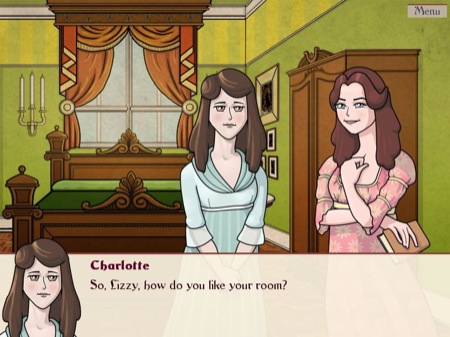
jane austen video game


The editors of Wired created a list of ten classic works of literature that they think should be turned into video games. A sample:

The Grapes of Wrath, John Steinbeck

First of all, it’s got “wrath” right in the title. And that’s not the only great marketing opportunity here; I’m already seeing a sort of “Get Your Kicks on Route 66″ campaign for this story of a rough-and-tumble pioneer family setting out for California. They’re not doing anything with the Oregon Trail license these days, are they? You could potentially get this into elementary schools as edutainment, although the breastfeeding scene might stick it with an M rating. –Chris Kohler[...]

The Canterbury Tales, Geoffrey Chaucer

This is probably best handed off to Eternal Darkness developer Silicon Knights. Not because of the company’s prowess for literary borrowing, but because it pulled off the whole multiple-protagonist thing pretty well already. Lots of potential upside for downloadable microtransactions: Think individual horse armor for all 24 characters. Plus, they could sell the Parson’s Tale segment as a GameStop exclusive. Also, what’s this bit about the Wife of Bath? Sexy shower scene incoming! Woo woo! –Chris Kohler
My own suggestions:
  • Beowulf, for obvious reasons.
  • Lord of the Flies by William Golding, as chaos is always thrilling in a game.
Just think -- in the future, high school kids might try to get out of reading for their English classes by playing the video game version instead of watching the movie version.

What would classic works of literature would you like to see as video games?

Wednesday, February 03, 2010

They're Made Out of Meat

A mention at Ace reminded me of the brilliant science fiction story "They're Made Out of Meat" by Terry Bisson. You can read the entire story here. If you can spare five minutes, it'll be worth your time.

Monday, January 25, 2010

The 100 Greatest Science Fiction/Fantasy Novels

This Recording proposes a list of the one hundred greatest science fiction and fantasy novels. Here are the first ten:

100. The Word For World Is Forest by Ursula K. LeGuin
99. Sorcerer's Son by Phyllis Eisenstein
98. Beggars in Spain by Nancy Kress
97. The Three Stigmata of Palmer Eldritch
96. Snow Crash by Neal Stephenson
95. Jonathan Strange and Mr. Norrell by Susanna Clarke
94. The Company by K.J. Parker
93. An Evil Guest by Gene Wolfe
92. Jurassic Park by Michael Crichton
91. Danny, The Champion of the World by Roald Dahl

I've actually read very few of these, as I prefer to stare at flickering electronic screens most of the day. But some of these are intriguing picks. And I had no idea that Vladimir Nabokov had written science fiction.

What titles would you place on such a list?


Link via Marginal Revolution

Sunday, January 17, 2010

Werner Herzog Reads Curious George


(YouTube Link)


German film director and social critic Werner Herzog is known for his dismal view of the human condition, as demonstrated in his movies Aguirre, the Wrath of God and Signs of Life. In this video, Herzog (or, more likely, an actor pretending to be him) reads and comments upon the classic children's book Curious George:

But is it really George's fault? Or is it the Man in the Yellow Hat's fault for taking an agent of chaos out of the wilderness and trying against all hope to civilize him.


via The Presurfer

Monday, January 04, 2010

The 15 Best Time Travel Stories of All Time

Tim at Pop Crunch has a list of what he considers to be the best time travel stories ever. I think that he succumbs to the temptation of emphasizing archaic and high literature, but it's worth a browse.

As I've mentioned before, my favorite time travel story is The Man Who Folded Himself by David Gerrold.

What's your favorite (print or film) time travel story?

Link via Neatorama